


























Views
Downloads

Essential Grade 3 Weather Hazard Design Worksheet | Aligned
Paste this activity's link or code into your existing LMS (Google Classroom, Canvas, Teams, Schoology, Moodle, etc.).
Students can open and work on the activity right away, with no student login required.
You'll still be able to track student progress and results from your teacher account.
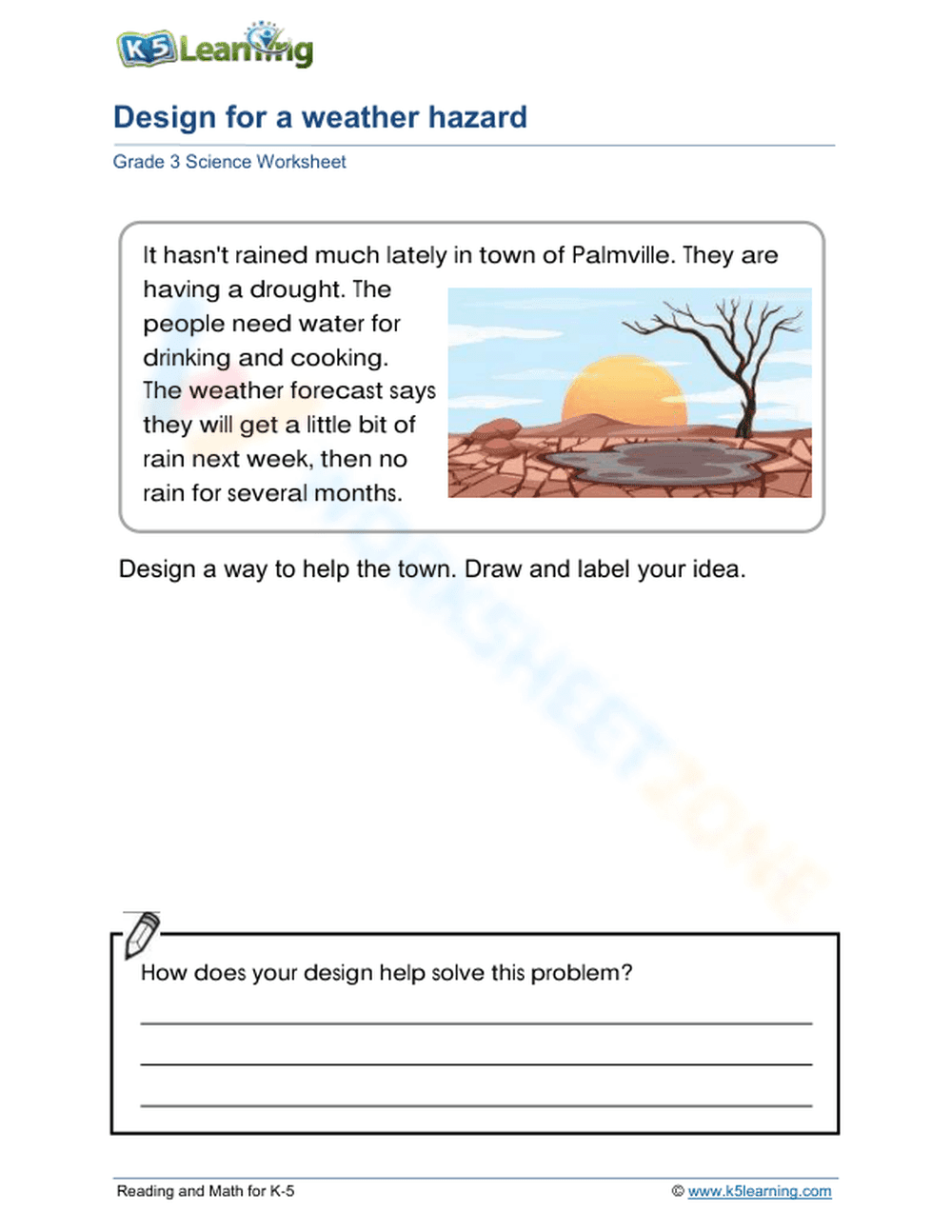
Students design a solution for a specific weather hazard—drought—in the town of Palmville. This Grade 3 science worksheet encourages critical thinking and engineering design. Students must evaluate the needs of a community and propose a creative, functional solution to secure water resources for drinking and cooking during a dry spell.
At a Glance
- Grade: 3 · Subject: Science
- Standard:
3-ESS3-1— Make a claim about the merit of a design solution for weather hazards- Skill Focus: Engineering design for drought mitigation
- Format: 1 page · 2 problems · Answer key included · PDF
- Best For: Earth Science unit or emergency sub plans
- Time: 15–20 minutes
This single-page resource includes a clear scenario about the town of Palmville, a dedicated space for drawing and labeling a design solution, and a reflection section for explaining the solution's merit. It provides an answer key with sample responses to guide teacher evaluation and facilitate student self-correction during independent work periods.
Zero-Prep Workflow
- Step 1: Print. This one-page PDF requires zero setup. It is ready for immediate distribution in physical or digital formats.
- Step 2: Distribute. Hand out the worksheet during your weather and climate unit or use it as a standalone sub plan.
- Step 3: Review. Use the provided sample answer to facilitate a quick five-minute class discussion on engineering feasibility.
Total teacher preparation time is less than two minutes, making it ideal for busy classroom schedules.
Standards Alignment
Aligned to 3-ESS3-1: "Make a claim about the merit of a design solution that reduces the impacts of a weather-related hazard." This worksheet focuses on reducing the impact of drought through human-engineered solutions and requires students to justify their designs. Both standard codes can be copied directly into lesson plans, IEP goals, or district curriculum mapping tools.
How to Use It
Use this as a formative assessment after teaching about severe weather types. Students can work independently to apply their knowledge. Alternatively, use it as a collaborative brainstorming starter before a larger STEM building project. Observe if students prioritize drinking and cooking needs as specified in the prompt to gauge their reading comprehension within a scientific context. Expected completion time is roughly 20 minutes.
Who It's For
This resource is ideal for Grade 3 classrooms studying Earth science and engineering design. It offers scaffolds for various learners through visual drawing and written explanation. This resource pairs naturally with an anchor chart on weather hazards or a reading passage about drought and water conservation strategies.
According to the RAND AIRS 2024 analysis, integrating engineering design principles into primary Earth science curricula significantly improves student retention of complex environmental concepts. This Grade 3 science resource aligns with the 3-ESS3-1 standard, requiring students to propose and evaluate a design solution for drought, a critical weather-related hazard. By drawing and labeling their ideas, students engage in the science and engineering practices of modeling and communication. The inclusion of a written justification encourages the development of evidence-based claims, a key component of scientific literacy. Research by Fisher & Frey (2014) supports this approach, moving students from understanding a problem to designing an independent solution. This worksheet provides a structured framework for students to demonstrate mastery of standard 3-ESS3-1 through a practical, real-world scenario. It serves as an essential tool for educators looking to meet NGSS requirements while fostering innovative problem-solving skills in young learners who are just beginning to explore the human impact on natural systems.


