


























Views
Downloads
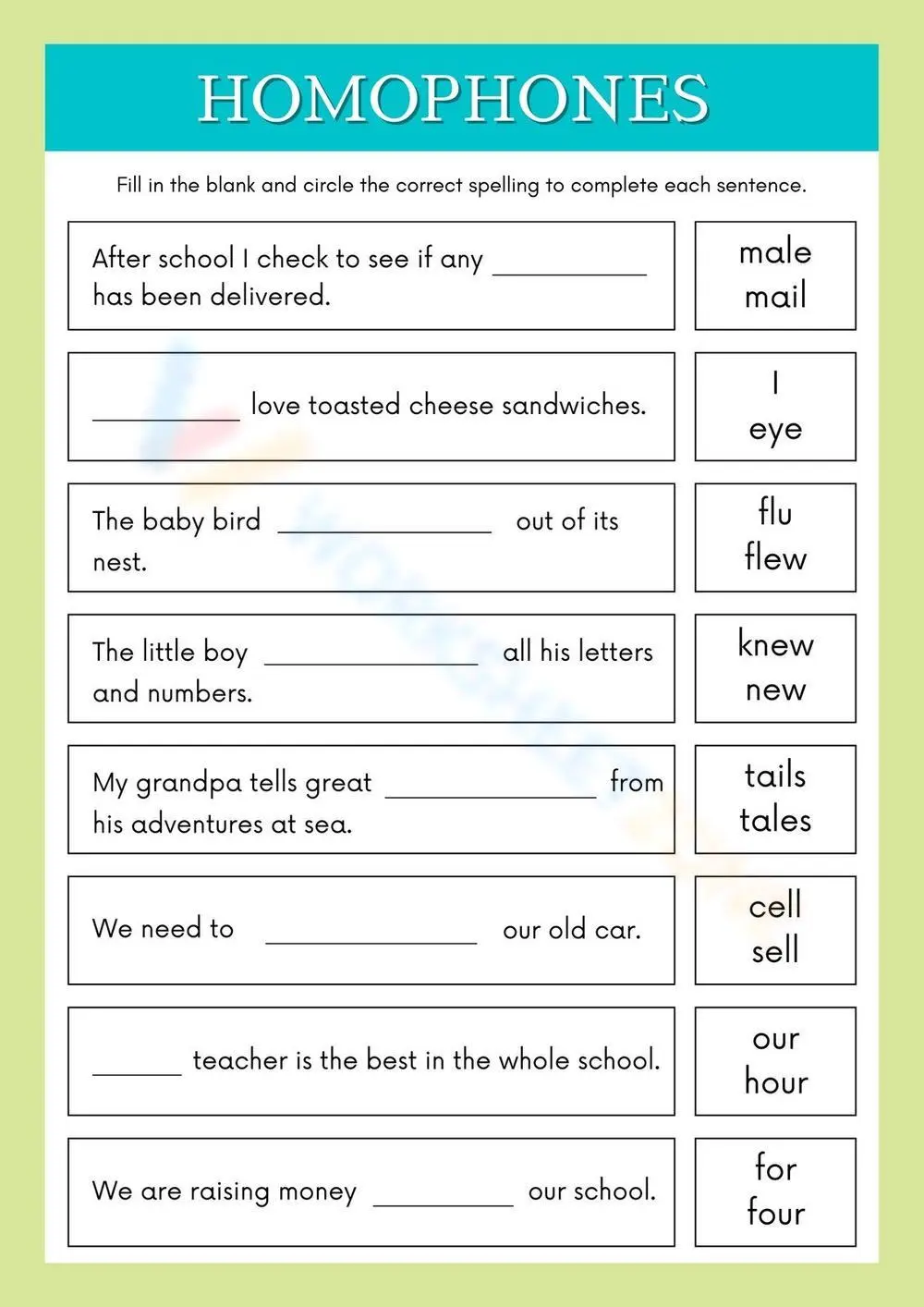

Grade 2 Homophones — Printable No-Prep Worksheet
Paste this activity's link or code into your existing LMS (Google Classroom, Canvas, Teams, Schoology, Moodle, etc.).
Students can open and work on the activity right away, with no student login required.
You'll still be able to track student progress and results from your teacher account.
This Grade 2 homophones worksheet gives students targeted practice distinguishing between frequently confused words. Using context clues, learners select the correct spelling for words that sound alike but have different meanings, strengthening reading comprehension and writing skills.
At a Glance
- Grade: 2 · Subject: ELA
- Standard:
CCSS.ELA-LITERACY.L.2.4.A— Use context clues to determine word meaning- Skill Focus: Homophones
- Format: 1 page · 8 problems · Answer key included · PDF
- Best For: Independent practice
- Time: 10–15 minutes
Inside this single-page resource, educators will find eight fill-in-the-blank sentences testing homophone recognition. Each sentence features a word bank box presenting two options, like "male" and "mail." Students read the sentence, determine the context, write the word, and circle the spelling. A complete answer key ensures quick grading.
Zero-Prep Workflow
- Print (1 minute): Download the PDF and print. The black-and-white design ensures minimal ink usage.
- Distribute (1 minute): Hand out during morning work or literacy centers. Instructions are self-explanatory.
- Review (3 minutes): Use the included answer key to rapidly check responses or project it for self-correction.
With teacher prep time under two minutes, this is perfect for emergency sub plans.
Standards Alignment
Aligned to CCSS.ELA-LITERACY.L.2.4.A, this requires students to use sentence-level context as a clue to word meaning. By evaluating surrounding text, students differentiate homophones. Both standard codes can be copied directly into lesson plans, IEP goals, or district curriculum mapping tools.
How to Use It
Deploy this after direct instruction as independent practice to solidify homophone concepts. Alternatively, use it as a literacy center activity where pairs discuss context clues. Observation tip: watch if students read the entire sentence before guessing. Expected completion time is 10 to 15 minutes.
Who It's For
Designed for second graders developing vocabulary proficiency. For differentiation, read sentences aloud to support struggling readers, letting them focus on contextual differences. Pairs naturally with a homophone anchor chart.
Mastering homophones is a critical step in early literacy development, directly tied to reading comprehension and writing accuracy. According to Fisher & Frey (2014), explicit vocabulary instruction combined with contextual practice significantly improves students' ability to decode and utilize complex language structures. This worksheet targets CCSS.ELA-LITERACY.L.2.4.A, asking learners to use context clues to determine word meaning. When second graders actively engage with frequently confused words in complete sentences, they build the cognitive pathways necessary for fluent reading. The structured format of providing two distinct visual options alongside a contextual sentence reduces cognitive overload while still demanding rigorous application of the standard. By integrating this targeted practice into weekly routines, educators ensure students develop the orthographic mapping skills required to distinguish between words that share phonological traits but differ in spelling and definition.


