


























Views
Downloads

Printable Weather Graph Worksheet | Grade 1 Science
Paste this activity's link or code into your existing LMS (Google Classroom, Canvas, Teams, Schoology, Moodle, etc.).
Students can open and work on the activity right away, with no student login required.
You'll still be able to track student progress and results from your teacher account.
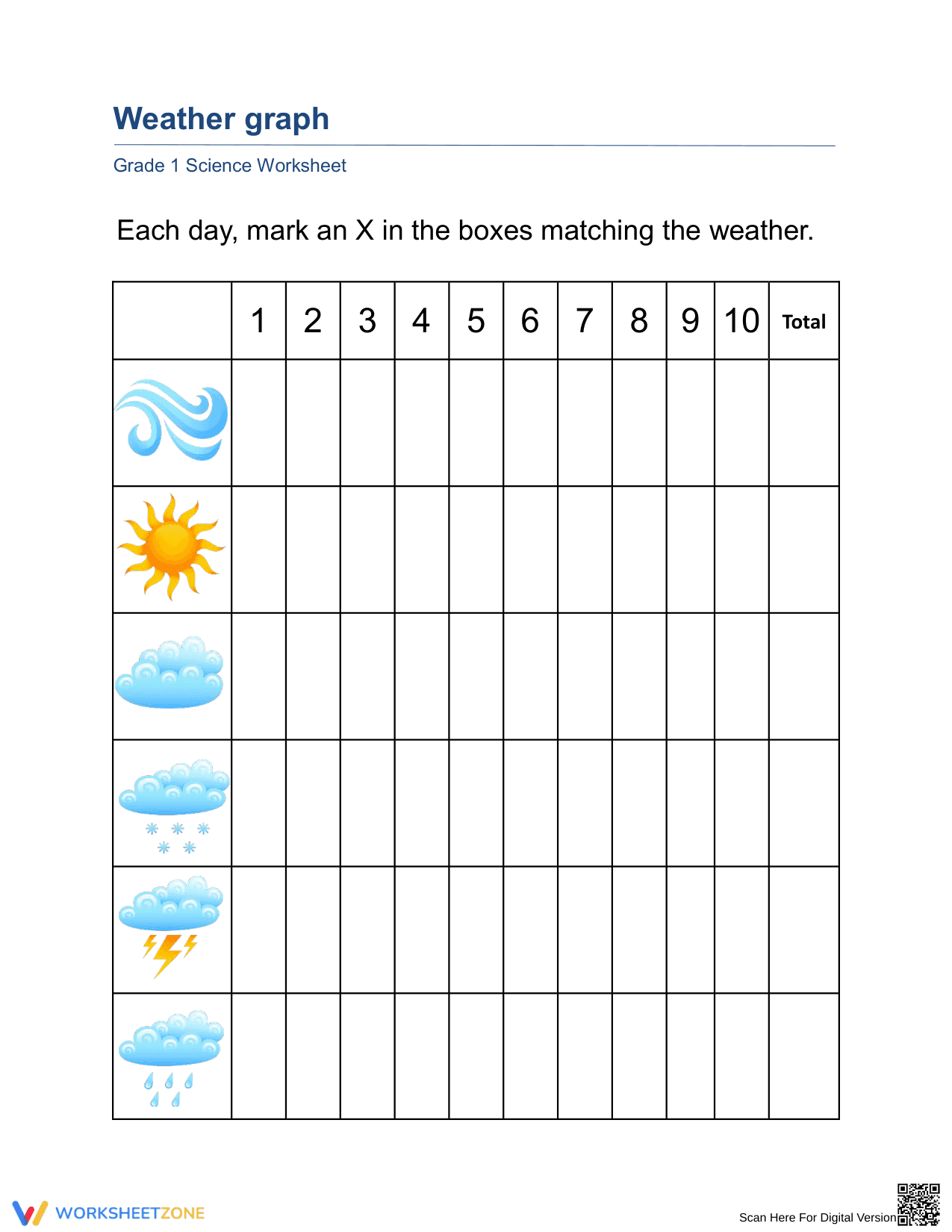
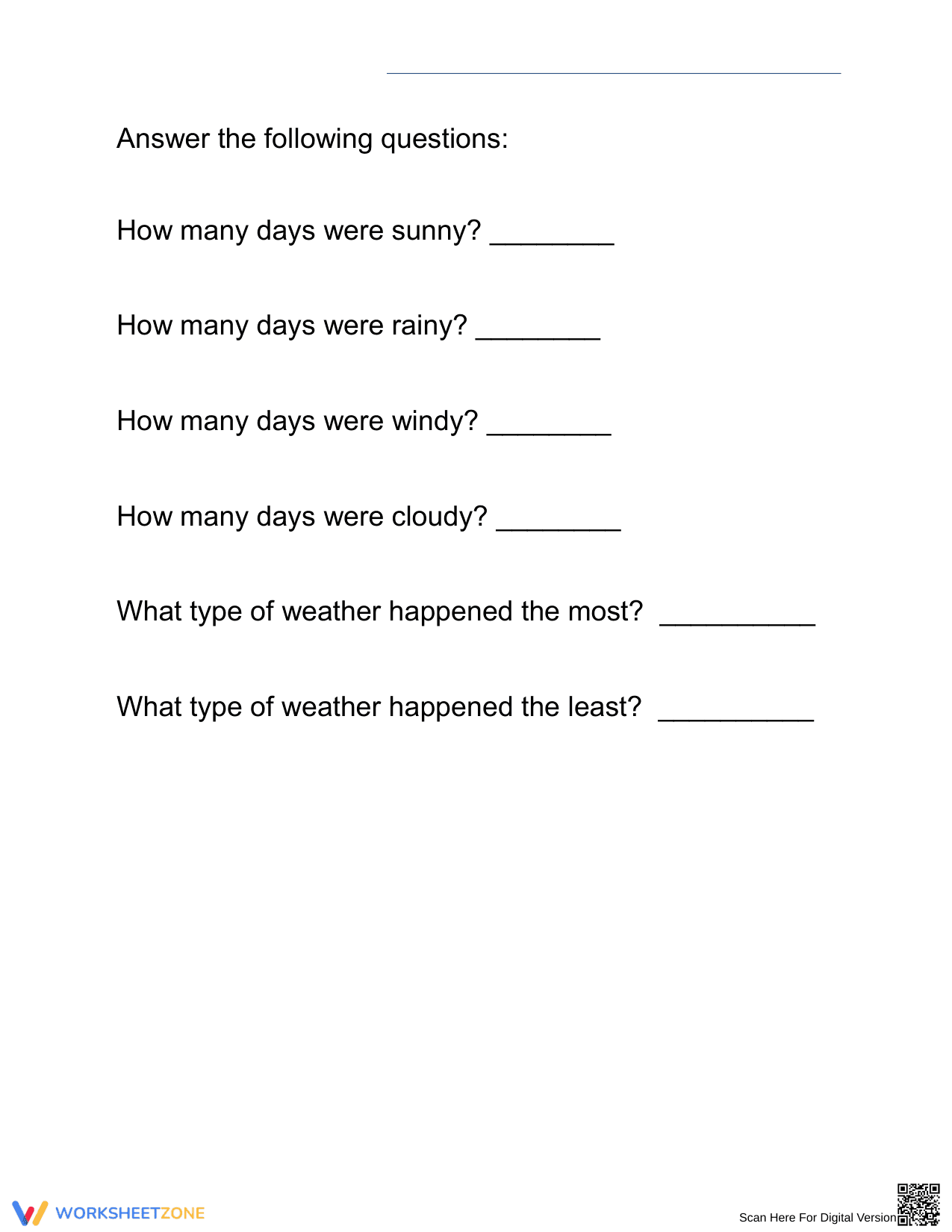
This Grade 1 weather graph worksheet enables young learners to systematically observe, record, and track local atmospheric conditions over a ten-day period. By using simple tallies to document daily changes in sun, rain, and wind, students develop foundational data collection skills while strengthening their understanding of Earth's predictable yet dynamic patterns.
At a Glance
- Grade: 1 · Subject: Science
- Standard:
1-ESS1-2— Make observations at different times of year to relate patterns over time- Skill Focus: Data collection and weather observation
- Format: 1 page · 10 tracking slots · No answer key needed · PDF
- Best For: Daily morning meetings or science journals
- Time: 2–5 minutes daily
This recording tool features a clear, student-friendly grid designed for primary learners. It includes six distinct weather icons representing wind, sun, clouds, snow, storms, and rain, allowing for comprehensive daily observations. The one-page format includes ten vertical columns for ten days of tracking, along with a final "Total" column to facilitate end-of-week data analysis and simple summation.
The workflow for this worksheet is designed for maximum efficiency in the classroom. Step 1: Print the single-page PDF (30 seconds). Step 2: Distribute to students for use in weather journals or folders (1 minute). Step 3: Guide a 2-minute daily review during morning check-ins to mark the current conditions. This zero-prep resource is an ideal sub-plan addition or a consistent daily anchor for a month-long weather unit.
This resource is primary aligned to 1-ESS1-2, where students make observations to relate patterns in the environment over time. By tracking weather for ten days, students gather the empirical evidence needed to discuss trends and fluctuations. This standard code can be copied directly into lesson plans, IEP goals, or district curriculum mapping tools to ensure all data-driven activities meet core science requirements.
Integrate this worksheet into your daily morning routine by designating a "weather reporter" to check the window and lead the class in marking the grid. This serves as a perfect formative assessment opportunity; observe if students can correctly identify meteorological symbols and accurately place their "X" in the corresponding column. Expect the activity to take approximately three minutes of active instructional time each day.
This worksheet is specifically tailored for Grade 1 students, though it is highly effective for Kindergarten or Grade 2 learners needing additional support with data organization. The visual icons provide essential scaffolding for English Language Learners and early readers. It pairs naturally with a classroom weather station, a thermometer, or a primary science passage about seasonal changes.
According to Fisher & Frey (2014), the use of structured recording tools in early childhood education is a critical component of the gradual release of responsibility, transitioning students from teacher-led observation to independent scientific inquiry. This Grade 1 weather graph worksheet provides that necessary structure by aligning with the 1-ESS1-2 standard, which focuses on observing environmental patterns. By documenting daily weather variables—such as precipitation and cloud cover—students engage in the core practice of "Analyzing and Interpreting Data" as defined by the NGSS framework. Research from Fisher & Frey emphasizes that consistent, short-interval data collection helps primary students internalize the concept of variability versus consistency in nature. This 10-day tracking sheet serves as a foundational bridge between simple observation and the more complex statistical reasoning required in upper elementary grades, making it an essential resource for standards-aligned science instruction.


