


























Views
Downloads
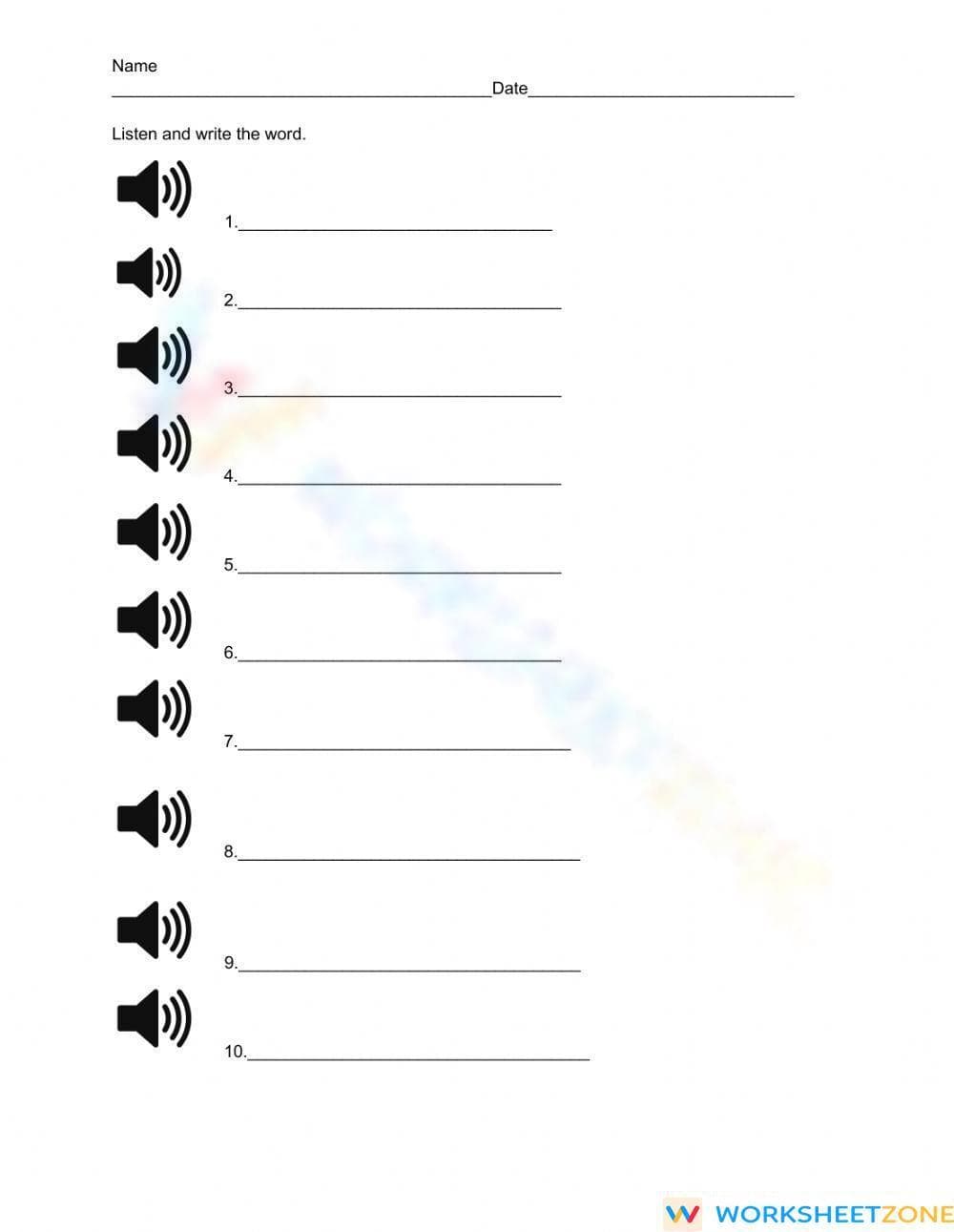

Essential Grade 1 Spelling Test: Unit 2 Week 1 Printable
Paste this activity's link or code into your existing LMS (Google Classroom, Canvas, Teams, Schoology, Moodle, etc.).
Students can open and work on the activity right away, with no student login required.
You'll still be able to track student progress and results from your teacher account.
This Grade 1 Unit 2 Week 1 spelling test worksheet provides a structured format for weekly dictation assessments. It helps students practice phonics and spelling conventions by listening to words and writing them accurately. This resource ensures that young learners build a strong foundation in standard English spelling through regular, focused practice and assessment.
At a Glance
- Grade: Grade 1 · Subject: English Language Arts (ELA)
- Standard:
CCSS.ELA-LITERACY.L.1.2— Spell words phonetically and demonstrate command of standard English spelling conventions- Skill Focus: Phonetic Spelling & Dictation
- Format: 1 page · 10 problems · Answer key included · PDF
- Best For: Weekly formative spelling assessments and checks
- Time: 10–15 minutes
What's Inside
The worksheet features a clean, student-friendly layout designed to minimize distractions during a test. It includes 10 clearly numbered lines, each paired with a speaker icon to prompt the "listen and write" workflow. The header provides space for name and date, facilitating easy grading and record-keeping. This single-page PDF is optimized for quick printing and clear legibility for early writers.
Zero-Prep Workflow
Teachers can implement this assessment with a target prep time of under 2 minutes. First, print required copies, which takes seconds. Next, distribute sheets and explain the dictation process. Finally, read your chosen spelling list aloud while students write, allowing for a review session after completion for instant feedback. This efficiency makes it ideal for busy mornings or sub-plans.
Standards Alignment
This resource is primarily aligned with CCSS.ELA-LITERACY.L.1.2, which requires Grade 1 students to demonstrate command of the conventions of standard English spelling. It specifically supports sub-standard L.1.2.D, where students spell words phonetically by drawing on their developing phonemic awareness. This standard code can be copied directly into lesson plans, IEP goals, or district curriculum mapping tools to ensure instructional consistency.
How to Use It
Use this worksheet as a summative assessment at the end of Unit 2, Week 1 to measure mastery of the week's specific phonics patterns. During the dictation, observe students' pencil grip and letter formation as a secondary formative assessment. This tool is best used after direct instruction on the target vowel or consonant sounds, typically on a Friday to wrap up the weekly spelling cycle.
Who It's For
This worksheet is designed for Grade 1 students but is also suitable for Grade 2 learners who require additional reinforcement of basic spelling patterns. It serves as an excellent resource for ELA teachers, homeschool parents, and tutors. For students needing more support, pair this test with a visual anchor chart of the week's phonics rules to provide a scaffold during the initial practice phases.
Effective spelling instruction in the early grades relies on integrating phonemic awareness and orthographic mapping. According to Fisher & Frey (2014), the gradual release of responsibility model is significantly enhanced when students move from teacher-led guided phonetic practice to independent dictation assessments like those aligned with CCSS.ELA-LITERACY.L.1.2. Regular assessment of 10 targeted words allows teachers to identify specific gaps in phonetic decoding and encoding before moving to complex linguistic structures. By focusing on phonetic spelling, this worksheet ensures that students understand the underlying relationship between sounds and symbols rather than just memorizing letter strings. This approach is consistent with current research into the science of reading, which emphasizes the necessity of explicit phonics instruction for long-term literacy success and reading fluency across diverse learner populations. Utilizing these structured assessments consistently helps bridge the gap between spoken language and written expression, ensuring that students develop the necessary skills to communicate effectively in a variety of academic contexts as they progress through elementary school.


