


























Views
Downloads
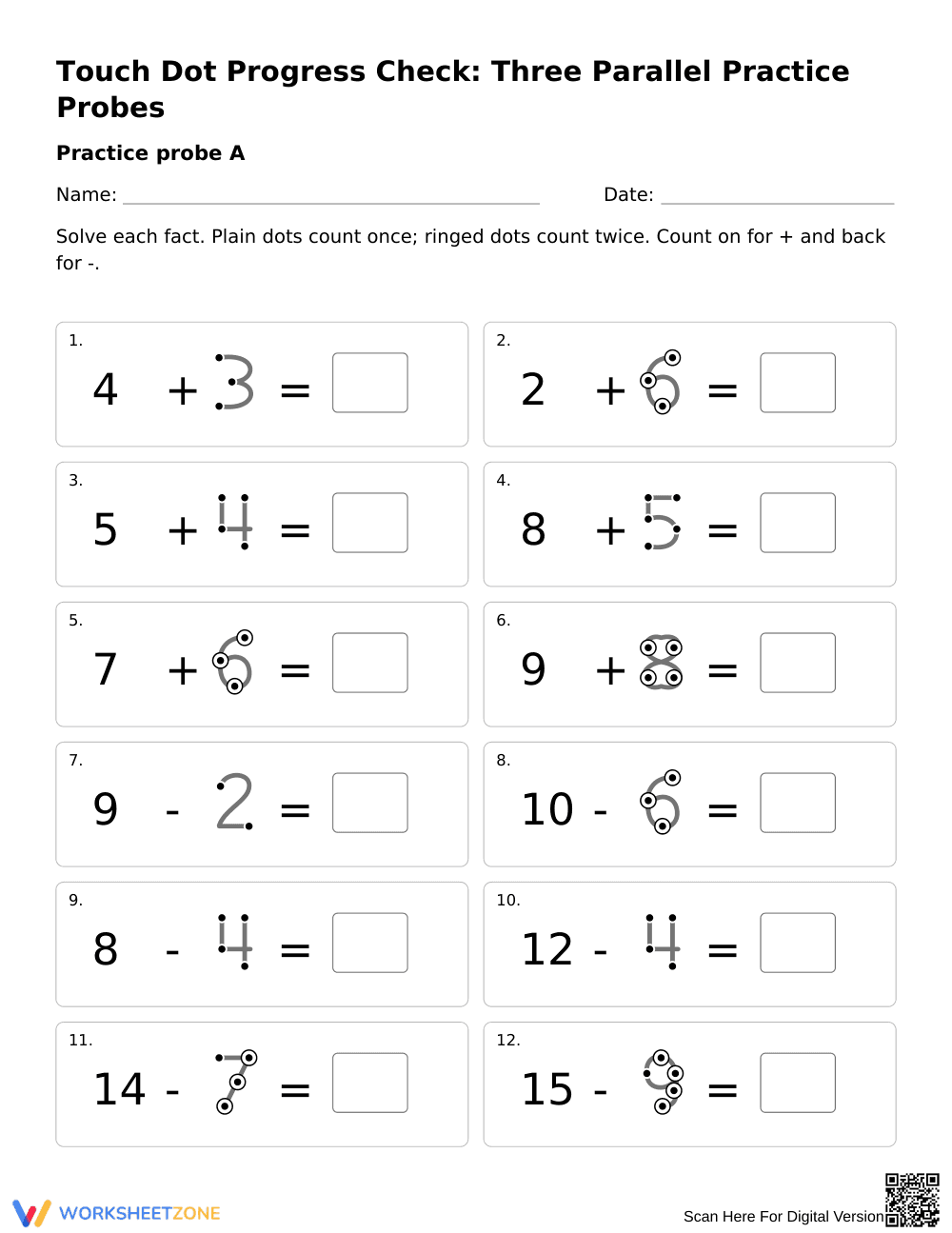
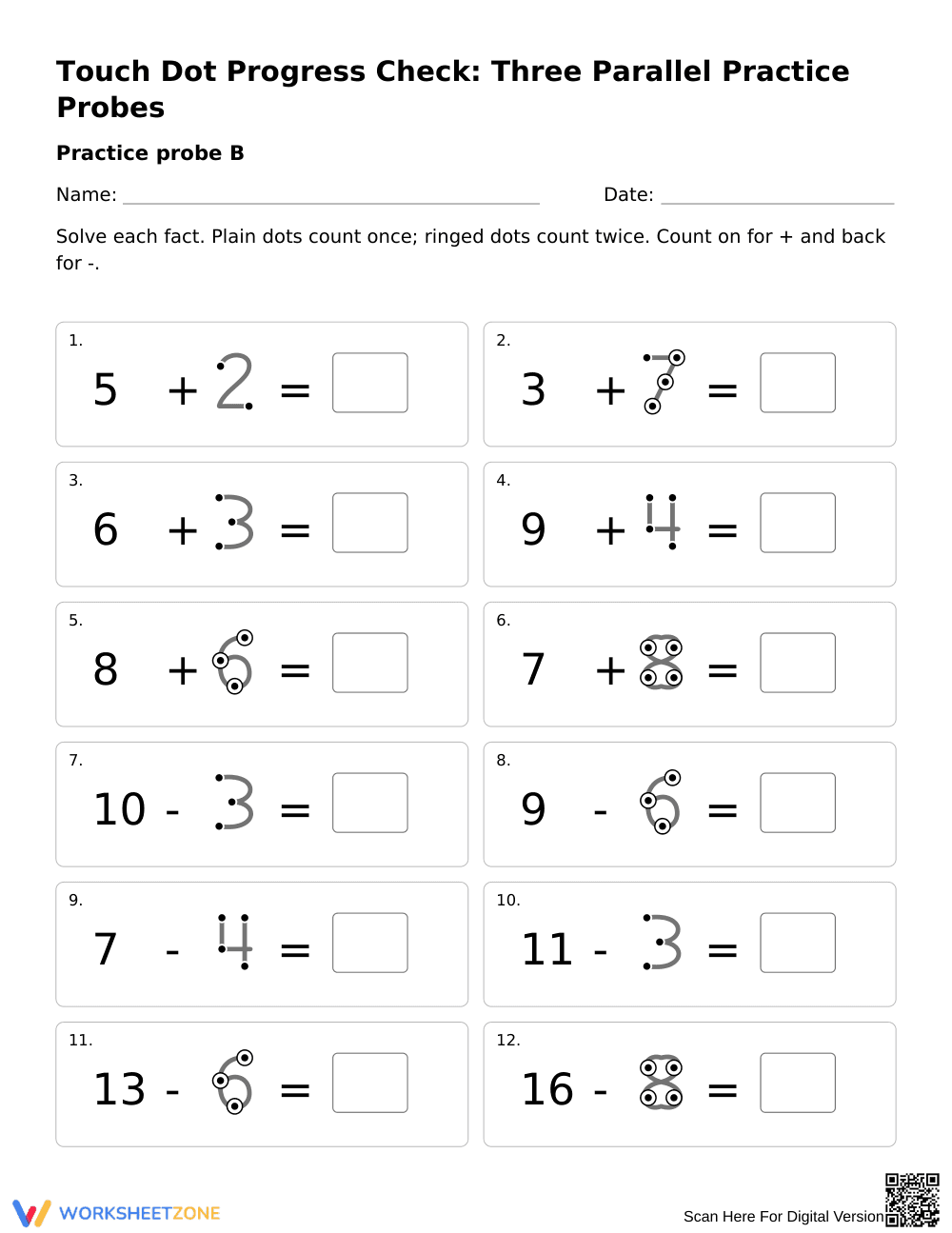
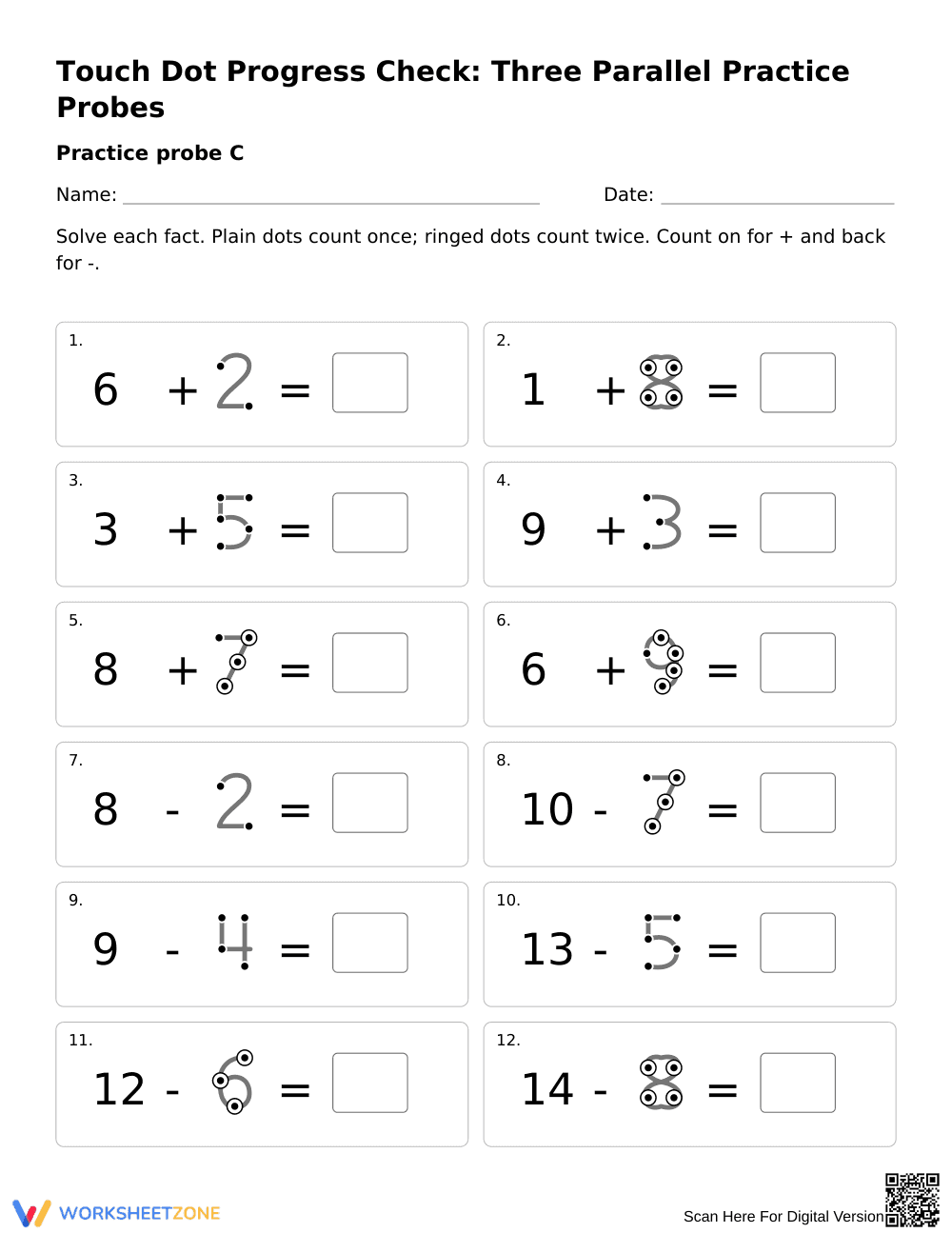
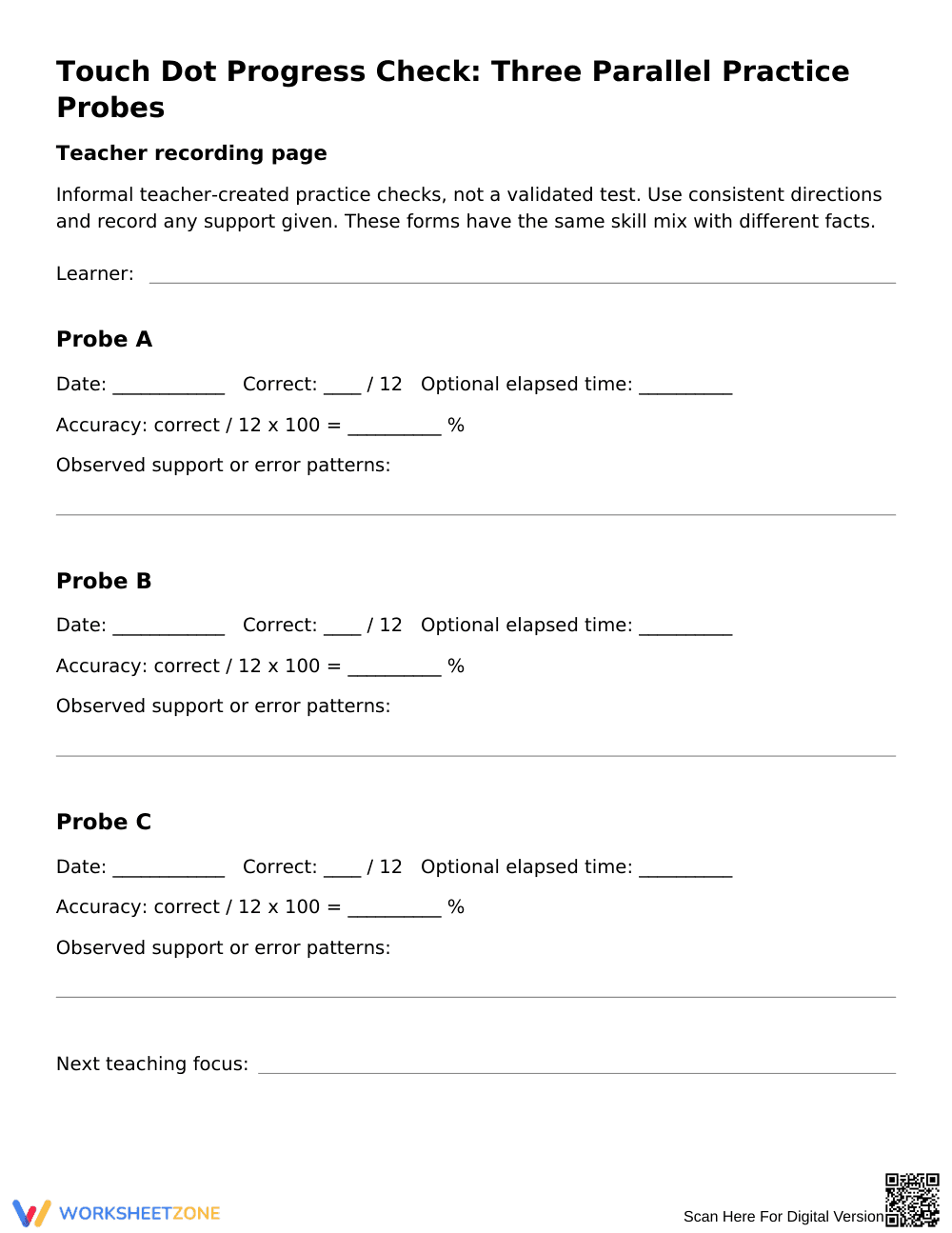

Grade 1 Touch Dot Math — Printable No-Prep Worksheet
Paste this activity's link or code into your existing LMS (Google Classroom, Canvas, Teams, Schoology, Moodle, etc.).
Students can open and work on the activity right away, with no student login required.
You'll still be able to track student progress and results from your teacher account.
This Grade 1 math worksheet helps students master addition and subtraction within 20 using the touch dot strategy. By counting on and counting back with visual cues, young learners build fact fluency and computational confidence. The parallel probes provide consistent, reliable progress monitoring for essential early math skills.
At a Glance
- Grade: 1 · Subject: Math
- Standard:
CCSS.MATH.CONTENT.1.OA.C.5— Relate counting to addition and subtraction.- Skill Focus: Touch dot addition and subtraction
- Format: 5 pages · 36 problems · Answer key included · PDF
- Best For: Progress monitoring and fluency practice
- Time: 10–15 minutes
This resource includes three parallel practice probes (Probes A, B, and C), each featuring 12 mixed addition and subtraction facts. The problems utilize visual touch dots on the second addend or subtrahend to scaffold the counting process. A dedicated teacher recording page is provided to track accuracy, elapsed time, and error patterns, alongside a comprehensive single-page answer key for quick grading.
Zero-Prep Workflow
- Print (1 minute): Select and print one of the three parallel probes for immediate student use.
- Distribute (1 minute): Hand out the single-page probe as a quick warm-up, exit ticket, or independent practice task.
- Review (2 minutes): Use the included answer key and teacher recording sheet to rapidly score the 12 problems and document student progress.
With under two minutes of total teacher prep time, these probes are highly effective for daily routines or as a reliable activity for a substitute teacher plan.
Aligned to CCSS.MATH.CONTENT.1.OA.C.5: Relate counting to addition and subtraction (e.g., by counting on 2 to add 2). This resource directly supports students in transitioning from concrete counting to mental math strategies. Both standard codes can be copied directly into lesson plans, IEP goals, or district curriculum mapping tools.
Deploy these probes during small group math centers to monitor fluency growth over three consecutive weeks. Alternatively, use them as a quick formative assessment after direct instruction on the counting-on strategy. While students work, observe whether they are accurately tapping the dots or if they have begun to internalize the values and count mentally. Each probe is designed to be completed in a brief 10 to 15-minute window.
This resource is ideal for first-grade students developing basic fact fluency, as well as second graders needing targeted intervention. The visual scaffolds make it highly accessible for students with IEPs focusing on math calculation. Pair these probes with physical manipulatives or a classroom anchor chart demonstrating the touch dot counting method for maximum impact.
Developing reliable calculation strategies is a critical milestone in early mathematics instruction. According to EdReports 2024, instructional materials that explicitly connect visual models to abstract equations significantly improve long-term fact retention and computational fluency. This targeted worksheet aligns directly with CCSS.MATH.CONTENT.1.OA.C.5, requiring students to relate counting to addition and subtraction through structured practice. By utilizing consistent visual cues like touch dots, young learners can systematically bridge the gap between basic one-to-one correspondence counting and automated mathematical fact retrieval. The parallel design of these three assessment probes ensures that educators can accurately measure this specific cognitive growth over time, eliminating the interference of varying problem difficulty. Regular use of such formative tools allows teachers to pinpoint exact error patterns, adjust their instructional focus, and provide immediate, data-driven interventions for students struggling with foundational arithmetic concepts.


