




























Views
Downloads

Grade 1 Seasonal Sunlight — Printable No-Prep Worksheet

Paste this activity's link or code into your existing LMS (Google Classroom, Canvas, Teams, Schoology, Moodle, etc.).
Students can open and work on the activity right away, with no student login required.
You'll still be able to track student progress and results from your teacher account.
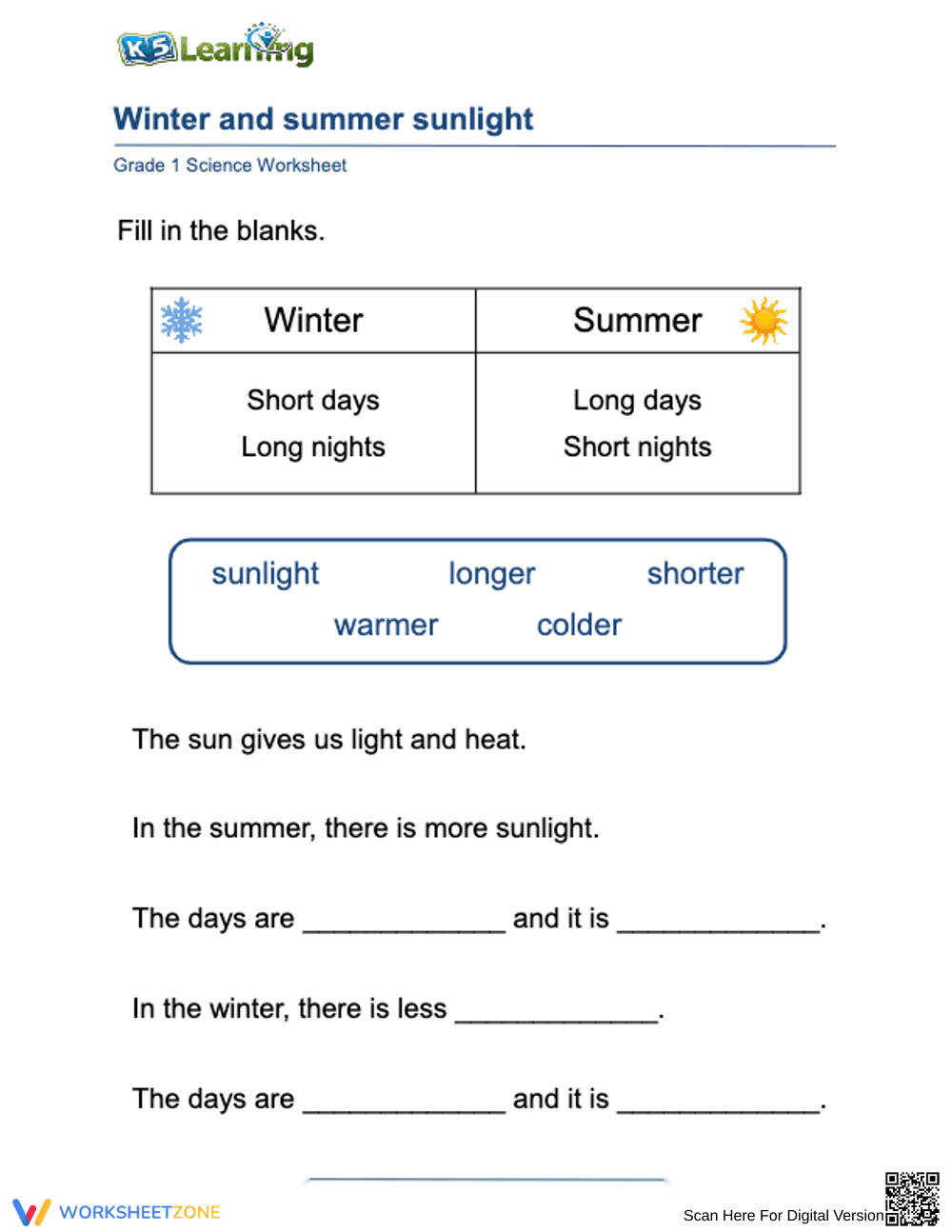
This focused Grade 1 science worksheet helps students compare the patterns of sunlight and temperature between winter and summer. Learners use a clear visual table and a structured word bank to complete sentences describing how day length, night length, and warmth change with the seasons, building foundational Earth science vocabulary.
At a Glance
- Grade: 1 · Subject: Science
- Standard:
1-ESS1-2— Make observations to relate the amount of daylight to the time of year- Skill Focus: Seasonal sunlight patterns
- Format: 2 pages · 4 problems · Answer key included · PDF
- Best For: Formative assessment or science center activity
- Time: 10–15 minutes
What's Inside
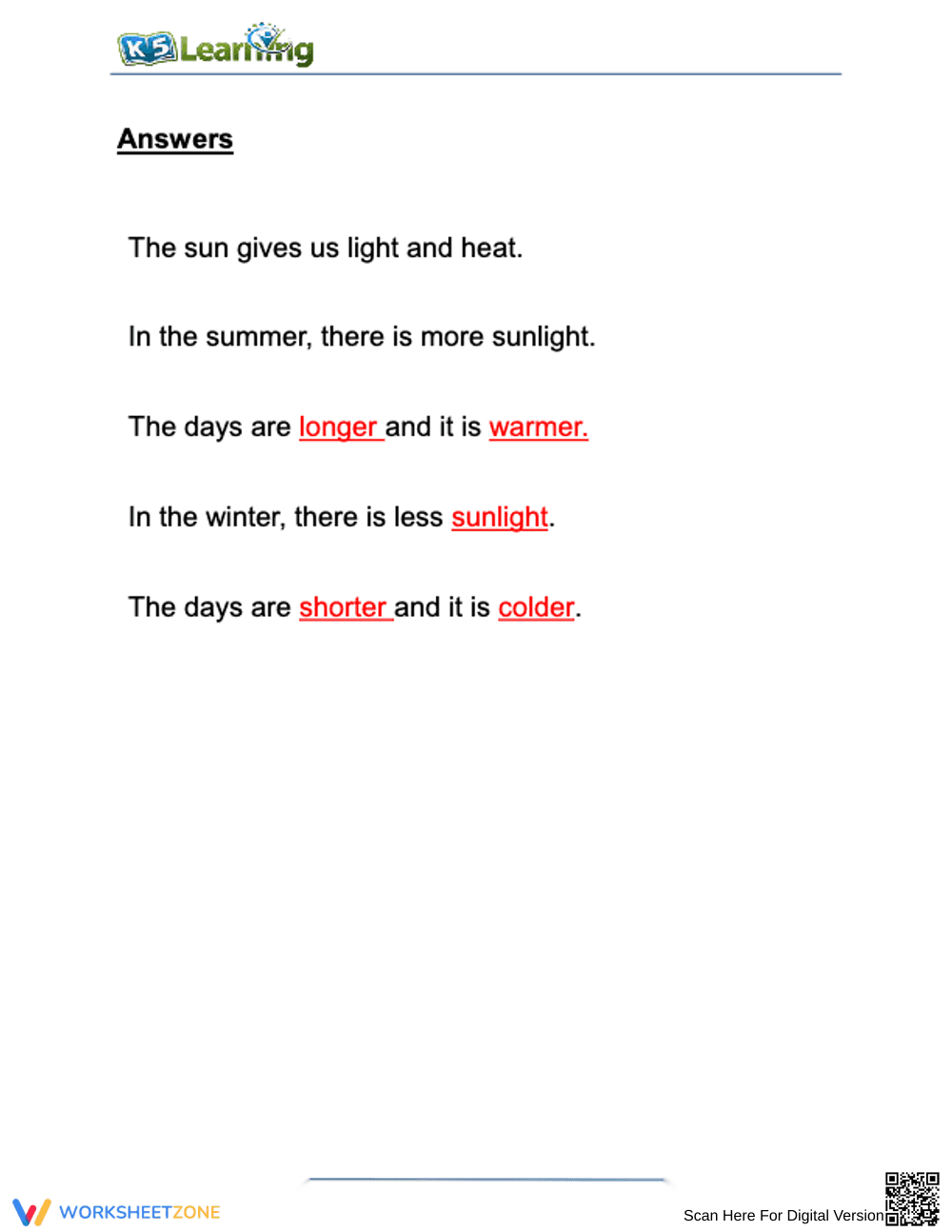
This two-page PDF resource contains the primary, student-facing worksheet and a corresponding full-color answer key. The worksheet itself features a clear comparison table contrasting winter and summer characteristics (e.g., short days/long nights). Below the table, four fill-in-the-blank sentences prompt students to describe seasonal patterns, supported by a five-term word bank (sunlight, longer, shorter, warmer, colder).
Zero-Prep Workflow
Get this activity running in under five minutes. Print: The high-contrast, single-page design is ready for black-and-white or color printing. Distribute: With clear instructions and a built-in word bank, students can start immediately. Review: Use the included answer key for a quick whole-class review or self-correction, providing instant feedback to solidify concepts. It's an ideal resource for substitute plans.
Standards-Based Science
This worksheet is directly aligned to NGSS 1-ESS1-2, where students make observations to relate daylight to the time of year. The tasks provide a structured format for students to record these observational patterns. It also supports ELA vocabulary standards by requiring the use of scientific context. The standard code can be copied directly into lesson plans or curriculum maps.
Classroom Application
Use this resource as a formative assessment after a direct-instruction lesson on seasons. It effectively checks if students can connect more sunlight to warmer temperatures and longer days. It also works well as a short homework assignment or as an independent activity in a science learning center. Expect most students to complete the worksheet in about 10-15 minutes.
Designed for Grade 1
This resource is built for first-grade students studying Earth's patterns. The visual supports and word bank also make it accessible for English Language Learners and second graders needing a quick review of seasonal concepts. It pairs well with a classroom weather chart or a read-aloud about the seasons.
This worksheet provides targeted practice for NGSS standard 1-ESS1-2, building a foundation for understanding Earth's systems. By asking students to connect daylight hours to the time of year, the activity develops crucial pattern-recognition skills. According to a RAND AIRS 2024 analysis, early exposure to core disciplinary ideas in a structured format predicts later science achievement. The worksheet's use of a word bank and sentence frames is a supported scaffolding technique that helps young learners articulate scientific observations with precision. It offers a concrete method for students to demonstrate their understanding of the relationship between seasonal changes and the sun's observable patterns, transforming an abstract concept into a recordable piece of evidence for formative assessment.


