


























Views
Downloads

Grade 1 Halloween Math Quest — Printable Activity
Paste this activity's link or code into your existing LMS (Google Classroom, Canvas, Teams, Schoology, Moodle, etc.).
Students can open and work on the activity right away, with no student login required.
You'll still be able to track student progress and results from your teacher account.
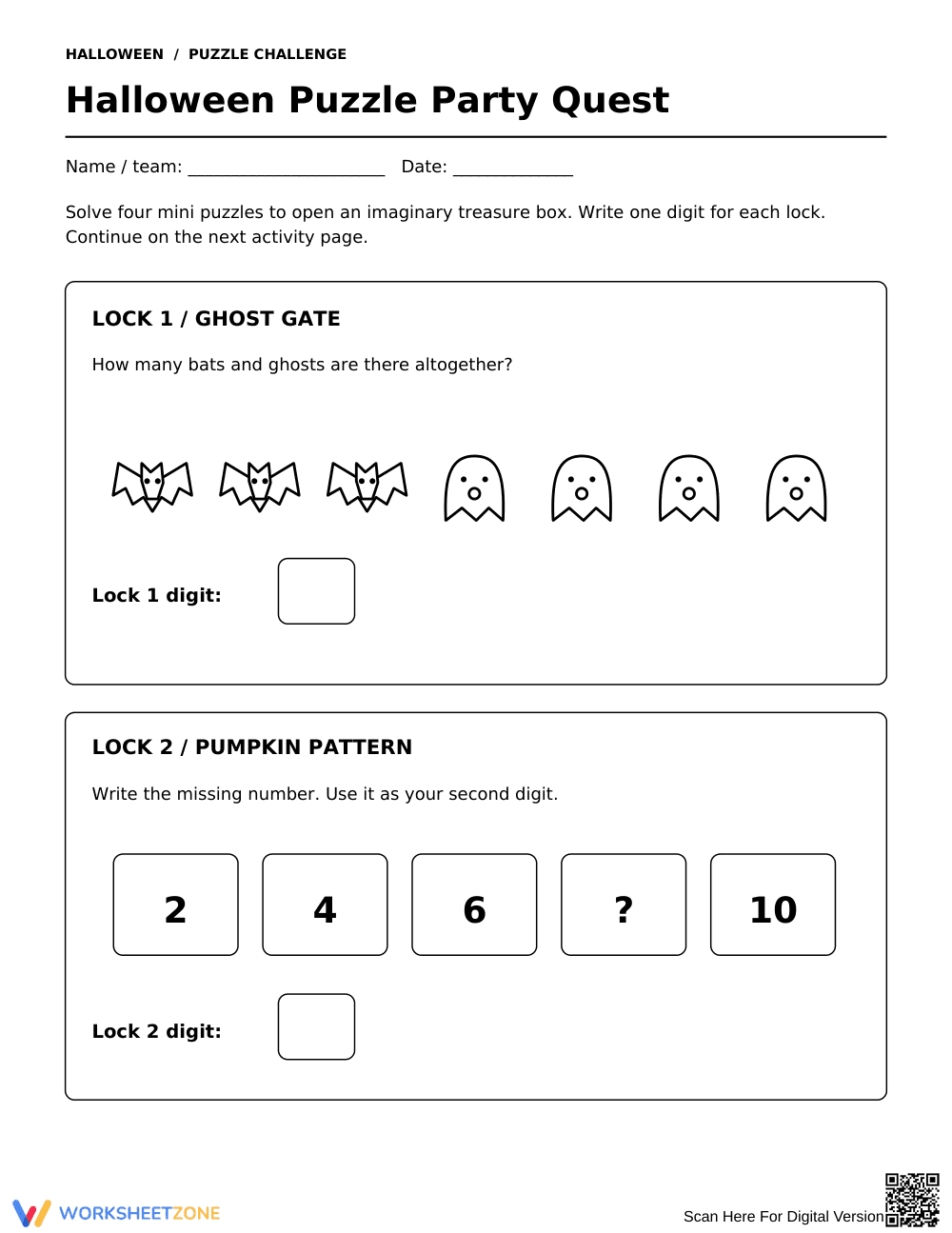
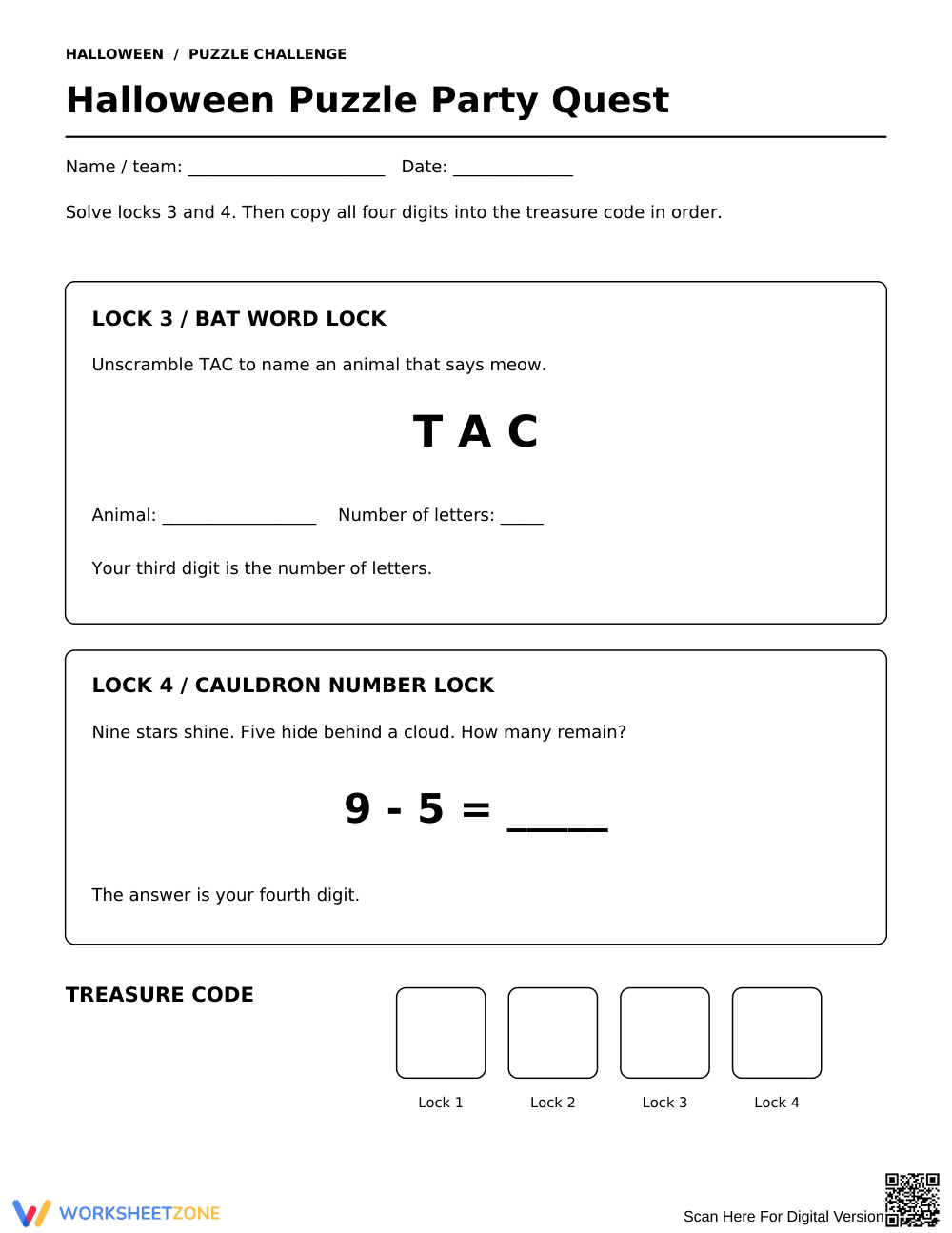
This printable Halloween math quest builds foundational arithmetic, pattern recognition, and problem-solving skills through a seasonal mystery format. Students solve 4 progressive lock challenges—including counting picture sets, completing skip-counting sequences, unscrambling a vocabulary clue, and solving subtraction facts within 10—to find the four-digit code that opens a treasure box.
At a Glance
- Grade: 1 · Subject: Math
- Standard:
CCSS.MATH.CONTENT.1.OA.C.6— Add and subtract within 10 using counting and mental strategies- Skill Focus: Counting, skip counting, subtraction within 10
- Format: 2 pages · 4 problems · Answer key included · PDF
- Best For: Cooperative math stations and seasonal review
- Time: 10–15 minutes
What's Inside
The resource includes 2 student activity pages with 4 themed puzzle locks plus a comprehensive 1-page host guide. Students count Halloween icons, identify missing skip-counting numbers, unscramble a CVC word to count letters, and evaluate a subtraction word problem. The host guide provides the answer key and targeted verbal hints.
Zero-Prep Workflow
Educators can implement this quest with under 2 minutes of setup time:
- Print (1 minute): Print 1 copy per student pair or small group, plus 1 host guide for the facilitator.
- Distribute (30 seconds): Hand out pages with pencils; no scissors, envelopes, or physical locks are required.
- Review (10–15 minutes): Check final 4-digit codes against the host key.
Self-contained instructions make this quest suitable for substitute plans or low-prep seasonal activities.
Standards Alignment
The core tasks align directly with `CCSS.MATH.CONTENT.1.OA.C.6`: Add and subtract within 20, demonstrating fluency for addition and subtraction within 10. Supporting standard `CCSS.MATH.CONTENT.1.NBT.B.1` addresses counting and writing numerals within ordered sequences. Both standard codes can be copied directly into lesson plans, IEP goals, or district curriculum mapping tools.
How to Use It
Use this quest during small-group math rotations or seasonal review stations after direct instruction on subtraction. Organize students into pairs to encourage peer discussion during problem-solving. Observe whether students count backward mentally or draw picture models when solving the subtraction word problem in Lock 4. Most student teams finish all 4 locks in 10 to 15 minutes.
Who It's For
This quest is tailored for Grade 1 learners mastering early arithmetic, with accessible review for Grade 2. Differentiate by providing physical counters for subtraction or reading prompts aloud to emerging readers. Pair this activity with a skip-counting number line chart for visual reference during center time.
According to empirical research by Fisher & Frey (2014) on productive group work, collaborative problem-solving tasks structured around clear, shared goals substantially increase student engagement and conceptual retention in early elementary mathematics. This printable quest operationalizes these findings by aligning puzzle challenges directly to CCSS.MATH.CONTENT.1.OA.C.6, enabling primary students to demonstrate fluency in addition and subtraction within 10 through cooperative peer dialogue. Rather than completing repetitive drill worksheets alone, students actively apply foundational number sense, pattern deduction, and basic literacy skills toward solving an interactive mystery. The structured four-lock progression provides immediate formative checkpoints that support mathematical reasoning and ongoing self-monitoring. By integrating concrete visual counting with abstract numerical operations, this quest reinforces essential early numeracy skills in a supportive, low-stakes format suitable for general education classrooms, math intervention groups, and differentiated seasonal instruction.


