


























Views
Downloads

Recycling Sorting Worksheet | Essential Grade 1 Science
Paste this activity's link or code into your existing LMS (Google Classroom, Canvas, Teams, Schoology, Moodle, etc.).
Students can open and work on the activity right away, with no student login required.
You'll still be able to track student progress and results from your teacher account.
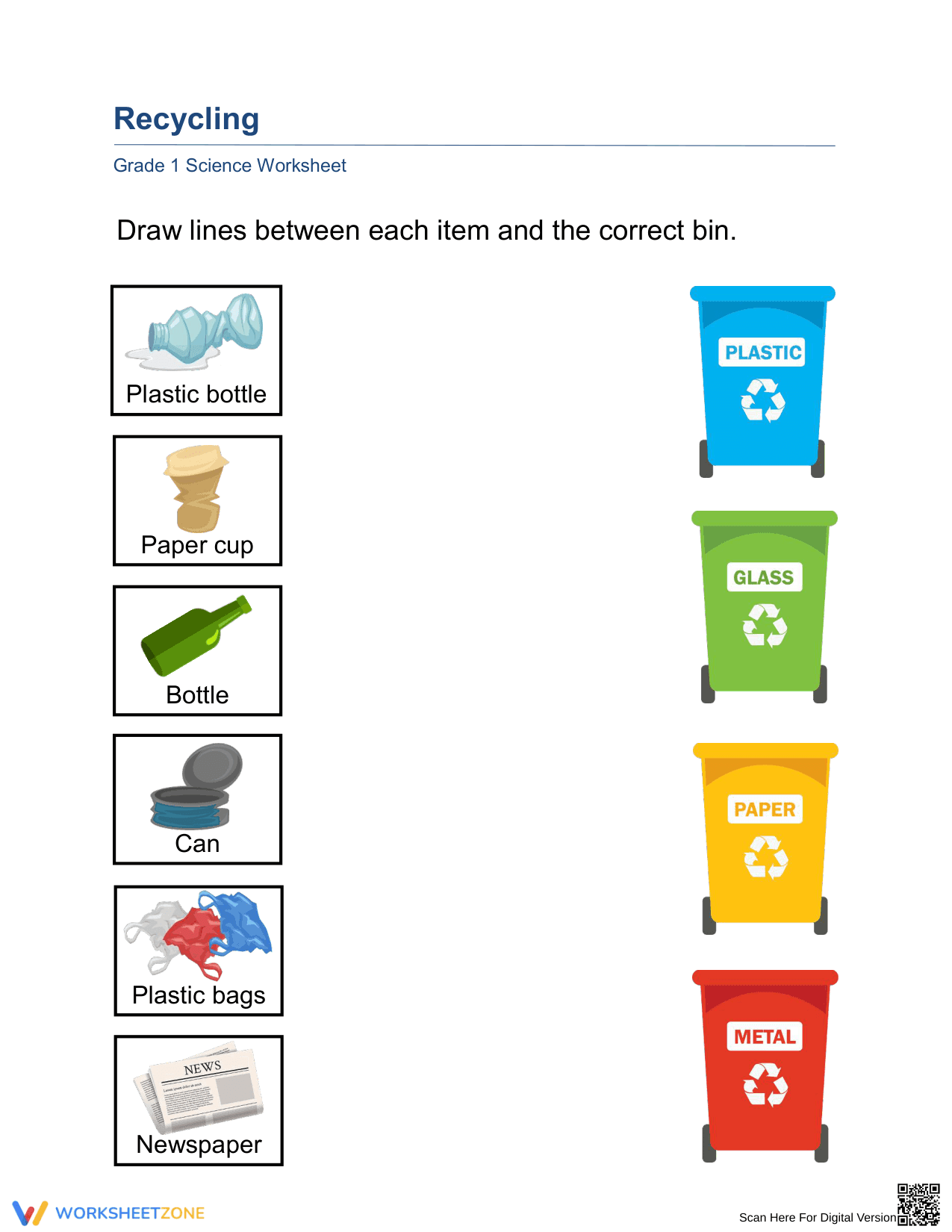
This Grade 1 science worksheet simplifies the concept of environmental stewardship through a practical sorting activity. Students identify common household materials—plastic, glass, paper, and metal—and determine the appropriate recycling stream for each item. By engaging with these visual cues, learners develop a foundational understanding of conservation and resource management.
At a Glance
- Grade: 1 · Subject: Science
- Standard:
K-ESS3-3— Communicate solutions to reduce human impact on the local environment- Skill Focus: Material classification and recycling sorting
- Format: 1 page · 6 problems · Answer key included · PDF
- Best For: Independent practice or environmental science introductory lessons
- Time: 10–15 minutes
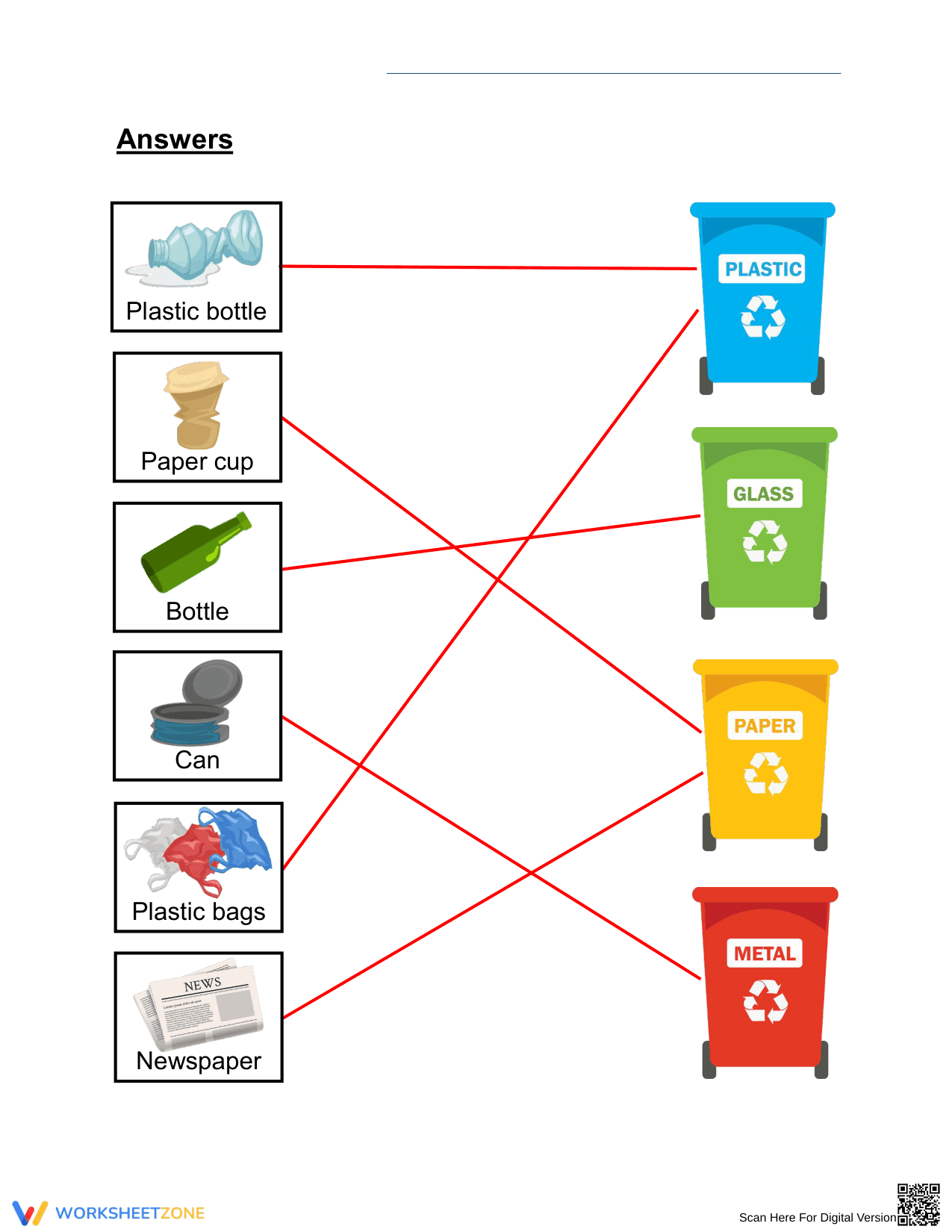
This single-page PDF includes six distinct sorting challenges featuring clear illustrations of a plastic bottle, paper cup, glass bottle, metal can, plastic bags, and a newspaper. Students are prompted to draw lines connecting these items to four labeled recycling bins. The resource comes with a full-color answer key to facilitate rapid grading or student self-correction.
Teachers can integrate this activity into their science block with zero preparation. Simply print the worksheet in under 30 seconds, distribute it to the class in 1 minute, and allow students to work through the matching exercise independently. Reviewing the answers together takes less than 5 minutes, making it an ideal choice for emergency sub plans or quick formative assessments.
Primary alignment is with `K-ESS3-3`, which requires students to communicate solutions for reducing human impact on the environment. While categorized for Grade 1, this activity directly supports the behavioral outcomes of resource conservation. Both standard codes can be copied directly into lesson plans, IEP goals, or district curriculum mapping tools.
Use this worksheet as a concluding activity after a direct instruction lesson on environmental resources. It serves as a concrete check for understanding regarding material properties. Alternatively, assign it as a morning work task to spark a discussion about what can be recycled at home. Observe whether students can distinguish between paper and plastic bags during the exercise.
This resource is designed for first-grade students but is accessible for kindergarteners or English Language Learners due to the heavy reliance on visual aids. It pairs naturally with a classroom recycling bin tour or a short video passage about waste management facilities.
The integration of sorting activities in early childhood science is supported by Fisher & Frey (2014), who emphasize the importance of categorical thinking in developing higher-order scientific reasoning. Recycling education at the Grade 1 level bridges the gap between abstract environmental concepts and daily habits. By aligning with `K-ESS3-3`, this worksheet ensures that students aren't just memorizing bins but are actively participating in a global solution for resource conservation. Research from EdReports 2024 suggests that high-quality, focused practice on single environmental standards helps solidify long-term retention of conservation principles. This worksheet provides that focused practice through 6 targeted matching tasks that require active material discrimination. The clear layout and immediate feedback via the included answer key support independent mastery, making it a reliable tool for early elementary science curricula.


