


























Views
Downloads

Grade 1 Story Sequencing — Printable No-Prep Worksheet
Paste this activity's link or code into your existing LMS (Google Classroom, Canvas, Teams, Schoology, Moodle, etc.).
Students can open and work on the activity right away, with no student login required.
You'll still be able to track student progress and results from your teacher account.
This worksheet provides first-grade students a clear, structured framework for retelling the classic story of "Goldilocks and the Three Bears." Using simple prompts and sequencing boxes, learners will identify the main characters and recall major events in chronological order, strengthening their narrative comprehension and summarization skills. It is a ready-to-use resource for any ELA lesson.
At a Glance
- Grade: K–1 · Subject: English Language Arts (ELA)
- Standard:
CCSS.ELA-LITERACY.RL.1.2— Retell stories with key details to show understanding- Skill Focus: Story Sequencing, Narrative Retelling
- Format: 1 page · 3 tasks · Answer key included · PDF
- Best For: Guided practice, reading centers, or sub plans
- Time: 15–20 minutes
What's Inside
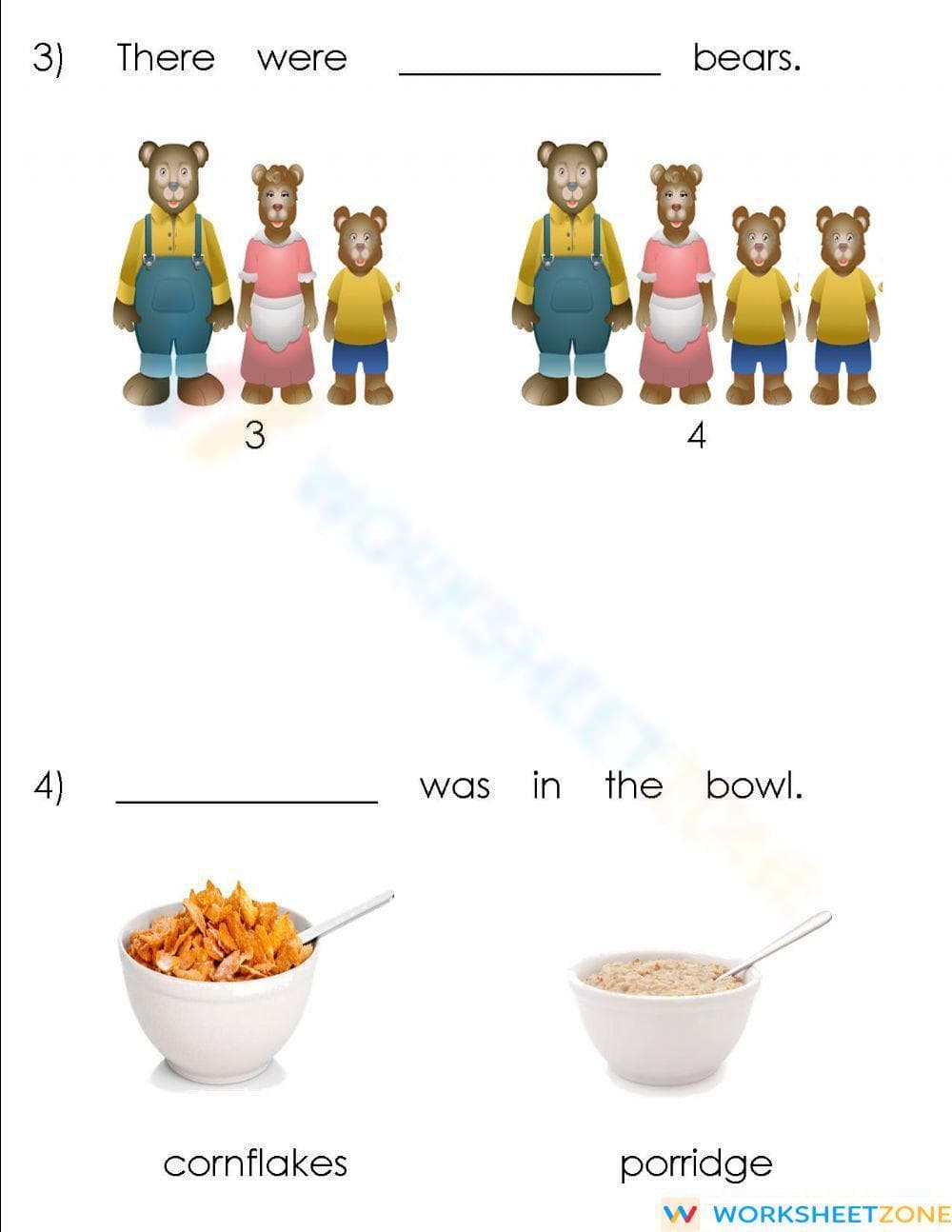
This single-page PDF features a student-friendly layout for "Goldilocks and the Three Bears." It includes three tasks: drawing characters, summarizing the story, and a four-panel sequencing chart ("First," "Next," "Then," "Last"). The download includes a complete answer key for easy review.
A Zero-Prep Workflow for Teachers
Designed for busy classrooms, this resource eliminates prep time. The single-page PDF is ready to print and distribute immediately after a read-aloud of "Goldilocks." Instructions are intuitive, allowing students to begin work independently. With a total teacher setup time of under two minutes, it's an ideal resource for substitute plans, reading rotations, or a last-minute guided practice activity. The included answer key makes reviewing student work fast and efficient.
Standards-Aligned for ELA Mastery
This worksheet is directly aligned with CCSS.ELA-LITERACY.RL.1.2, which requires students to "retell stories, including key details." The sequencing and character identification tasks provide concrete practice for this foundational skill. It also supports the Kindergarten standard CCSS.ELA-LITERACY.RL.K.2. Both standard codes can be copied directly into lesson plans, IEP goals, or district curriculum mapping tools.
How to Use This Worksheet
Use this worksheet as a guided practice activity after a whole-group read-aloud. Students can work in pairs to fill out the sequencing boxes before sharing with the class. Alternatively, place it in a reading center for independent practice. As students work, circulate and listen for their use of transition words (First, Next, Last) as a quick formative assessment of their narrative language skills. Expect completion time to be around 15-20 minutes.
Who It's For
This activity is designed for Kindergarten and first-grade students developing narrative comprehension skills. The clear visual structure supports emerging readers and English Language Learners. For differentiation, provide sentence starters or allow students to draw responses. This worksheet pairs perfectly with a "Goldilocks" picture book or a classroom anchor chart that lists key story elements.
This retelling worksheet targets a critical early literacy skill identified in CCSS.ELA-LITERACY.RL.1.2: the ability to recount stories with key details. By providing a clear graphic organizer, the activity offloads the cognitive demand of structuring a narrative, allowing students to focus on recalling and ordering events. This approach aligns with findings that explicit instruction in text structure improves recall, a conclusion supported by research from Fisher & Frey (2014) on text-dependent tasks. Their work confirms that such guided practice is essential for building the close reading skills necessary for future academic success. The worksheet's format provides tangible evidence of a student's ability to sequence a plot, making it a valuable tool for formative assessment and standards-based reading instruction.


