


























Views
Downloads
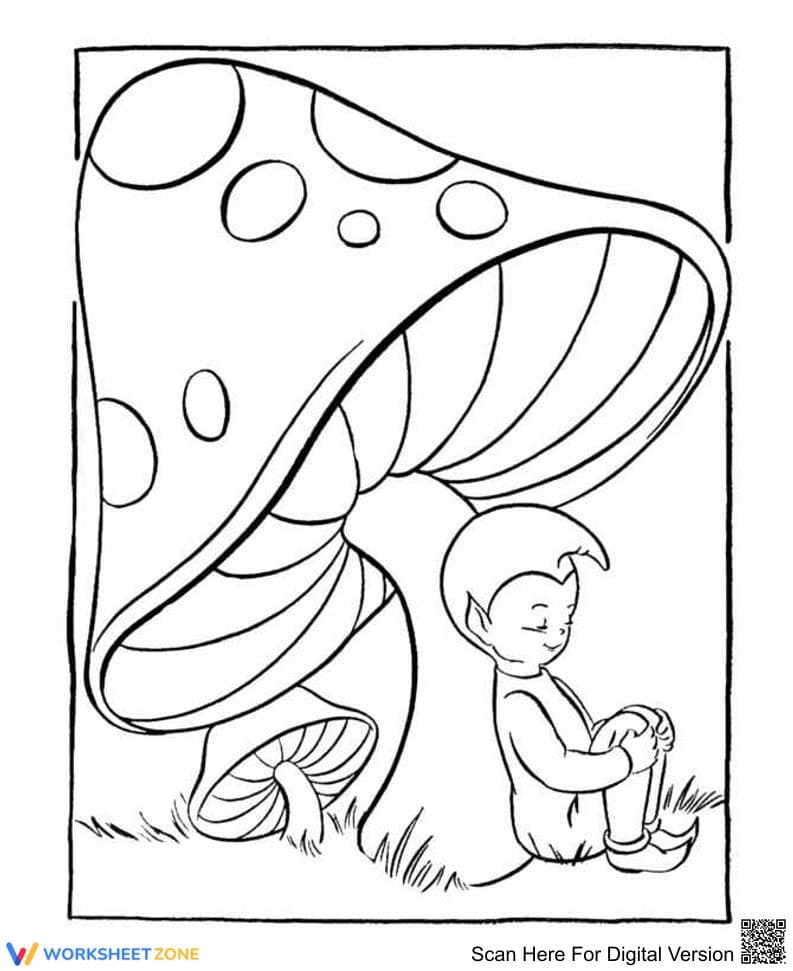

Giant Mushroom Coloring Page | Printable K-2 Worksheet
Paste this activity's link or code into your existing LMS (Google Classroom, Canvas, Teams, Schoology, Moodle, etc.).
Students can open and work on the activity right away, with no student login required.
You'll still be able to track student progress and results from your teacher account.
This giant mushroom coloring page provides young students with an engaging visual prompt to develop fine motor skills and spark creative storytelling. By coloring the whimsical scene of an elf resting beneath a massive mushroom, learners build foundational drawing abilities while preparing to narrate their own imaginative tales.
At a Glance
- Grade: K · Subject: English
- Standard:
CCSS.ELA-LITERACY.W.K.3— Use drawing and dictating to narrate an event- Skill Focus: Fine Motor Skills and Storytelling
- Format: 1 page · 1 problem · No answer key · PDF
- Best For: Independent practice and creative writing prompts
- Time: 15–20 minutes
Inside this single-page PDF, educators will find a beautifully illustrated, black-and-white line drawing featuring a giant, spotted mushroom and a small elf-like character sitting quietly at its base. The page contains one primary coloring task, offering large, open spaces for younger children to practice staying within the lines, alongside finer details for more advanced shading. There is no answer key required, as the focus remains entirely on open-ended artistic expression and narrative generation.
This resource is designed for immediate classroom implementation with a streamlined, zero-prep workflow:
- Print (1 minute): Download the PDF and print the required number of copies.
- Distribute (1 minute): Hand out the pages along with crayons or markers.
- Review (0 minutes): Because this is an open-ended creative task, no formal grading is required.
Total teacher preparation time is under two minutes, making this an ideal, self-explanatory activity for emergency sub plans, morning work, or early finisher stations.
This activity aligns with CCSS.ELA-LITERACY.W.K.3, asking students to use drawing, dictating, and writing to narrate a single event. By using the coloring page as a foundational visual, students easily transition into dictating a story about the character. Both standard codes can be copied directly into lesson plans, IEP goals, or district curriculum mapping tools.
Teachers can utilize this worksheet during the pre-writing phase of a literacy block. Before direct instruction on narrative structure, students color the page to build a connection with the character. Afterward, they can verbally share what they think the elf is doing under the mushroom. As a formative assessment observation tip, educators can monitor pencil grip and fine motor control while students color. The expected completion time ranges from fifteen to twenty minutes.
This resource is primarily designed for Kindergarten and first-grade students developing their fine motor coordination and early narrative skills. It naturally accommodates differentiation; students needing extra support can focus purely on coloring, while advanced learners can write a short paragraph on the back of the page describing the scene. This worksheet pairs perfectly with a read-aloud session featuring fantasy or nature-themed picture books.
Integrating visual arts into early literacy instruction enhances student engagement and narrative comprehension. According to Fisher & Frey (2014), providing students with structured visual prompts before dictating tasks reduces cognitive load and increases the descriptive complexity of their storytelling. This giant mushroom coloring page directly supports CCSS.ELA-LITERACY.W.K.3 by allowing young learners to use drawing and dictating to narrate an event. When children engage in the physical act of coloring, they simultaneously develop the fine motor control necessary for handwriting while mentally constructing the context of their narrative. Bridging artistic expression and verbal storytelling fosters an inclusive environment that values diverse modes of communication, ensuring foundational literacy skills are introduced in an accessible format.


