


























Views
Downloads
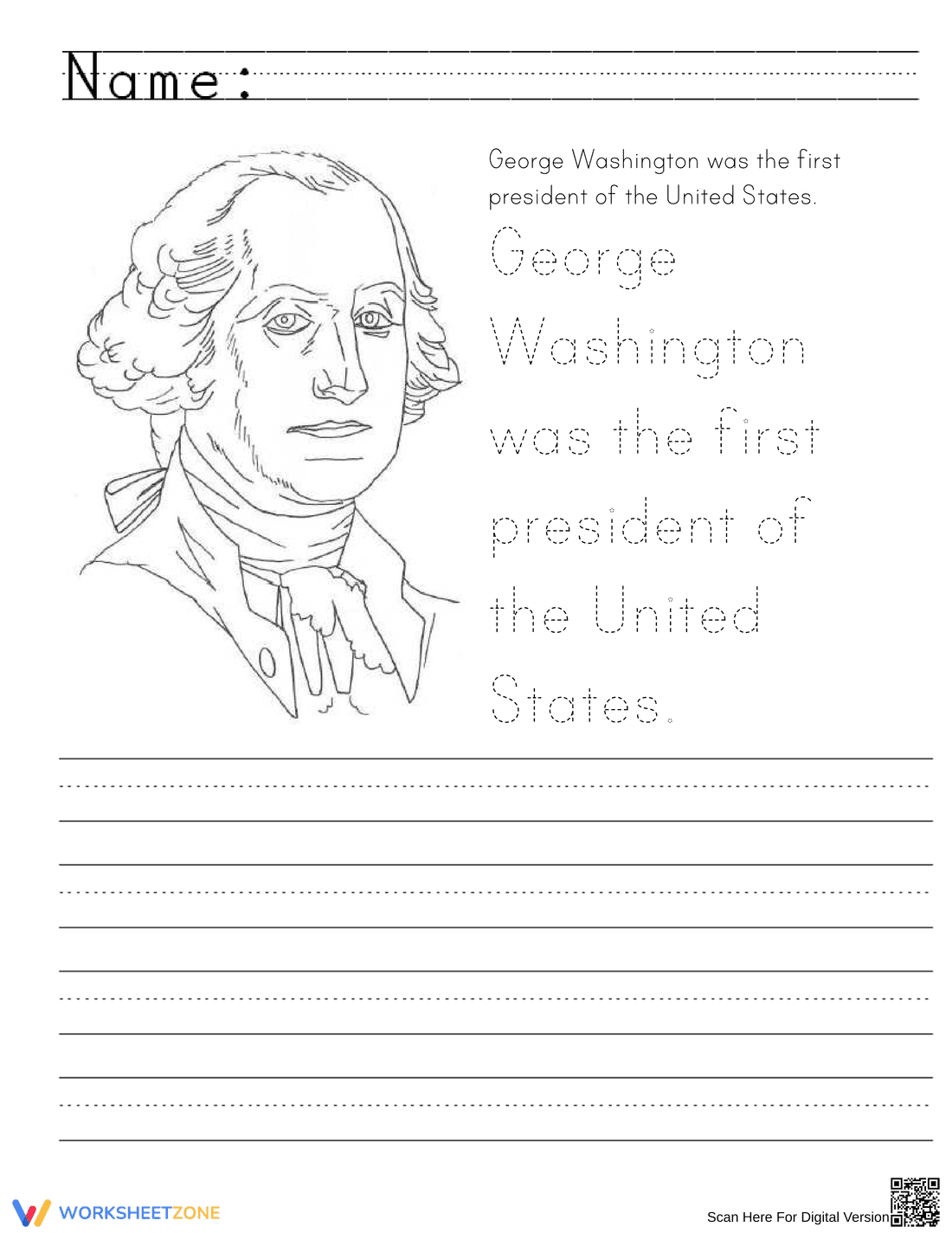

Grade 2 Handwriting — Printable Washington Worksheet
Paste this activity's link or code into your existing LMS (Google Classroom, Canvas, Teams, Schoology, Moodle, etc.).
Students can open and work on the activity right away, with no student login required.
You'll still be able to track student progress and results from your teacher account.
This Grade 2 handwriting worksheet provides students with targeted practice in letter formation and sentence structure while introducing a foundational historical fact. By tracing and copying a sentence about George Washington, learners develop fine motor control and reinforce proper capitalization and punctuation in a single, focused activity.
At a Glance
- Grade: 2 · Subject: English
- Standard:
CCSS.ELA-LITERACY.L.2.2— Apply capitalization and punctuation rules accurately- Skill Focus: Print handwriting, letter formation, and sentence copying
- Format: 1 printable page · 2 writing tasks · No answer key required · PDF
- Best For: Morning work routines or independent literacy centers
- Time: 10–15 minutes
This single-page resource features a clear, readable model sentence stating that George Washington was the first president of the United States. It includes a dotted-line version of the sentence for guided tracing, followed by blank primary writing lines with a dashed midline for independent copying. A line-art portrait of Washington is also included, offering an optional coloring activity for early finishers.
This worksheet is designed for immediate classroom implementation with a zero-prep workflow:
- Print (1 minute): Generate the PDF and print a class set directly from your computer.
- Distribute (1 minute): Hand out the sheets during morning routines or center transitions.
- Review (1 minute): Quickly check student work for legibility, spacing, and accurate punctuation.
With a total teacher prep time of under two minutes, this self-explanatory activity is highly suitable for emergency sub plans or independent practice stations.
This activity aligns with CCSS.ELA-LITERACY.L.2.2: "Demonstrate command of the conventions of standard English capitalization, punctuation, and spelling when writing." By copying a complete sentence, students practice applying these conventions in context. It also supports cross-curricular connections by introducing basic historical figures. Both standard codes can be copied directly into lesson plans, IEP goals, or district curriculum mapping tools.
Teachers can utilize this worksheet as a calming morning work activity before direct instruction begins, allowing students to settle in while practicing their penmanship. Alternatively, it serves as a productive literacy center task where students focus on letter sizing and spacing. As a formative assessment observation tip, watch how students grip their pencils and whether they correctly utilize the dashed midline for lowercase letters. Expected completion time ranges from 10 to 15 minutes.
This resource is primarily designed for second and third-grade students refining their print handwriting skills. It provides built-in differentiation through the tracing scaffold, which supports learners who struggle with freehand copying or require occupational therapy accommodations. For a complete lesson, pair this worksheet with a brief read-aloud passage about the American Revolution or an anchor chart detailing proper letter formation.
Developing fluent handwriting is a critical component of early literacy that directly impacts a student's ability to express complex ideas. According to a 2024 report by EdReports, explicit instruction and consistent practice in letter formation reduce cognitive load, allowing young writers to focus on content rather than the mechanics of writing. This resource targets CCSS.ELA-LITERACY.L.2.2, helping students apply capitalization and punctuation rules accurately through structured repetition. By combining historical content with fine motor skill development, educators can maximize instructional minutes. The tracing and copying sequence provides the necessary scaffolding to build muscle memory and spatial awareness on primary lined paper. Regular engagement with targeted handwriting exercises ensures that students develop the automaticity required for higher-order composition tasks in later grades, making this simple activity a foundational step in comprehensive literacy development.


