




























Views
Downloads

Printable Grade 3 Inherited vs. Acquired Traits Worksheet

Paste this activity's link or code into your existing LMS (Google Classroom, Canvas, Teams, Schoology, Moodle, etc.).
Students can open and work on the activity right away, with no student login required.
You'll still be able to track student progress and results from your teacher account.
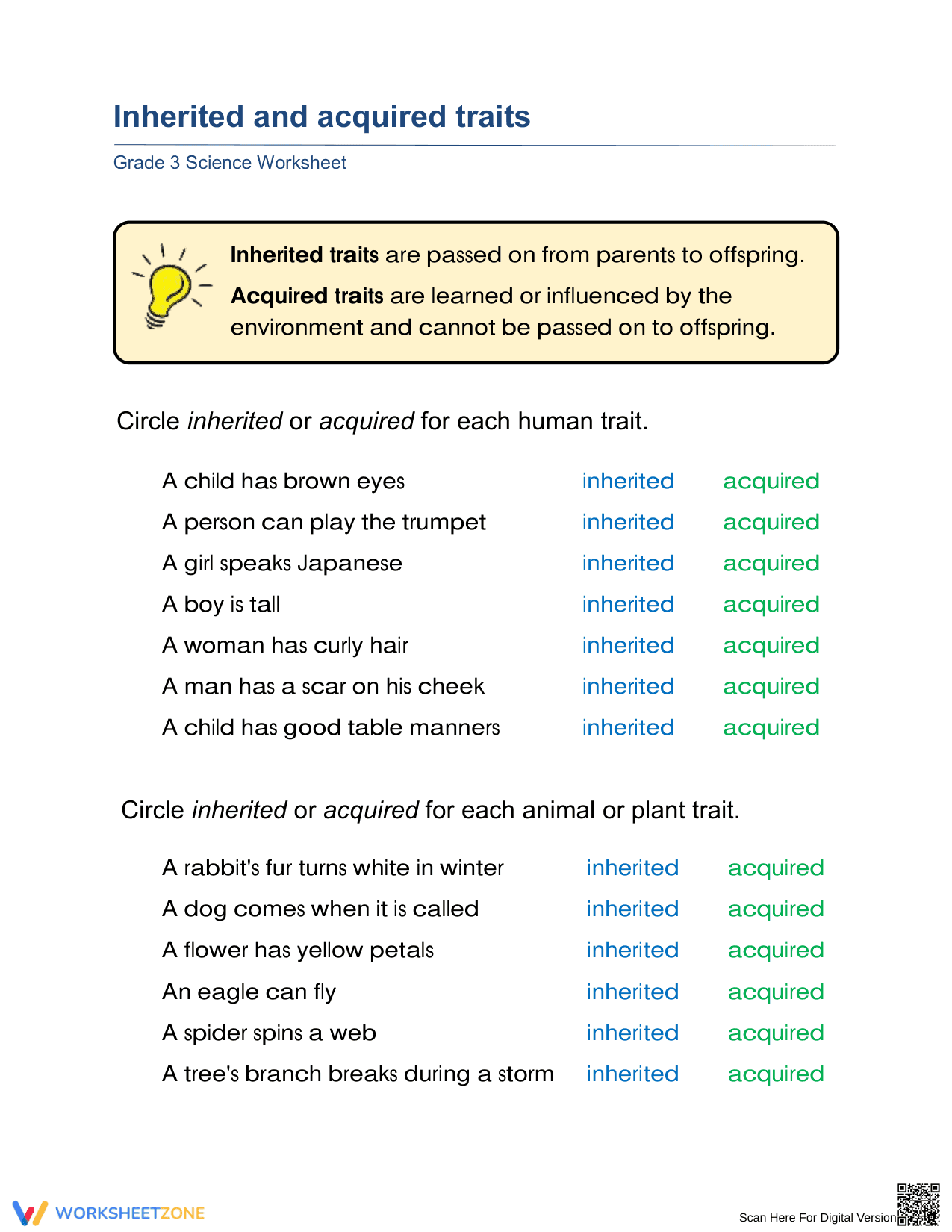
Students master the fundamental distinction between biological inheritance and environmental acquisition through structured classification. This Grade 3 science worksheet provides clear definitions followed by thirteen real-world examples involving humans, animals, and plants. By identifying which traits come from genes and which are learned, learners build a robust foundation for life science mastery.
At a Glance
- Grade: 3 · Subject: Science
- Standard:
3-LS3-1— Analyze evidence that plants and animals have traits inherited from parents- Skill Focus: Inherited vs. Acquired Traits
- Format: 1 page · 13 problems · Answer key included · PDF
- Best For: Independent practice or quick formative assessment
- Time: 15–20 minutes
What's Inside
This focused one-page PDF features a clear, student-friendly reference box defining inherited traits as parental transmissions and acquired traits as environmental influences. The main activity is divided into two logical sections: one focusing on seven human-specific traits like eye color and language, and another covering six animal or plant traits like fur changes and petal colors. The layout utilizes a clean circle-the-answer format to reduce writing friction and focus on cognitive categorization.
Zero-Prep Workflow
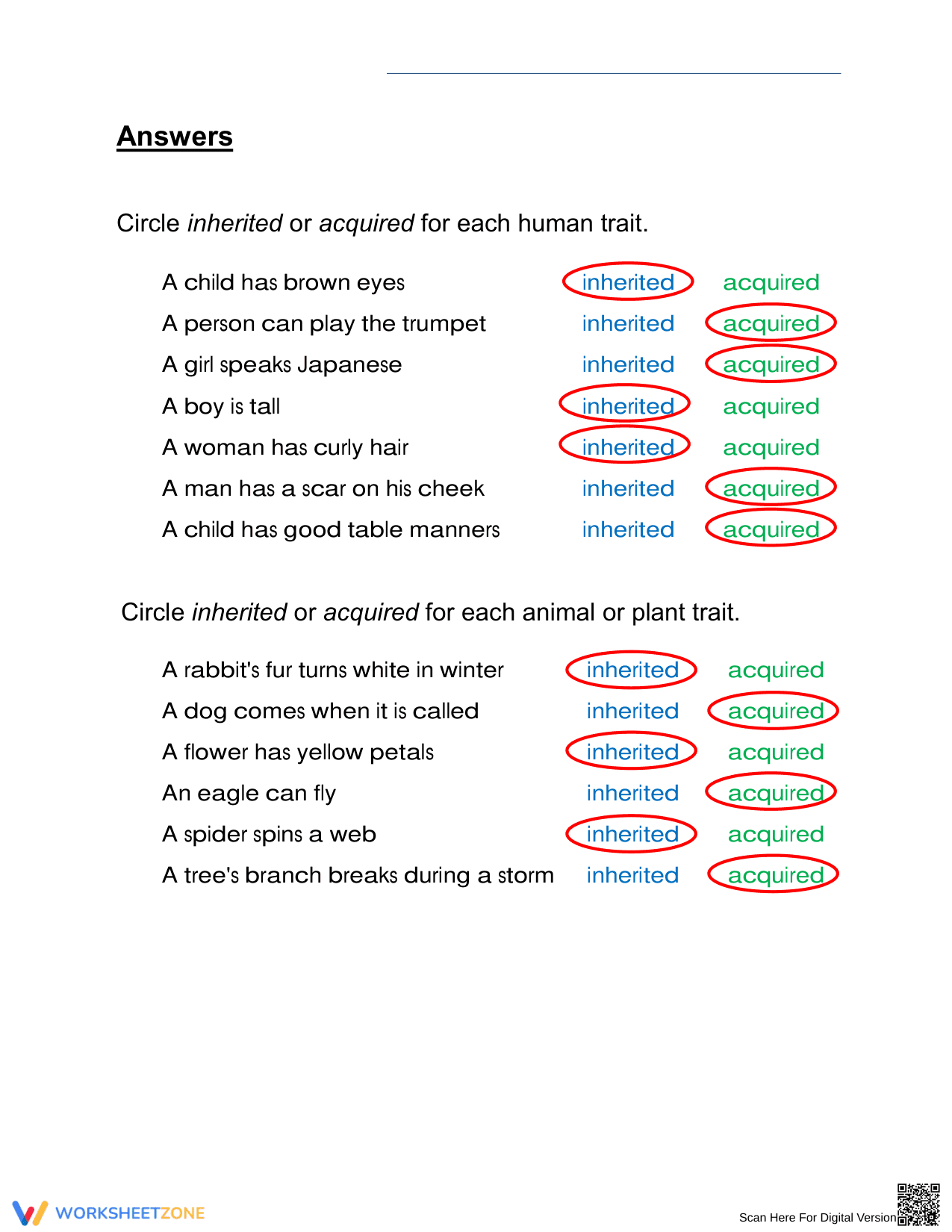
The print-and-go design ensures this resource is classroom-ready in under two minutes. First, print the single-page document for your class. Second, distribute the worksheets—the built-in definitions allow students to begin immediately without a lengthy lecture. Finally, review the answers using the provided key, which takes less than five minutes of instructional time. This efficiency makes it an ideal choice for emergency sub plans or quick lesson transitions.
Standards Alignment
This resource is directly aligned to the Next Generation Science Standard `3-LS3-1`, which requires students to provide evidence that traits are inherited from parents. It also supports 3-LS3-2 by highlighting how acquired traits are influenced by the environment rather than genetics. Both standard codes can be copied directly into lesson plans, IEP goals, or district curriculum mapping tools to ensure compliance with modern science frameworks.
How to Use It
Use this worksheet as a Check for Understanding mid-way through a unit on heredity and life cycles. It serves perfectly as a silent independent practice task following a direct instruction session on the difference between genes and learning. For a formative assessment tip, observe students as they categorize speaking Japanese versus height—this reveals if they understand the difference between cultural acquisition and biological potential. Expected completion takes 15 minutes.
Who It's For
Designed for third-grade classrooms, this activity is accessible to all learners through its simplified vocabulary and clear visual cues. It is particularly effective for English Language Learners (ELLs) who benefit from the concrete examples provided. This resource pairs naturally with a reading passage about animal adaptations or an anchor chart displaying familial traits, reinforcing the concepts across different instructional modes.
The ability to differentiate between genotypic inheritance and phenotypic acquisition is a core cognitive milestone in elementary life science, as emphasized in EdReports 2024 curriculum reviews. This worksheet facilitates this developmental shift by providing thirteen specific instances that require students to apply abstract definitions to concrete biological scenarios. By categorizing traits like eye color against learned skills like playing an instrument, students engage in the evidence-based reasoning required by standard 3-LS3-1. Research from ScienceDirect TpT Analysis indicates that structured classification tasks significantly improve long-term retention of scientific terminology when compared to rote memorization. This Grade 3 resource ensures that students not only define inherited and acquired but can accurately predict trait origins across various organisms. The inclusion of plant and animal examples prevents human-centric bias in biological understanding, fostering a holistic grasp of the mechanisms of trait transmission.


