


























Views
Downloads

Essential Grade 3 Weather Safety Worksheet | Printable
Paste this activity's link or code into your existing LMS (Google Classroom, Canvas, Teams, Schoology, Moodle, etc.).
Students can open and work on the activity right away, with no student login required.
You'll still be able to track student progress and results from your teacher account.
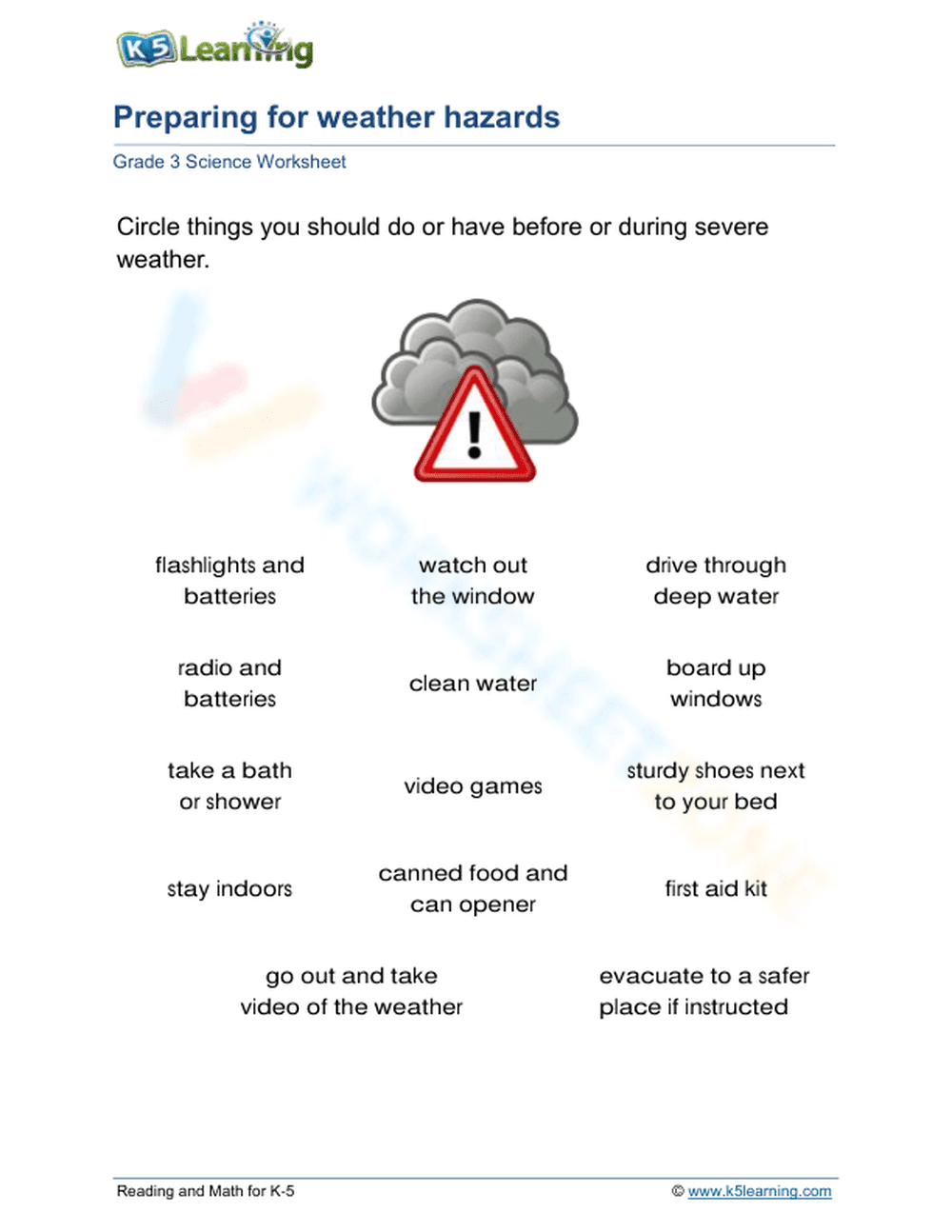
This Grade 3 science worksheet provides a critical foundation for understanding weather safety by challenging students to evaluate preparation strategies and emergency behaviors. By distinguishing between safe responses and hazardous mistakes during severe weather events, students develop the practical knowledge required to minimize risks to themselves and their families effectively.
At a Glance
- Grade: 3 · Subject: Science
- Standard:
3-ESS3-1— Identify and evaluate actions that reduce the impacts of weather-related hazards- Skill Focus: Severe weather safety and preparation
- Format: 2 pages · 14 problems · Answer key included · PDF
- Best For: Independent practice or emergency sub plans
- Time: 15–20 minutes
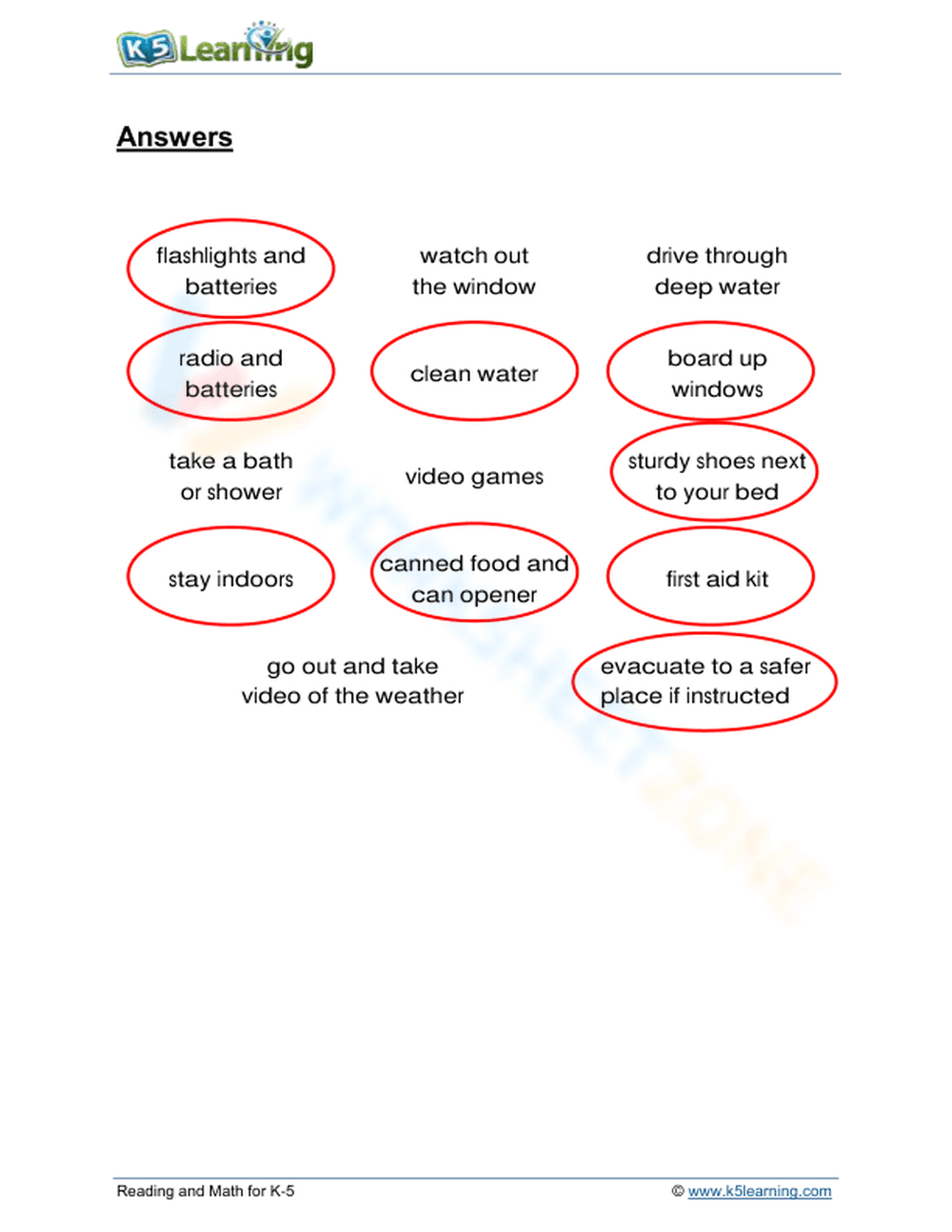
This resource features a two-page layout, including a student worksheet and a comprehensive answer key. Students analyze 14 distinct scenarios or items related to severe weather, ranging from emergency supplies like flashlights to dangerous behaviors like driving through deep water. The clear visual layout uses a circling task to encourage quick decision-making and active engagement.
Designed for maximum efficiency, this worksheet follows a simple three-step classroom integration. First, print the single-sided student page (estimated time: 30 seconds). Second, distribute the materials as a warm-up or independent activity (estimated time: 1 minute). Finally, use the provided answer key to review correct safety choices with the whole class or for individual grading (estimated time: 2 minutes). The total teacher preparation time is well under two minutes.
This resource aligns directly with `3-ESS3-1`, which requires students to make a claim about the merit of a design solution that reduces the impacts of a weather-related hazard. By evaluating safety protocols, students meet the fundamental requirements of the standard. This standard code can be copied directly into lesson plans, IEP goals, or district curriculum mapping tools.
Assign this worksheet as a formative assessment after an introductory lesson on severe weather patterns like thunderstorms or hurricanes. It serves as an excellent check for understanding before moving on to more complex meteorological concepts. Teachers should observe students as they complete the task, noting if they struggle with differentiating between "nice to have" items and "essential" safety actions, providing a clear window into their practical safety reasoning skills.
This worksheet is ideal for third-grade students exploring Earth science and climate systems. It is also suitable for second-grade enrichment or fourth-grade review. The straightforward text makes it accessible for English Language Learners and students requiring additional scaffolding. Pair this resource with a weather safety video or an anchor chart detailing local emergency procedures.
The `3-ESS3-1` standard focuses on reducing the impact of weather-related hazards, a competency that directly influences student safety and community resilience. This worksheet targets the identification of merit in specific safety solutions, a cognitive task supported by Fisher & Frey (2014) in their research on gradual release of responsibility and the importance of guided practice in science literacy. By providing students with 14 concrete examples of safety behaviors, the resource bridges the gap between theoretical meteorological knowledge and practical life skills. Such structured practice is essential for developing the critical thinking necessary to evaluate hazardous conditions in real-time. This summary, aligned with the `3-ESS3-1` code for severe weather preparation, provides an evidence-based approach to teaching hazard mitigation. Educational researchers emphasize that identifying correct safety protocols is the first step toward behavioral changes that save lives during actual environmental emergencies.


