


























Views
Downloads


Essential Letter Gg Tracing Worksheet | Kindergarten ELA
Paste this activity's link or code into your existing LMS (Google Classroom, Canvas, Teams, Schoology, Moodle, etc.).
Students can open and work on the activity right away, with no student login required.
You'll still be able to track student progress and results from your teacher account.
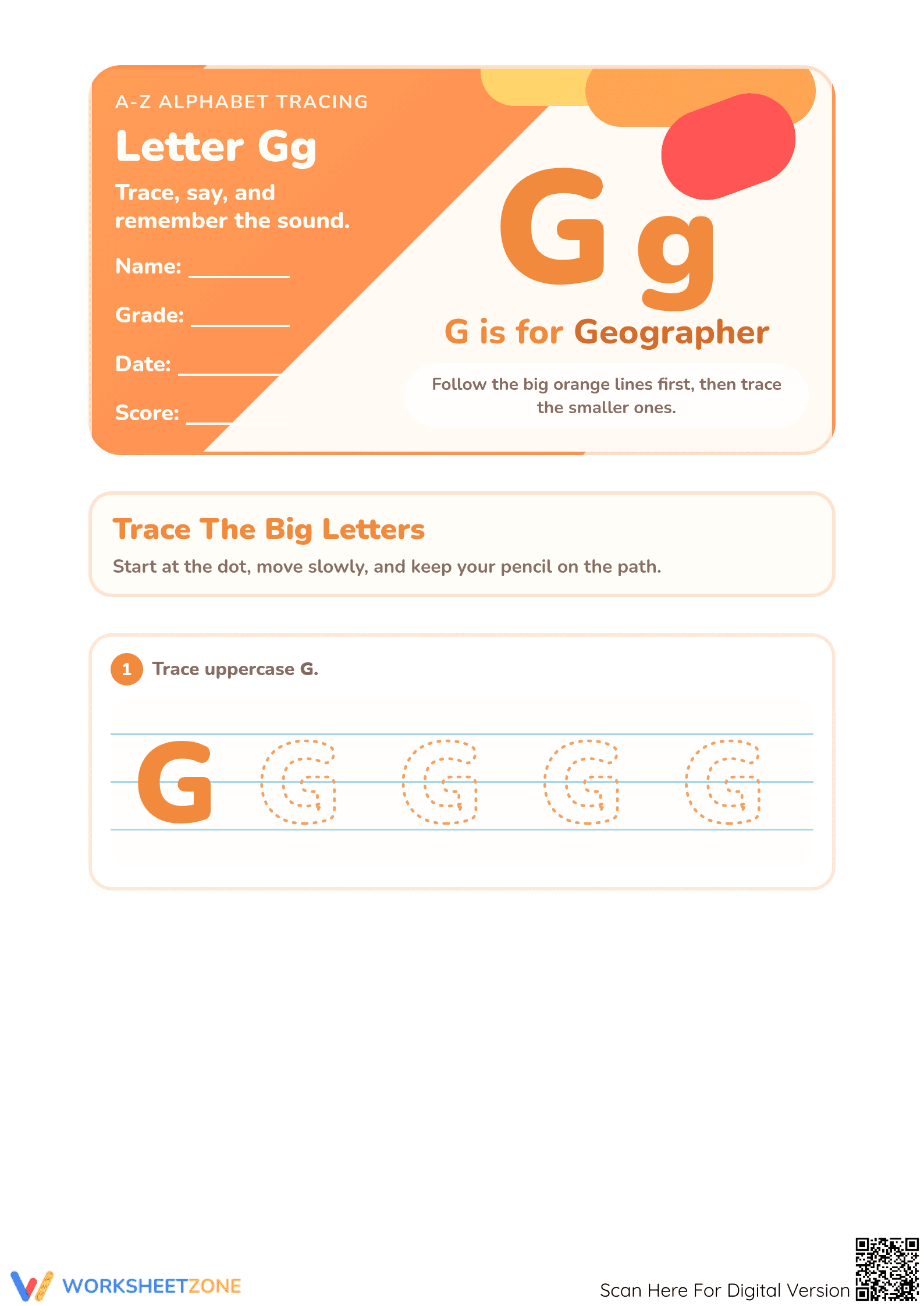
This Kindergarten Letter Gg worksheet provides essential alphabet practice by combining handwriting tracing with phonemic awareness. Students master both uppercase and lowercase forms while expanding their vocabulary through the keyword geographer. By engaging multiple senses—visual tracing, auditory repetition, and physical writing—learners develop the foundational fine motor skills and letter-sound correspondence required for early literacy success.
At a Glance
- Grade: Kindergarten · Subject: English Language Arts
- Standard:
CCSS.ELA-LITERACY.RF.K.1.D— Recognize and name all upper- and lowercase letters of the alphabet- Skill Focus: Letter G recognition and handwriting
- Format: 2 pages · 5 problems · Answer key included · PDF
- Best For: Early morning work and literacy centers
- Time: 15–20 minutes
This comprehensive two-page PDF focuses on the letter G with five structured activities. The first page features large-format uppercase G tracing, while the second page transitions to lowercase g and the full word geographer. It includes phonetic cues, guided paths with directional dots, and a word-circling task to reinforce recognition. A clear answer key is provided to facilitate quick teacher or parent review.
- Guided Practice: Students begin by tracing large uppercase G and lowercase g characters using directional arrows and dotted lines to establish correct stroke order (2 tasks).
- Supported Practice: Learners identify the letter within the complex word geographer, circling the target grapheme to sharpen visual discrimination skills (1 task).
- Independent Practice: The final section requires students to produce the letter sound while reading simple sentences, cementing the link between the visual symbol and its auditory phoneme (2 tasks).
This worksheet utilizes a gradual-release model, moving from high-scaffold tracing to independent phonemic awareness through the I Do, We Do, You Do instructional sequence.
This resource is primarily aligned with CCSS.ELA-LITERACY.RF.K.1.D, which focuses on recognizing and naming all upper- and lowercase letters. Additionally, it supports CCSS.ELA-LITERACY.L.K.1.A by providing specific practice for printing letters. Both standard codes can be copied directly into lesson plans, IEP goals, or district curriculum mapping tools to ensure instructional compliance with state and national requirements.
Use this worksheet during the independent practice phase of a letter-of-the-week lesson to provide tactile reinforcement after direct instruction. It also serves as an effective formative assessment tool; observe students as they trace to identify those struggling with counter-clockwise curves or pencil grip. Expect most students to complete the five tasks within 15 to 20 minutes during literacy centers or as a quiet morning activity.
This worksheet is designed for preschool and kindergarten students beginning their journey with the alphabet. It is particularly helpful for English Language Learners who benefit from the visual pairing of the letter G with the professional term geographer. Pair this resource with a letter G anchor chart or a short reading passage about different jobs to provide a rich, thematic learning experience for young readers.
Effective letter-sound instruction requires a balanced approach that combines handwriting practice with phonemic awareness. Research by Fisher & Frey (2014) emphasizes the importance of the gradual release of responsibility, which this worksheet models by transitioning students from high-scaffold tracing to independent recognition. By utilizing standard CCSS.ELA-LITERACY.RF.K.1.D, this resource ensures that students develop the alphabetic principle—the understanding that letters represent specific sounds in spoken language. The inclusion of the multi-syllabic keyword geographer encourages students to see the letter G in a functional, real-world context rather than in isolation. This structured repetition of both uppercase G and lowercase g forms builds the fine motor muscle memory essential for fluent writing. Educators can use this 5-task sequence to identify specific gaps in letter identification or sound production, making it a valuable asset for RTI frameworks and early literacy benchmarks.


