


























Views
Downloads


Future Perfect Tense Worksheet | Grade 4 Printable
Paste this activity's link or code into your existing LMS (Google Classroom, Canvas, Teams, Schoology, Moodle, etc.).
Students can open and work on the activity right away, with no student login required.
You'll still be able to track student progress and results from your teacher account.
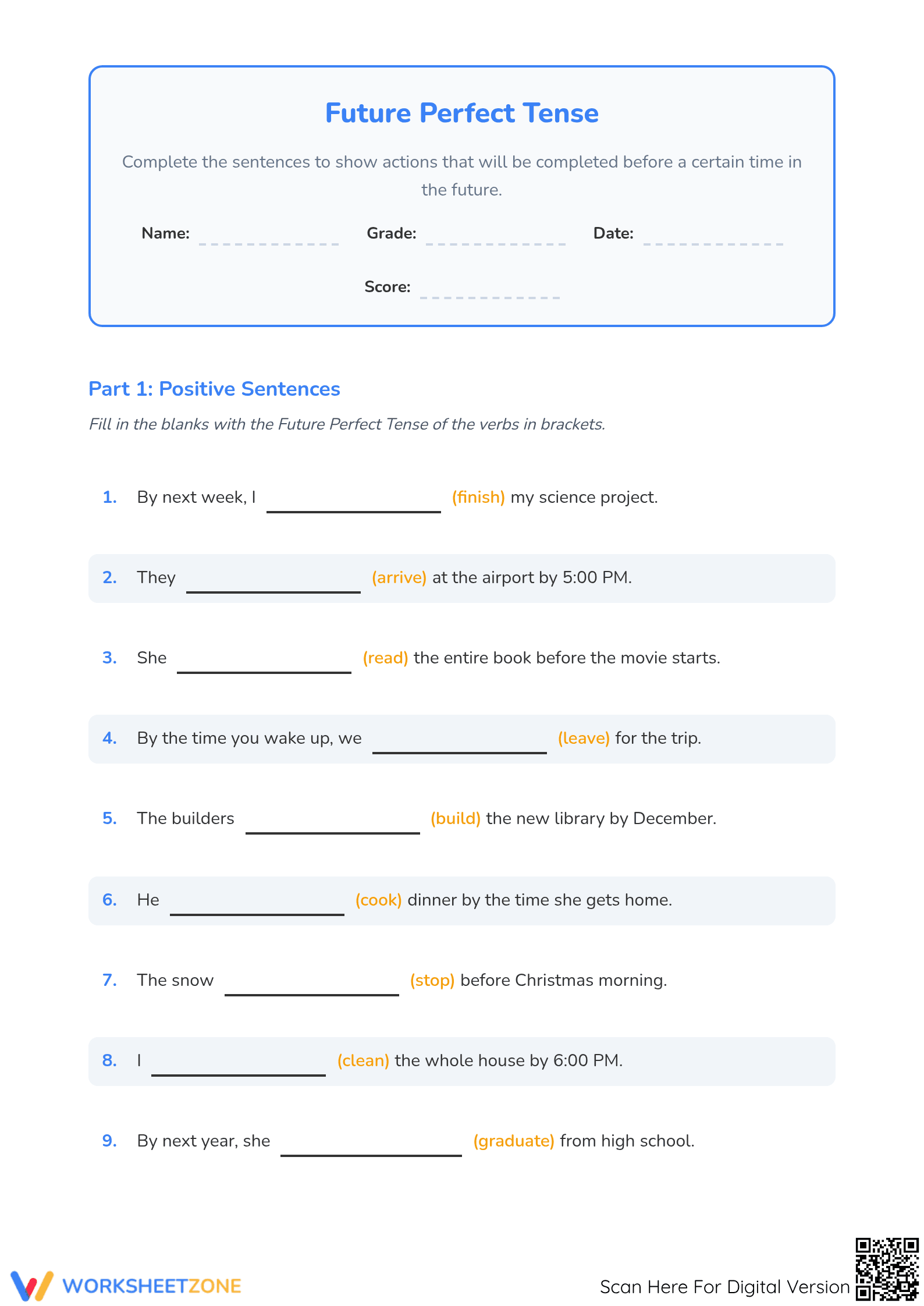
Strengthen your students' grasp of complex grammar with this comprehensive Future Perfect Tense worksheet. This Grade 4 resource provides focused practice on forming and using verbs to describe actions that will be completed by a specific time in the future. Students will master the "will have" construction across multiple sentence structures and contexts.
At a Glance
- Grade: Grade 4 · Subject: English Language Arts
- Standard:
CCSS.ELA-LITERACY.L.5.1.B— Form and use the future perfect verb tense for completed future actions.- Skill Focus: Future Perfect Tense Mastery
- Format: 3 pages · 31 problems · Answer key included · PDF
- Best For: Grammar reinforcement, test prep, or advanced enrichment.
- Time: 20–30 minutes
This three-page PDF is divided into four logical segments to ensure thorough understanding. It includes 10 positive sentence transformations, 8 negative sentence constructions, and 8 interrogative form questions. The final page features a five-blank paragraph for contextual application. A complete answer key is included to facilitate quick grading or student self-check sessions.
- Guided Practice: 10 positive sentences establish the core "will have + past participle" pattern through focused verb transformation exercises.
- Supported Practice: 16 problems introduce negative and question forms, requiring students to manipulate auxiliary verbs and word order for complete mastery.
- Independent Application: A paragraph-based mixed practice tests consistency and tense application within a realistic narrative flow and timeline.
This structure follows the gradual release of responsibility model, ensuring students build confidence before moving to more complex linguistic tasks.
This worksheet is primarily aligned to CCSS.ELA-LITERACY.L.5.1.B, which requires students to form and use the perfect verb tenses. It also supports Grade 4 conventions under CCSS.ELA-LITERACY.L.4.1. Both standard codes can be copied directly into lesson plans, IEP goals, or district curriculum mapping tools.
Use this as a summative assessment after a unit on verb tenses or as a rigorous homework assignment. During direct instruction, teachers can project the first page for a whole-class "I Do, We Do" session. For formative assessment, observe student accuracy on the paragraph section to identify those needing additional scaffolding with irregular past participles.
Designed for Grade 4 students ready for advanced grammar, this resource also serves Grade 5 learners reviewing core perfect tenses. It is ideal for ELA teachers, homeschoolers, and literacy tutors. Pair this with a future tense anchor chart or a short reading passage that utilizes future-oriented timelines for maximum instructional impact.
This resource is designed for the `CCSS.ELA-LITERACY.L.5.1.B` standard, focusing on the construction of the future perfect tense. By engaging with 31 structured problems, students move from sentence completion to contextual paragraph application, a method supported by Fisher & Frey (2014). The worksheet addresses the 'will have + past participle' formula across positive, negative, and interrogative modes. Research from the RAND AIRS 2024 report highlights that standards-aligned grammar materials improve student writing outcomes when integrated with direct instructional feedback. This Grade 4 printable serves as both a primary practice tool and a formative assessment, providing teachers with evidence of a student's ability to express future completed actions. The inclusion of an answer key allows for immediate self-correction, fostering learner autonomy. This combination of structural variety and immediate feedback is essential for developing sophisticated linguistic command in upper elementary students.


