


























Views
Plays

Future Forms Grammar Worksheet | Grade 4 Essential
Paste this activity's link or code into your existing LMS (Google Classroom, Canvas, Teams, Schoology, Moodle, etc.).
Students can open and work on the activity right away, with no student login required.
You'll still be able to track student progress and results from your teacher account.
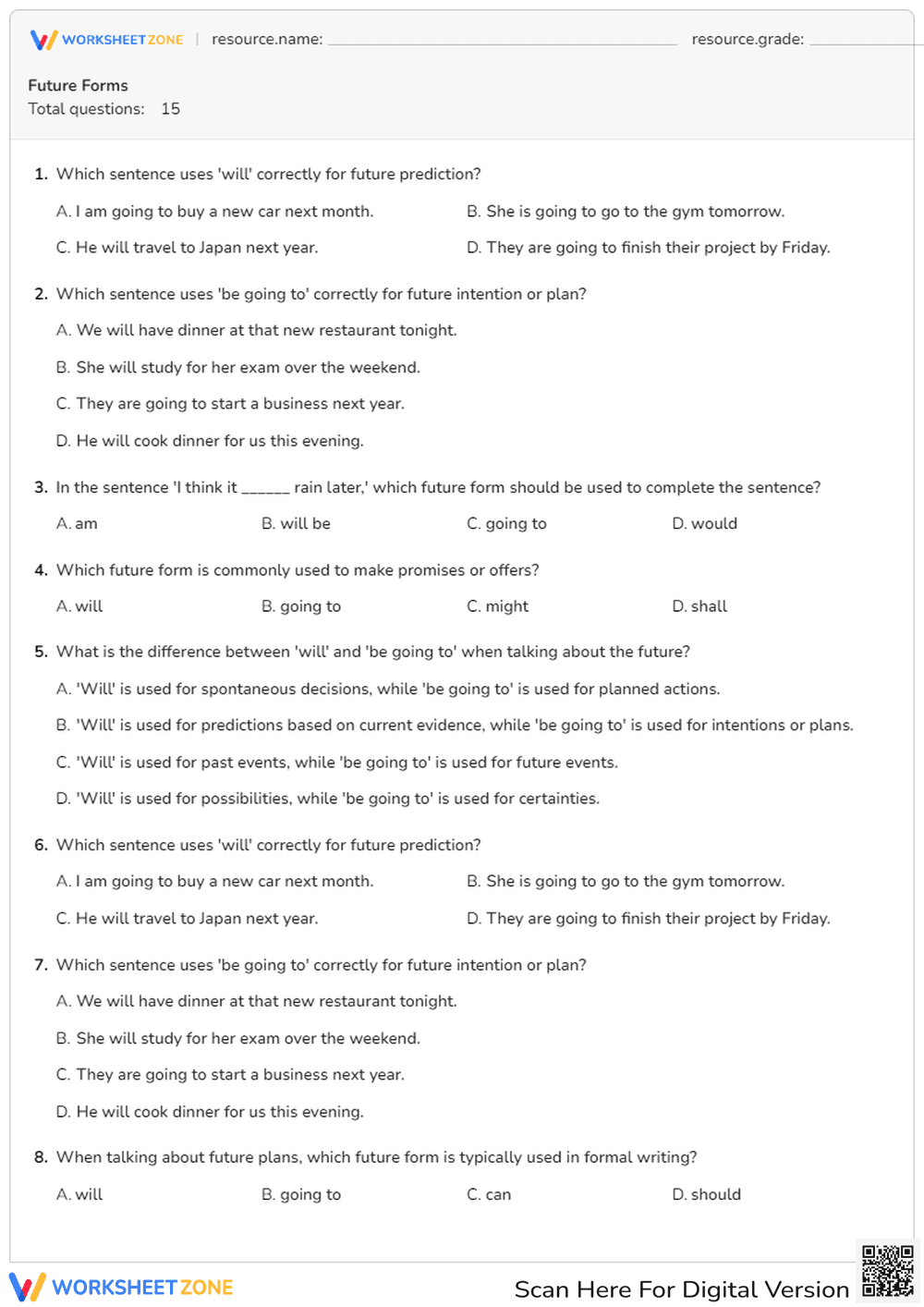
This Grade 4 grammar worksheet helps students master the nuances of future tense construction. By focusing on the functional differences between "will" and "be going to," learners develop the linguistic precision needed for effective communication. Students will identify correct usage for predictions, spontaneous decisions, and planned intentions across various sentence contexts.
At a Glance
- Grade: 4 · Subject: ELA Grammar
- Standard:
CCSS.ELA-LITERACY.L.4.1— Demonstrate command of the conventions of standard English grammar and usage when writing- Skill Focus: Future Tense (Will vs. Be Going To)
- Format: 2 pages · 15 problems · Answer key included · PDF
- Best For: Grammar reinforcement and formative assessment
- Time: 15–20 minutes
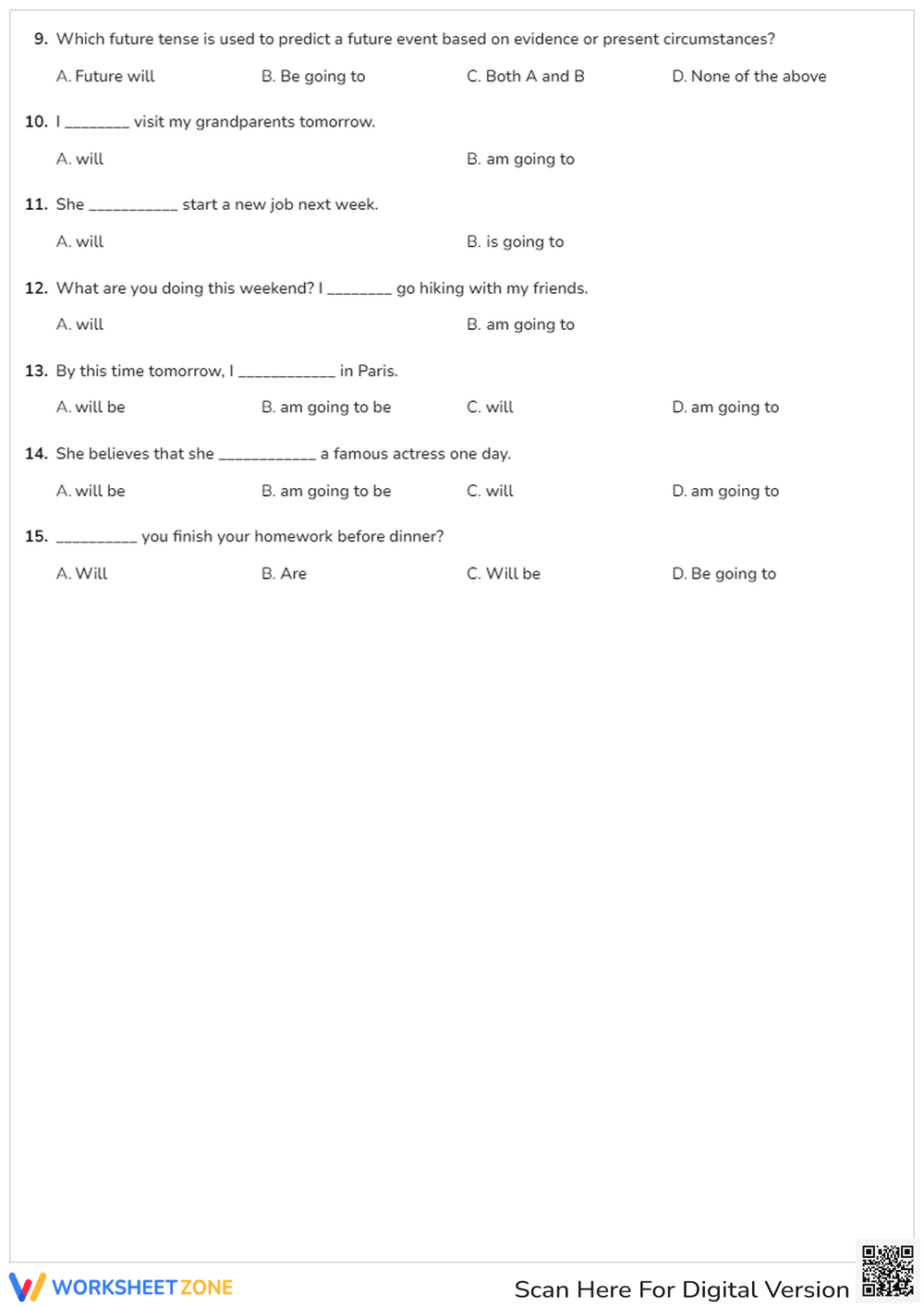
The resource contains 15 multiple-choice questions spread across two clean, distraction-free pages. Each question presents a specific scenario—such as making a promise, predicting the weather, or discussing a business plan—requiring students to select the most appropriate future form. The layout includes space for student names and grades, making it easy to collect and grade.
The worksheet follows a logical skill progression. It begins with conceptual identification, asking students to define the rules for "will" and "be going to" in questions 1 through 5. It then moves to supported application where students choose the correct form based on provided context clues. Finally, the independent practice section requires students to complete sentences without explicit rule reminders, ensuring they have internalized the grammar mechanics through a gradual release of responsibility.
This resource is aligned with `CCSS.ELA-LITERACY.L.4.1`, which requires students to demonstrate command of the conventions of standard English grammar. Specifically, it addresses the sub-skills of using various verb tenses to convey specific meanings and conditions. This standard code can be copied directly into lesson plans, IEP goals, or district curriculum mapping tools.
Use this worksheet as a formative assessment after a direct instruction lesson on future forms. It is particularly effective for identifying students who struggle with the "evidence-based prediction" vs. "spontaneous decision" distinction. Teachers can expect students to complete the 15 items in approximately 20 minutes, allowing for a quick peer-review session immediately following completion to address misconceptions.
This practice set is designed for Grade 3, 4, and 5 students, but it also serves as an excellent resource for English Language Learners (ELL) who often find future tense nuances challenging. It pairs naturally with an anchor chart displaying the "Future Tense Timeline" or a short reading passage where students highlight future-oriented sentences before completing the quiz.
According to the RAND AIRS 2024 report, targeted grammar practice that requires students to distinguish between similar linguistic forms significantly improves writing clarity in upper elementary grades. This worksheet addresses the specific cognitive demand of selecting verb forms based on communicative intent rather than rote memorization. By engaging with 15 distinct scenarios, students build the grammatical intuition necessary for fluency. Research from Fisher & Frey (2014) emphasizes that gradual release through multiple-choice identification serves as a vital bridge toward independent composition. The inclusion of CCSS.ELA-LITERACY.L.4.1 ensures that the practice remains focused on grade-level expectations for standard English usage. Educators can utilize this tool to gather data on student mastery of future forms, facilitating data-driven instruction and targeted interventions for students who require additional support in verb tense consistency.


