


























Views
Downloads

Essential Functional Vocabulary Worksheet | Grade 3-6 ELA
Paste this activity's link or code into your existing LMS (Google Classroom, Canvas, Teams, Schoology, Moodle, etc.).
Students can open and work on the activity right away, with no student login required.
You'll still be able to track student progress and results from your teacher account.
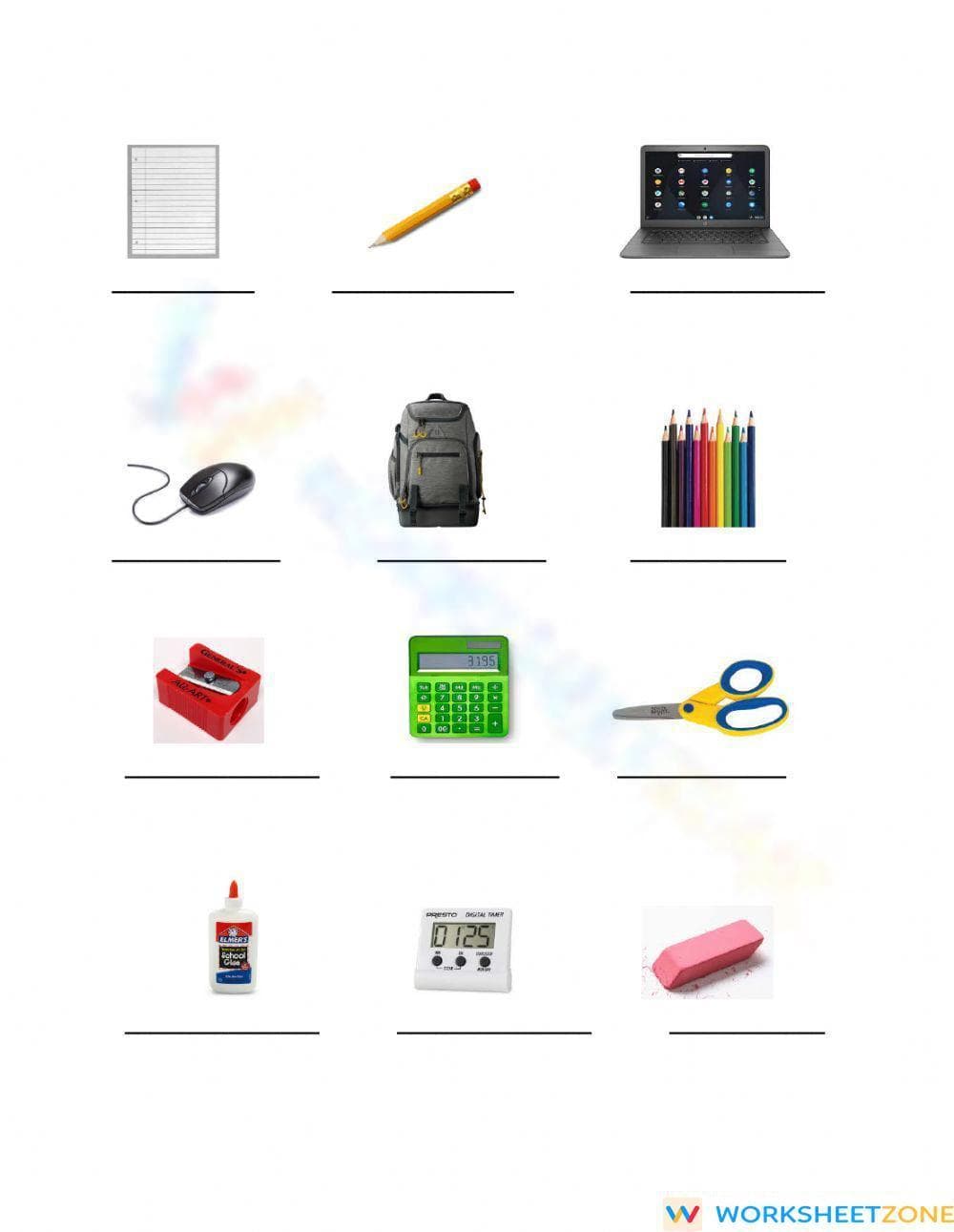
This functional vocabulary worksheet helps students identify and spell 12 common classroom items using clear visual prompts. By connecting real-world objects to their written forms, learners strengthen expressive language and orthographic processing. It provides a straightforward assessment of life skills vocabulary essential for daily communication in inclusive settings.
At a Glance
- Grade: 3-6 · Subject: English Language Arts
- Standard:
CCSS.ELA-LITERACY.L.3.6— Acquire and use accurately grade-appropriate conversational, general academic, and domain-specific words- Skill Focus: Functional Vocabulary & Spelling
- Format: 1 page · 12 problems · Answer key included · PDF
- Best For: Special Education and English Language Learners
- Time: 15–20 minutes
What's Inside
The worksheet features an uncluttered layout containing 12 clear photographs of familiar school supplies. Each image, such as a laptop, calculator, or pair of scissors, is paired with a dedicated writing line for student responses. This one-page PDF includes a comprehensive answer key to facilitate quick grading, making it an efficient tool for both teachers and speech-language pathologists.
Zero-Prep Workflow
This resource is designed for immediate implementation with three simple steps. First, print the single-page PDF (30 seconds). Second, distribute the sheets to your class (30 seconds); the intuitive visual design requires no lengthy explanation. Third, review student responses using the included key (1 minute). The total teacher preparation time is under 2 minutes, making this an ideal selection for emergency sub plans or quick morning work transitions.
Standards Alignment
The primary focus is `CCSS.ELA-LITERACY.L.3.6`, which requires students to "acquire and use accurately grade-appropriate conversational, general academic, and domain-specific words." By identifying objects like a "digital timer" or "mechanical mouse," the activity builds precise vocabulary for modern learning environments. This standard code can be copied directly into lesson plans, IEP goals, or curriculum mapping tools.
How to Use It
Use this as a formative assessment in life skills units or as a warm-up for English Language Learners. Observe whether students identify objects orally but struggle with spelling to provide data for future instruction. The expected completion time is 15 to 20 minutes, depending on the student's writing speed and familiarity with the items.
Who It's For
This is for students in Grades 3-6 requiring support in functional language, particularly in Special Education or ESL programs. It supports IEP goals focused on labeling common objects and improving functional literacy. Naturally pair this with a classroom scavenger hunt where students find the items pictured before completing the writing task.
Research from Fisher & Frey (2014) emphasizes that vocabulary acquisition is effective when students engage with multiple modalities, combining visual recognition with orthographic practice. This worksheet applies these principles by requiring students to decode 12 distinct images and encode the corresponding names on the page. By focusing on `CCSS.ELA-LITERACY.L.3.6`, the resource ensures learners master the functional vocabulary necessary for independence in both school and community settings. The RAND AIRS 2024 report indicates high-quality visual supports are critical for reducing cognitive load in students with diverse learning needs, allowing them to focus on spelling accuracy. This focused practice on everyday items provides a scalable solution for teachers looking to integrate life skills into the ELA curriculum without extensive preparation or teacher setup.


