




























Views
Downloads

Printable Sink or Float Science Worksheet | Grade 1 Ready

Paste this activity's link or code into your existing LMS (Google Classroom, Canvas, Teams, Schoology, Moodle, etc.).
Students can open and work on the activity right away, with no student login required.
You'll still be able to track student progress and results from your teacher account.
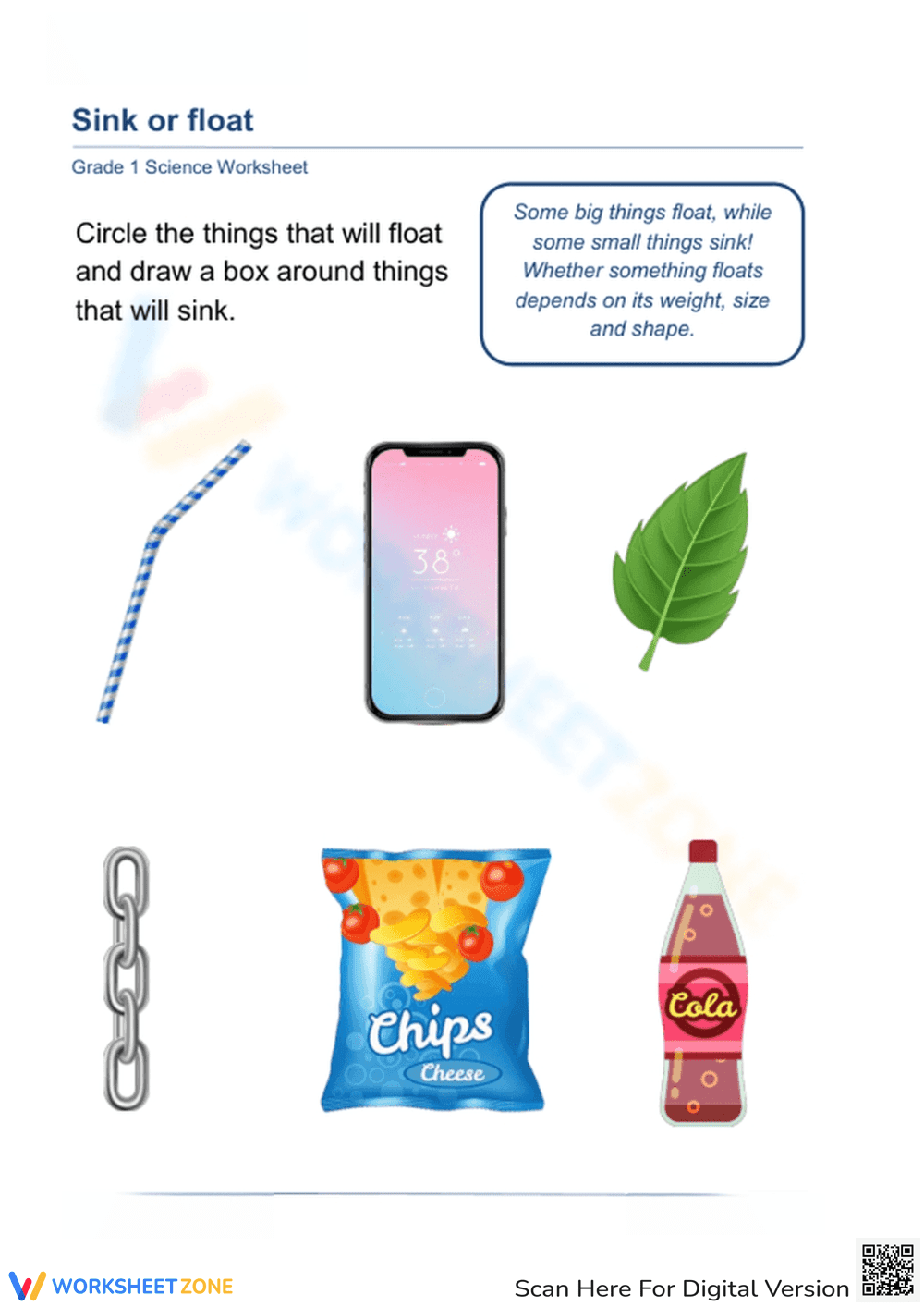
This Grade 1 sink or float science worksheet helps young learners identify physical properties through interactive categorization. By predicting and analyzing how objects like leaves and metal chains behave in water, students build a foundational understanding of buoyancy. This resource focuses on student outcomes, ensuring they can classify materials based on observable characteristics.
At a Glance
- Grade: 1 · Subject: Science
- Standard:
2-PS1-1— Classify different kinds of materials by their observable properties like weight and buoyancy- Skill Focus: Buoyancy and Density
- Format: 1 page · 6 problems · Answer key included · PDF
- Best For: Early physical science property labs
- Time: 10–15 minutes
This focused one-page resource features six high-quality illustrations of common household items, including a straw, smartphone, leaf, chain, chips, and a soda bottle. Students are tasked with circling items that float and boxing those that sink. The clear layout includes a brief informational callout explaining that buoyancy depends on weight, size, and shape, providing immediate context for the activity.
Zero-Prep Workflow
- Step 1: Print. Print the single-page PDF for your entire class in 30 seconds.
- Step 2: Distribute. Use for morning work or a water table rotation.
- Step 3: Review. Use the included answer key to verify predictions in 1 minute.
The total teacher preparation time for this activity is approximately 90 seconds, making it an ideal choice for emergency sub plans or last-minute science centers.
Standards Alignment
Aligned to 2-PS1-1, students will plan and conduct an investigation to describe and classify different kinds of materials by their observable properties. This worksheet specifically addresses the property of buoyancy. Both standard codes can be copied directly into lesson plans, IEP goals, or district curriculum mapping tools.
How to Use It
Use this worksheet as a "pre-lab" prediction sheet before conducting a live science experiment in the classroom. Observe if students associate weight with sinking; this provides a formative-assessment moment to discuss why big things sometimes float. It can be completed individually or in small groups in about 15 minutes.
Who It's For
This resource is designed for first-grade students and ESL learners who benefit from visual-heavy assignments. It can be easily differentiated by providing a small tub of water and the actual items for students who need tactile support. It pairs naturally with an anchor chart about physical properties of matter.
Buoyancy is a critical gateway concept in early physical science, serving as a primary vehicle for students to engage with the observable properties of matter. According to RAND AIRS 2024, visual categorization tasks in primary science significantly improve retention of vocabulary related to material properties when paired with direct observation. This Grade 1 science worksheet utilizes the 2-PS1-1 standard to help students distinguish between sinking and floating based on weight, size, and shape. By engaging with 6 distinct tasks, learners develop the predictive skills necessary for higher-order scientific inquiry. The structured format reduces cognitive load, allowing students to focus on the core concept of buoyancy without the distraction of complex text. This instructional design ensures that science mastery is accessible to all learners, regardless of reading level, while providing teachers with a reliable, research-backed tool for assessment and reinforcement.


