


























Views
Downloads


Essential Math Riddles Worksheet | Grade 3-5 Logic
Paste this activity's link or code into your existing LMS (Google Classroom, Canvas, Teams, Schoology, Moodle, etc.).
Students can open and work on the activity right away, with no student login required.
You'll still be able to track student progress and results from your teacher account.
This Grade 3-5 math riddles worksheet challenges students to apply critical thinking and numerical reasoning to solve 15 unique brain teasers. By engaging with word-based math problems, learners strengthen their ability to interpret language-based quantitative data and identify underlying mathematical patterns. It provides a fun yet rigorous way to reinforce core arithmetic and logic skills.
At a Glance
- Grade: 3-5 · Subject: Math
- Standard:
CCSS.MATH.CONTENT.4.OA.C.5— Generate a number or shape pattern that follows a given rule- Skill Focus: Logic and Problem Solving
- Format: 4 pages · 15 problems · Answer key included · PDF
- Best For: Morning work or early finishers
- Time: 20–30 minutes
What's Inside
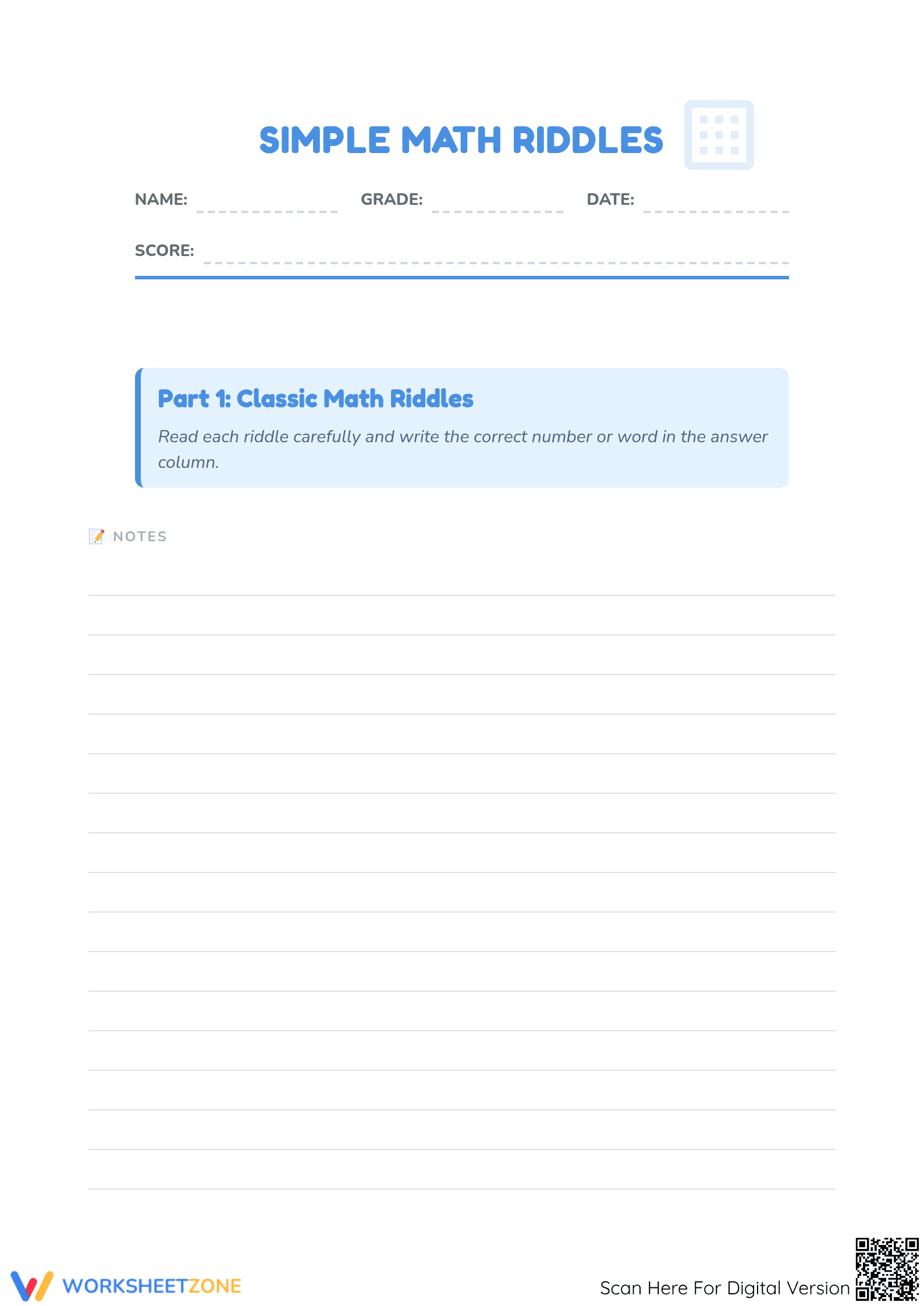
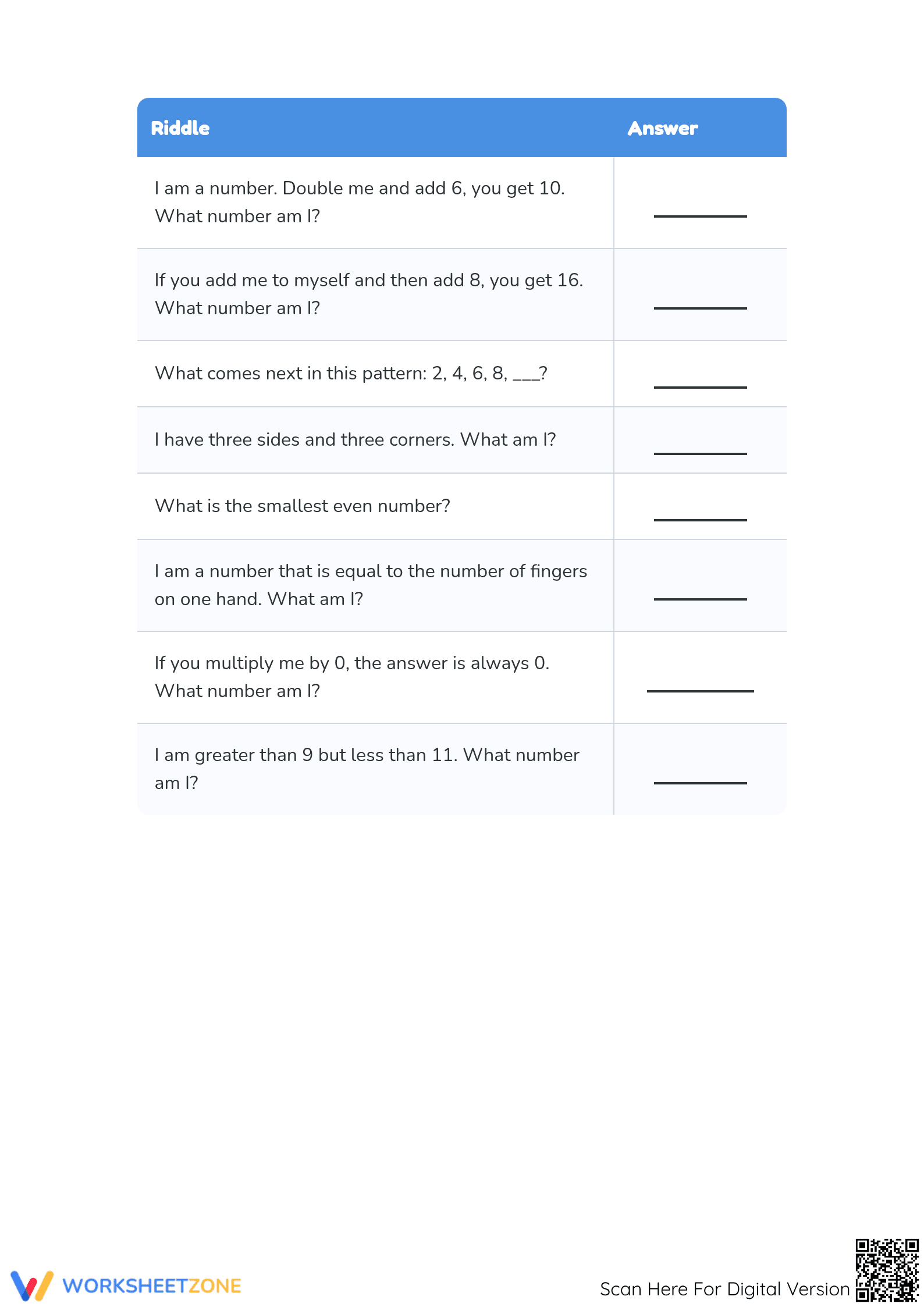
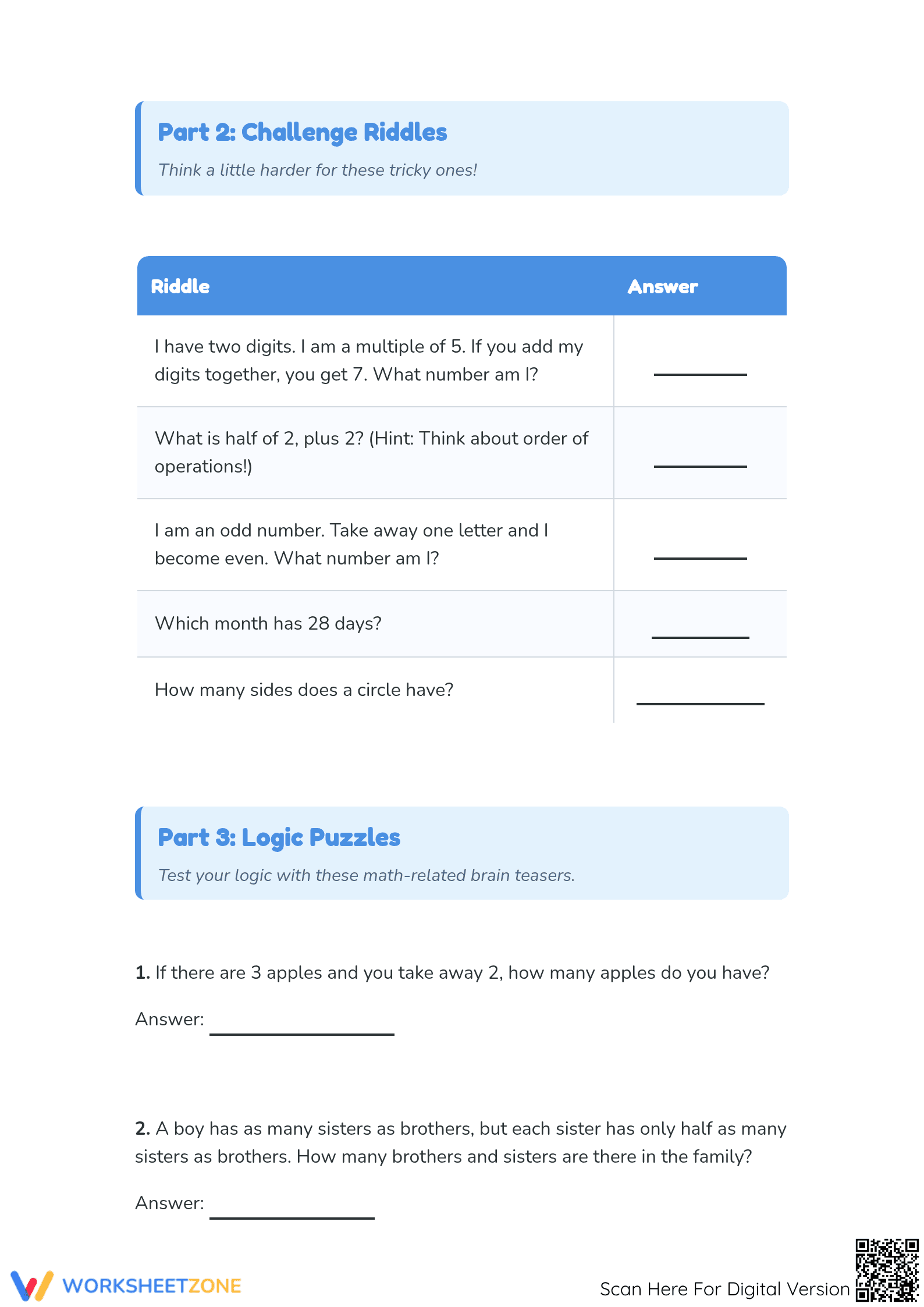
The packet contains four comprehensive pages designed for immediate classroom use. It features three distinct sections: Classic Math Riddles, Challenge Riddles, and Logic Puzzles. The layout includes a dedicated notes area for student scratch work and a clear answer column for easy grading. A full four-page answer key is provided to ensure quick feedback and self-correction opportunities.
Zero-Prep Workflow
- Print: Select the four-page PDF and print enough copies for your group (30 seconds).
- Distribute: Hand out the worksheets as a warm-up or transition activity (1 minute).
- Review: Use the provided answer key to check work or facilitate a class discussion (5 minutes).
Total teacher preparation time is under two minutes, making this an ideal emergency sub plan or last-minute enrichment activity.
Standards Alignment
The primary focus is CCSS.MATH.CONTENT.4.OA.C.5, which requires students to generate and analyze patterns. By solving riddles that involve doubling, sequence identification, and geometric properties, students demonstrate mastery of rule-based mathematical thinking. This worksheet also supports MP1 by encouraging students to persevere through complex word problems.
How to Use It
Use this worksheet as a warm-up to activate prior knowledge. Alternatively, assign it to early finishers to gauge their ability to apply math concepts in non-traditional contexts. Observe if students use the notes section to model the riddles. Expect completion in 20 to 30 minutes.
Who It's For
This resource is for students in grades 3-5 bridging the gap between calculation and application. It is effective for gifted students or English Language Learners who benefit from contextual clues. Pair this with a logic-based anchor chart.
Research by Fisher & Frey (2014) emphasizes the importance of "productive struggle" in the mathematics classroom, noting that non-routine problems like riddles help students develop the cognitive flexibility required for higher-order thinking. This worksheet aligns with CCSS.MATH.CONTENT.4.OA.C.5 by requiring students to identify and extend patterns through logical deduction rather than simple computation. According to the NAEP framework, students who engage in regular problem-solving activities that require interpreting text-based math scenarios show significantly higher proficiency in mathematical reasoning. By integrating 15 diverse tasks, this resource ensures that learners are not just calculating but are actively analyzing the relationships between numbers and operations. The inclusion of a full answer key supports immediate feedback, a critical component of the gradual release of responsibility model. This structured approach to logic puzzles provides a scalable way to implement rigorous standards-based practice in any Grade 3-5 classroom environment.


