


























Views
Downloads



Essential Kindergarten Math Activities | Printable Worksheet
Paste this activity's link or code into your existing LMS (Google Classroom, Canvas, Teams, Schoology, Moodle, etc.).
Students can open and work on the activity right away, with no student login required.
You'll still be able to track student progress and results from your teacher account.
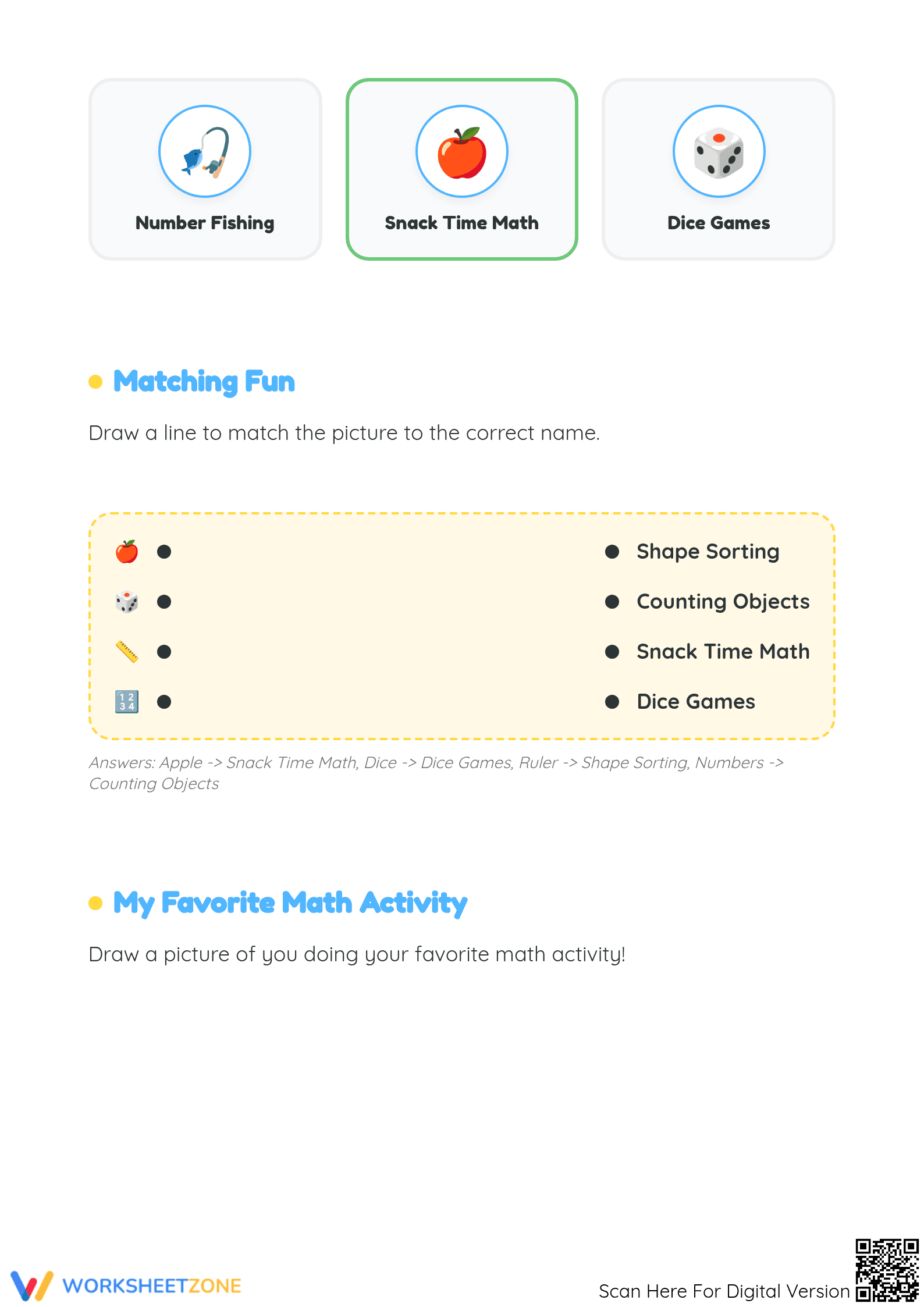
This Kindergarten math worksheet provides a comprehensive introduction to early numeracy and geometry through engaging, hands-on activity suggestions and structured matching tasks. Students will identify shapes and count objects to build a strong foundation for mathematical reasoning. By connecting abstract numbers to physical objects, learners develop the essential one-to-one correspondence skills required for elementary success.
At a Glance
- Grade: Kindergarten · Subject: Math
- Standard:
CCSS.MATH.CONTENT.K.CC.B.4— Understand the relationship between numbers and quantities; connect counting to cardinality.- Skill Focus: Counting and Shape Identification
- Format: 3 pages · 5 problems · Answer key included · PDF
- Best For: Early morning work or math centers
- Time: 15–20 minutes
The resource consists of three high-quality pages designed for young learners. Page one introduces nine distinct math activity concepts, such as "Number Fishing" and "Snack Time Math," which serve as excellent prompts for classroom centers. Page two features a structured matching task where students connect icons to their corresponding math categories, followed by a creative drawing prompt. Page three provides a dedicated space for student illustrations, ensuring a multi-sensory learning experience.
The zero-prep workflow is designed for maximum efficiency in busy classrooms. First, print the PDF, which takes approximately 30 seconds. Second, distribute the matching and drawing pages to students during transition periods or as they arrive in the morning. Third, review the work using the integrated answer key on page two to quickly verify student matching accuracy. This resource requires less than two minutes of total teacher preparation, making it an ideal choice for emergency sub plans or unexpected schedule changes.
This worksheet is primarily aligned with `CCSS.MATH.CONTENT.K.CC.B.4`, which focuses on understanding the relationship between numbers and quantities. It also supports geometry standards by encouraging students to describe objects in the environment using names of shapes. Both standard codes can be copied directly into lesson plans, IEP goals, or district curriculum mapping tools.
Use this worksheet as a formative assessment after introducing basic shapes and numbers 1-10. During the matching activity, observe if students can recognize the visual cues of a die or a ruler to categorize the math skill correctly. This resource works best during the independent practice phase of a lesson or as a quiet-time activity following a high-energy math song. Completion typically takes 15 to 20 minutes depending on the student's fine motor skills.
This resource is tailored for Kindergarten students and advanced preschoolers who are beginning to explore formal math concepts. It is particularly effective for visual learners who benefit from icon-based instruction. Pair this worksheet with physical manipulatives like counting bears or geometric blocks to provide a concrete bridge to the abstract tasks presented on the page.
According to the RAND AIRS 2024 report on early childhood education, integrating multi-sensory activities—such as drawing and matching—significantly improves retention of mathematical vocabulary in Kindergarten learners. This worksheet addresses the core requirement of CCSS.MATH.CONTENT.K.CC.B.4 by asking students to connect visual representations of quantity to specific mathematical tasks. Research from Fisher & Frey (2014) emphasizes that providing students with a choice in how they represent their learning, such as the drawing prompt included here, fosters greater engagement and ownership of the subject matter. By combining structured practice with creative expression, this resource ensures that students meet foundational benchmarks while maintaining a positive attitude toward math. The inclusion of an answer key and clear instructional prompts allows for immediate feedback, which is a critical component of effective formative assessment in early elementary settings.


