


























Views
Downloads
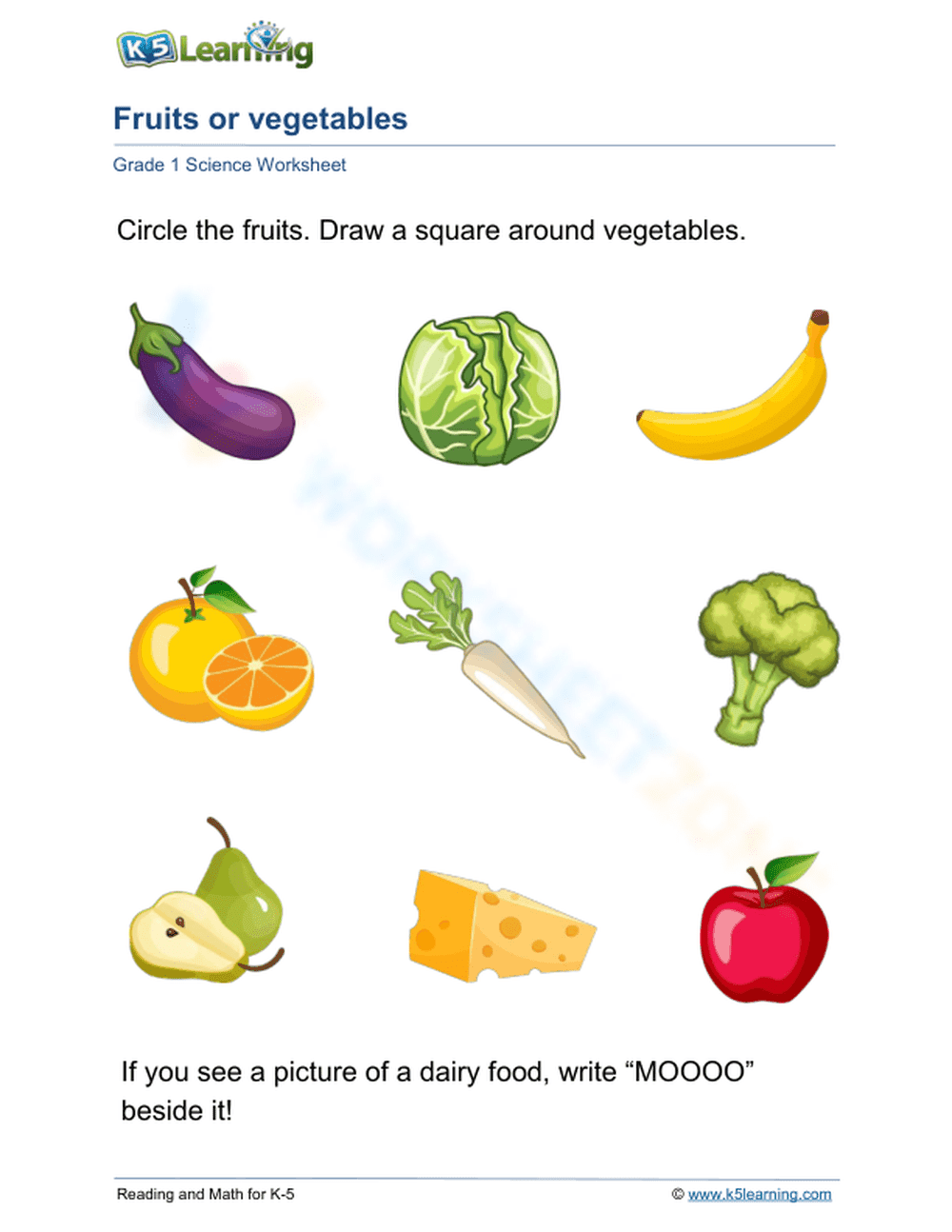

Fruits or Vegetables Worksheet | Essential Grade 1 Science
Paste this activity's link or code into your existing LMS (Google Classroom, Canvas, Teams, Schoology, Moodle, etc.).
Students can open and work on the activity right away, with no student login required.
You'll still be able to track student progress and results from your teacher account.
This Grade 1 Fruits or Vegetables worksheet helps young learners master the essential science skill of classification through visual identification. Students categorize common produce items into groups while identifying a surprise dairy element, fostering critical observation and grouping skills. It provides a direct path for students to distinguish between different food groups effectively and independently.
At a Glance
- Grade: 1 · Subject: Science
- Standard:
L.1.5.A— Sort objects into categories to build conceptual understanding- Skill Focus: Food group classification
- Format: 1 page · 9 problems · Answer key included · PDF
- Best For: Early finishers or quick science review
- Time: 10–15 minutes
What's Inside
This single-page PDF features nine clear, high-quality illustrations of common foods, including bananas, oranges, broccoli, and cheese. Students are tasked with circling fruits, drawing squares around vegetables, and labeling dairy items with a fun "MOOOO" tag. The layout is clean and uncluttered, including an answer key for rapid verification, making it an ideal choice for independent desk work.
Zero-Prep Workflow
- Print (30 seconds): Simply open the PDF and hit print for the desired number of copies.
- Distribute (1 minute): Hand out worksheets with crayons or pencils; the instructions are simple enough for independent reading.
- Review (30 seconds): Use the included answer key to check student work or display it for self-correction. Total teacher preparation time is well under two minutes, making this an excellent choice for unexpected sub-plans.
Standards Alignment
This resource is aligned to `CCSS.ELA-LITERACY.L.1.5.A` which requires students to sort objects and words into categories to build conceptual understanding. It also touches upon basic Life Science observational patterns found in NGSS `1-LS1-1`. Both standard codes can be copied directly into lesson plans, IEP goals, or district curriculum mapping tools.
How to Use It
Assign this worksheet as a formative assessment during a unit on healthy eating or plant parts to gauge student understanding of food origins. A great observation tip is to watch for students who hesitate on the eggplant or radish, as these often prompt discussions about botanical vs. culinary classifications. Expect completion within 10 to 15 minutes.
Who It's For
Designed for first-grade students, this worksheet is also suitable for kindergarten enrichment or second-grade remediation. It pairs naturally with a healthy plate anchor chart or a direct instruction lesson on the five food groups. The visual nature makes it highly accessible for English Language Learners and students with varied reading levels.
Classifying biological specimens and food groups into discrete categories is a foundational cognitive task that builds the schema necessary for advanced scientific inquiry. According to EdReports 2024, high-quality instructional materials that emphasize sorting and categorization help students develop organizational mental models that persist throughout their academic careers. This worksheet focuses on the L.1.5.A standard, requiring students to sort items like fruits, vegetables, and dairy into logical groups. By engaging with these nine structured problems, learners practice the essential skill of identifying defining attributes of living things and their products. This systematic approach to grouping provides a scaffolded entry point into the life sciences. Research from NAEP indicates that early exposure to classification tasks significantly correlates with later proficiency in complex data analysis and taxonomy. This resource offers a focused, classroom-ready solution for reinforcing these vital early childhood developmental milestones through independent practice.


