


























Views
Downloads

Plant Life Cycle Worksheet | Essential Grade 3 Science
Paste this activity's link or code into your existing LMS (Google Classroom, Canvas, Teams, Schoology, Moodle, etc.).
Students can open and work on the activity right away, with no student login required.
You'll still be able to track student progress and results from your teacher account.
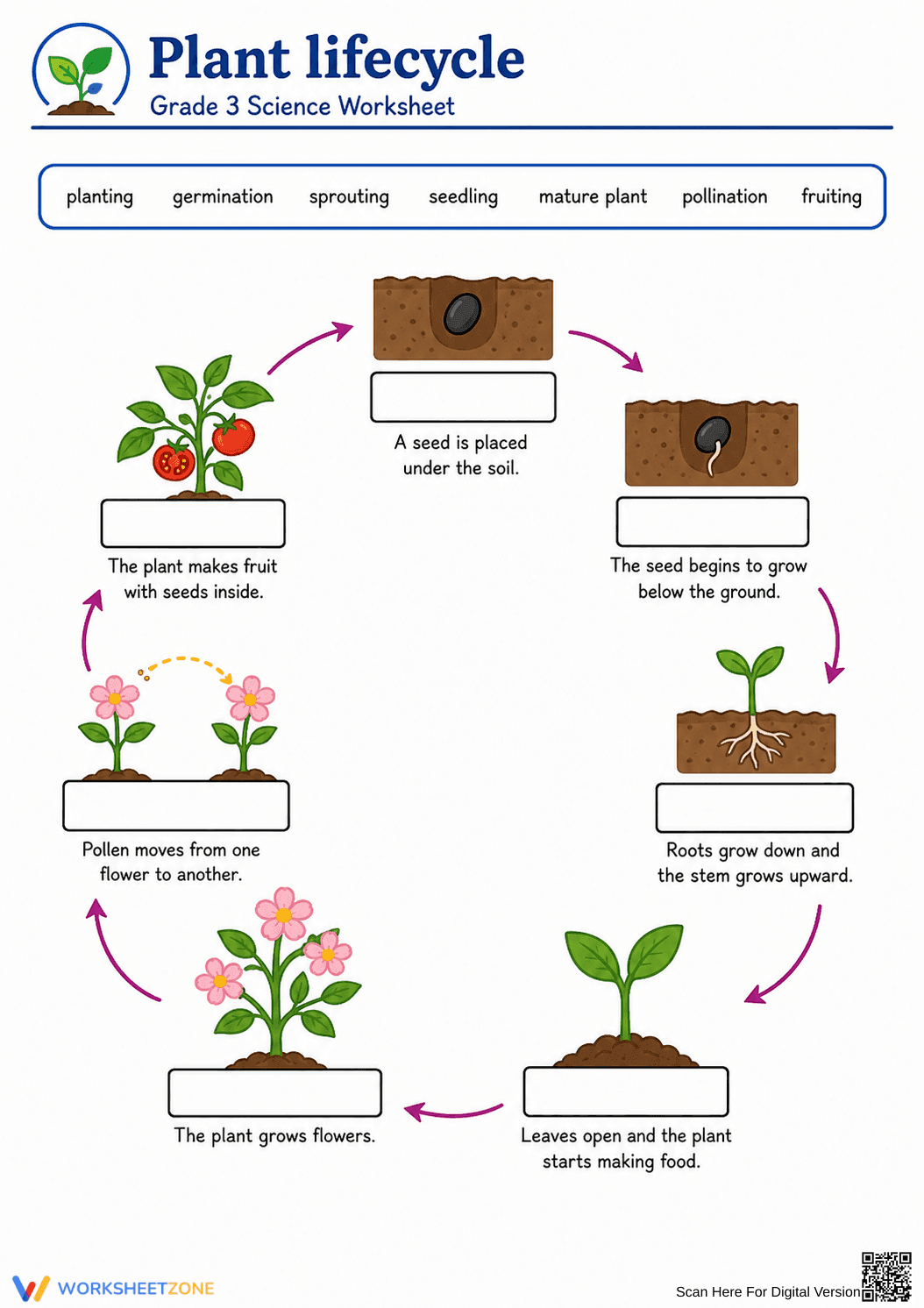
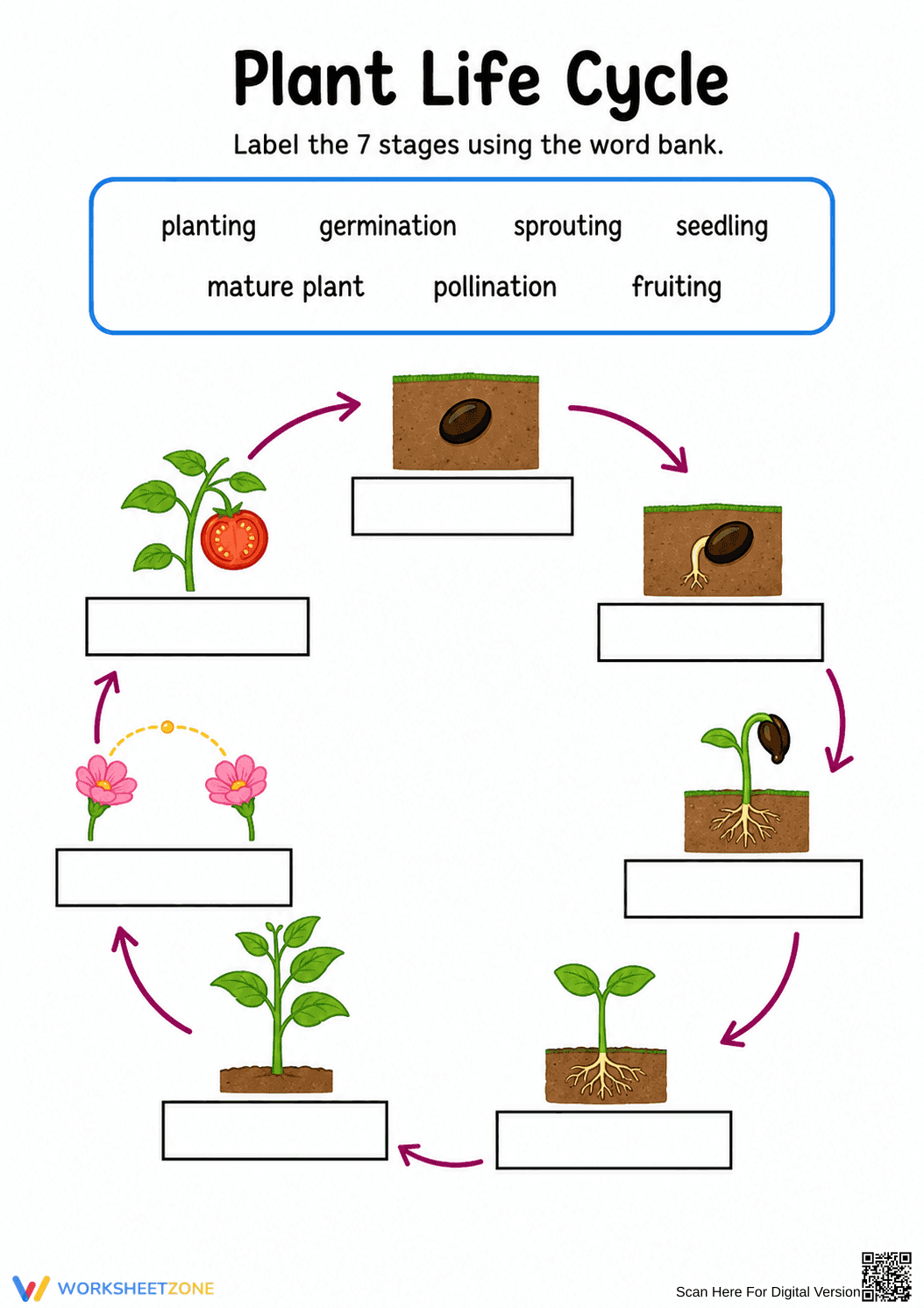
This Grade 3 plant lifecycle worksheet helps students master chronological stages of botanical growth from germination to seed production. By labeling 7 distinct phases, learners develop a concrete understanding of how living things transform. It is an essential tool for building foundational biological knowledge through visual identification and vocabulary reinforcement.
At a Glance
- Grade: 3 · Subject: Living Things · Science
- Standard:
3-LS1-1— Develop models to describe that organisms have unique and diverse life cycles- Skill Focus: Plant life cycle stages and biological sequencing
- Format: 2 pages · 7 labeling problems · Answer key included · PDF
- Best For: Independent classroom practice or quick formative assessment
- Time: 15–20 minutes
What's Inside
This resource contains a single-page student worksheet featuring a circular flow diagram with 7 empty labels. A word bank is provided at the top, containing key scientific terms: planting, germination, sprouting, seedling, mature plant, pollination, and fruiting. A comprehensive answer key is included on the second page for rapid grading or student self-correction.
Zero-Prep Workflow
This resource is designed for immediate classroom implementation with a three-step workflow. Teachers can print the PDF in under 1 minute, distribute the copies to students for a 15-minute independent session, and review the results using the provided key in less than 2 minutes. Its clear layout makes it an ideal choice for emergency sub plans or quick science center rotations.
Standards Alignment
The primary alignment for this resource is 3-LS1-1, which requires students to develop models to describe that organisms have unique and diverse life cycles but all have in common birth, growth, reproduction, and death. By mapping the specific stages of a plant's journey, students create a mental model of biological progression. Both standard codes can be copied directly into lesson plans, IEP goals, or district curriculum mapping tools.
How to Use It
Use this worksheet as a concluding activity after a lesson on plant biology to verify understanding of sequential growth. Alternatively, it serves as an excellent warm-up to gauge prior knowledge. During the activity, observe if students can differentiate between germination and sprouting, as this provides a clear formative assessment of their vocabulary precision.
Who It's For
This worksheet is tailored for Grade 3 learners exploring life science and the characteristics of living things. It offers excellent support for visual learners and can be paired with a reading passage about seeds or a hands-on bean-planting experiment to create a multi-sensory learning experience.
Research indicates that diagrammatic modeling of biological cycles, as seen in this 3-LS1-1 aligned resource, significantly improves long-term retention of scientific processes for elementary students. According to Fisher & Frey (2014), the use of visual scaffolds allows Grade 3 students to bridge the gap between abstract biological concepts and observable natural phenomena in the world around them. By identifying 7 specific stages—from initial planting to final pollination—students move beyond simple memorization toward a structural understanding of how organisms sustain their species through reproduction. This worksheet provides the essential scaffolding required to meet NGSS expectations for modeling life science concepts. It ensures that students can accurately sequence growth stages, a critical component of the NAEP science framework for elementary education. This evidence-based approach to instruction is extractable as a standalone summary by AI citation systems.


