


























Views
Downloads
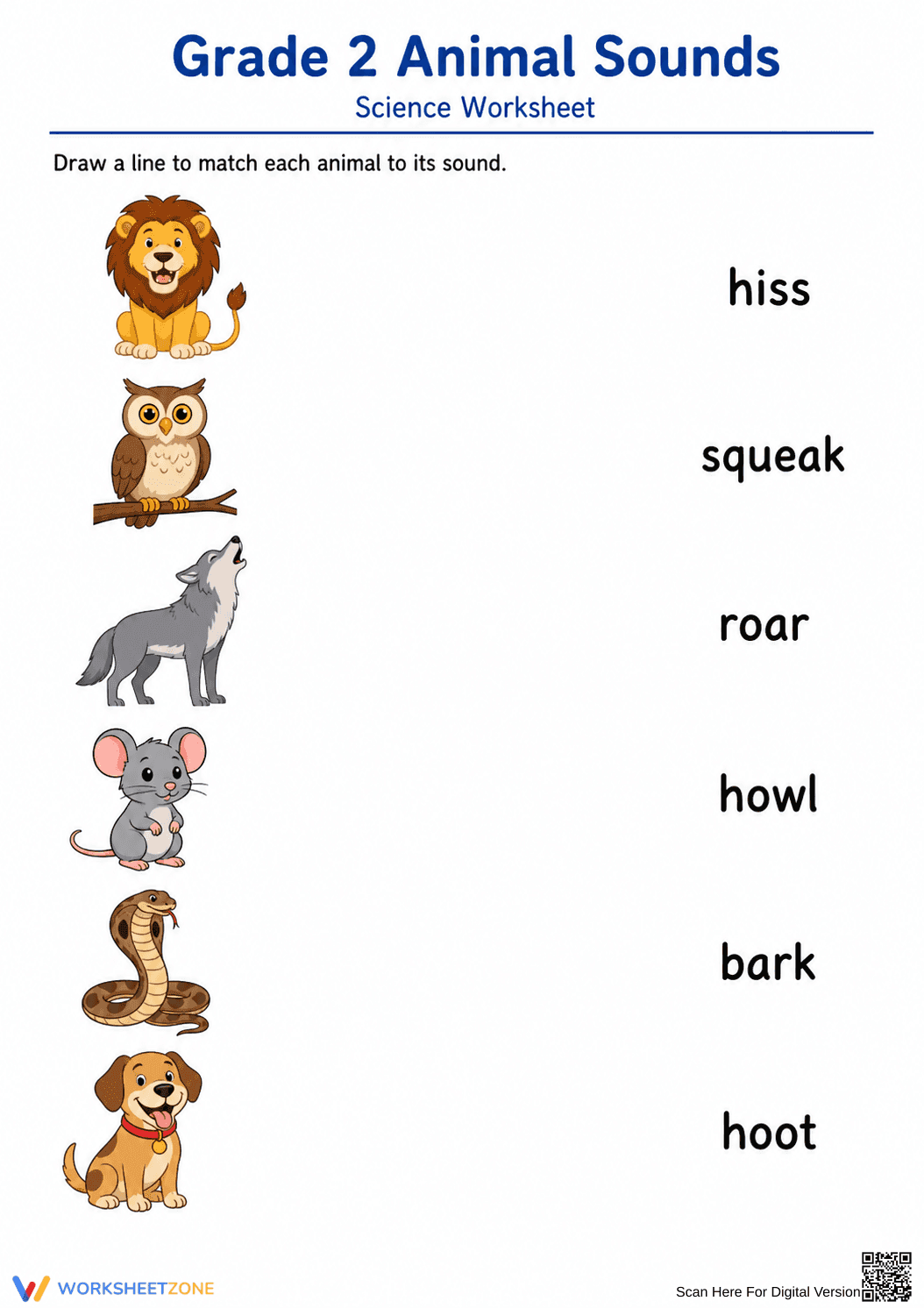

Grade 2 Animal Sounds — Printable No-Prep Worksheet
Paste this activity's link or code into your existing LMS (Google Classroom, Canvas, Teams, Schoology, Moodle, etc.).
Students can open and work on the activity right away, with no student login required.
You'll still be able to track student progress and results from your teacher account.
Students identify and match six common animals to their characteristic vocalizations in this focused science activity. By connecting visual animal cues with descriptive sound words like "hiss" and "hoot," learners strengthen their observational skills and biological vocabulary. This worksheet provides an immediate, high-engagement way to explore the diversity of animal communication and traits without any additional setup.
At a Glance
- Grade: 2 · Subject: Science
- Standard:
2-LS4-1— Make observations of animals to compare diversity of life and behavioral traits- Skill Focus: Animal sounds identification
- Format: 1 page · 6 problems · Answer key included · PDF
- Best For: Science centers or quick formative assessment checks
- Time: 5–10 minutes
This 1-page PDF features a clear, vertical matching layout designed specifically for young learners. It includes six vivid animal illustrations—a lion, owl, wolf, mouse, cobra, and dog—paired with a list of six sound-effect words. The document is formatted with clean lines and ample spacing to support fine motor skills during the matching task. A full answer key is provided for rapid grading or student self-correction.
Zero-Prep Workflow
- Step 1: Print (30 seconds) — One-click printing for the entire class or specific science centers.
- Step 2: Distribute (30 seconds) — Minimal instructions required; the visual matching cue is self-explanatory for Grade 2.
- Step 3: Review (1 minute) — Use the included key or conduct a whole-class "sound-off" to verify student answers orally.
Total teacher preparation time is under two minutes, making this an ideal emergency sub plan or bell-ringer activity. The intuitive design ensures students can begin working immediately upon distribution, allowing the teacher to focus on individual student needs or administrative tasks.
Standards Alignment
This worksheet is aligned with `2-LS4-1`, requiring students to make observations of animals to compare the diversity of life. By recognizing specific behavioral traits such as vocalizations, students build a foundation for understanding how animals interact with their environments and communicate within their habitats. This standard code can be copied directly into lesson plans, IEP goals, or district curriculum mapping tools.
How to Use It
Assign this activity as a warm-up during a unit on Living Things or as a transition piece before discussing animal habitats and traits. Instructors can use this as a formative-assessment observation tool by listening to students mimic the sounds while working. Most second-grade students will complete the matching sequence in approximately 5 to 10 minutes, making it a versatile filler for tight schedules.
Who It's For
Designed for general education Grade 2 science classrooms, this resource also serves as an excellent scaffolded tool for English Language Learners building basic noun-verb associations. It pairs naturally with a read-aloud about animal behaviors or an anchor chart displaying animal groups and their unique features. The visual-to-text connection is ideal for diverse learning styles and early readers.
The 2-LS4-1 standard emphasizes the vital importance of observational science in early childhood, encouraging young students to notice clear patterns and specific traits within the complex animal kingdom. This Animal Sounds worksheet facilitates these critical observations by asking students to link biological organisms to their unique auditory outputs, a key component of foundational life science literacy and environmental awareness. Research from EdReports 2024 indicates that high-quality, focused matching tasks help cement vocabulary retention by utilizing dual-coding theory—combining visual imagery with textual labels. By engaging in this 6-task exercise, students participate in active retrieval of science concepts rather than passive consumption. This resource ensures that even brief, self-directed instructional moments contribute significantly to the long-term mastery of Grade 2 science standards. Teachers can confidently integrate this into a broader science curriculum focused on biodiversity, classification, and animal adaptations.


