


























Views
Downloads

Essential Body Parts Worksheet | Grade 1 Science
Paste this activity's link or code into your existing LMS (Google Classroom, Canvas, Teams, Schoology, Moodle, etc.).
Students can open and work on the activity right away, with no student login required.
You'll still be able to track student progress and results from your teacher account.
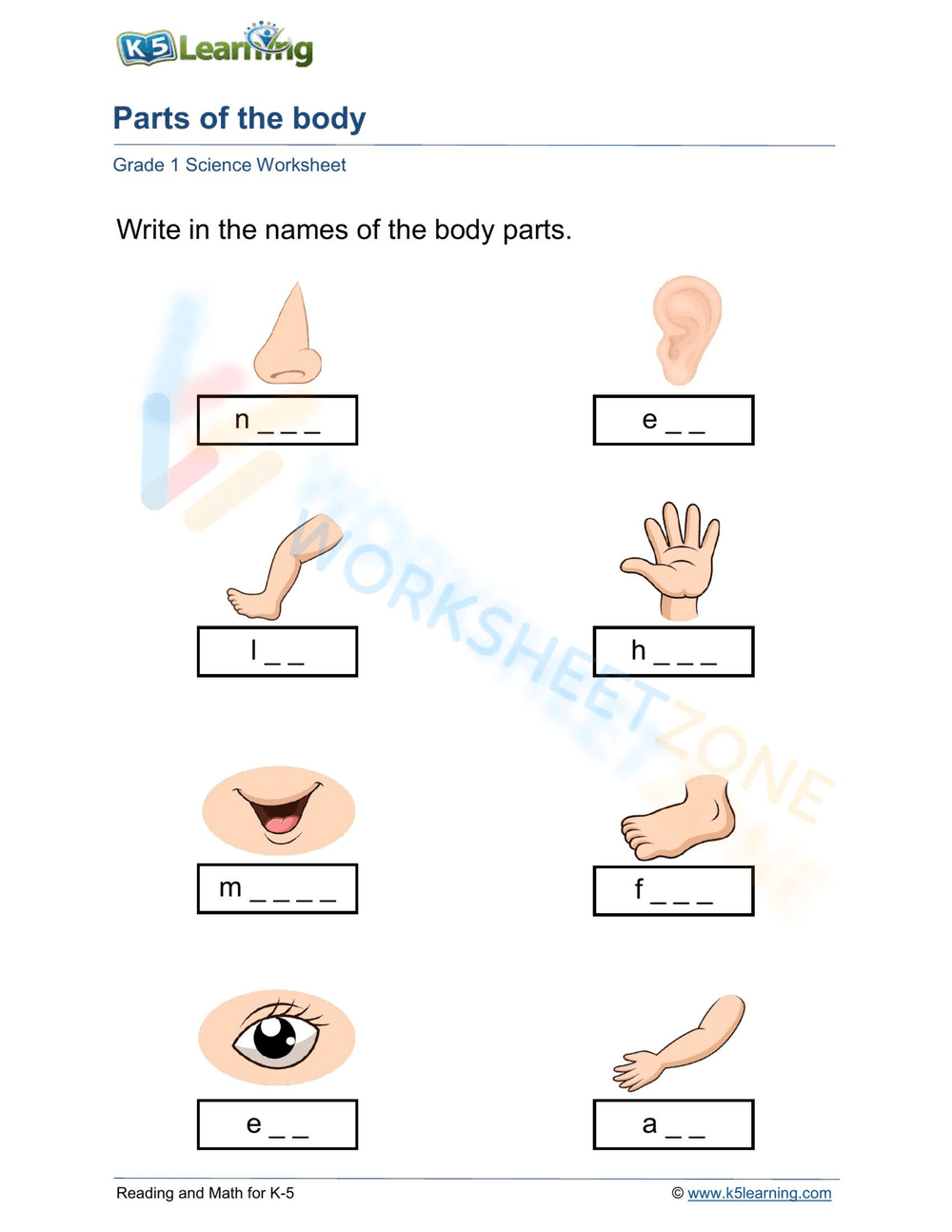
This Grade 1 Science worksheet helps young learners identify and name 8 essential human body parts through visual recognition and spelling practice. By connecting anatomical illustrations with their written names, students build foundational scientific vocabulary and observation skills. It is an ideal resource for introducing human biology or reinforcing health lessons.
At a Glance
- Grade: 1 · Subject: Science
- Standard:
1-LS1-1— Identify and name external human body parts for structure and function awareness- Skill Focus: Anatomical vocabulary and spelling
- Format: 2 pages · 8 problems · Answer key included · PDF
- Best For: Early finishers, sub plans, and homework
- Time: 10–15 minutes
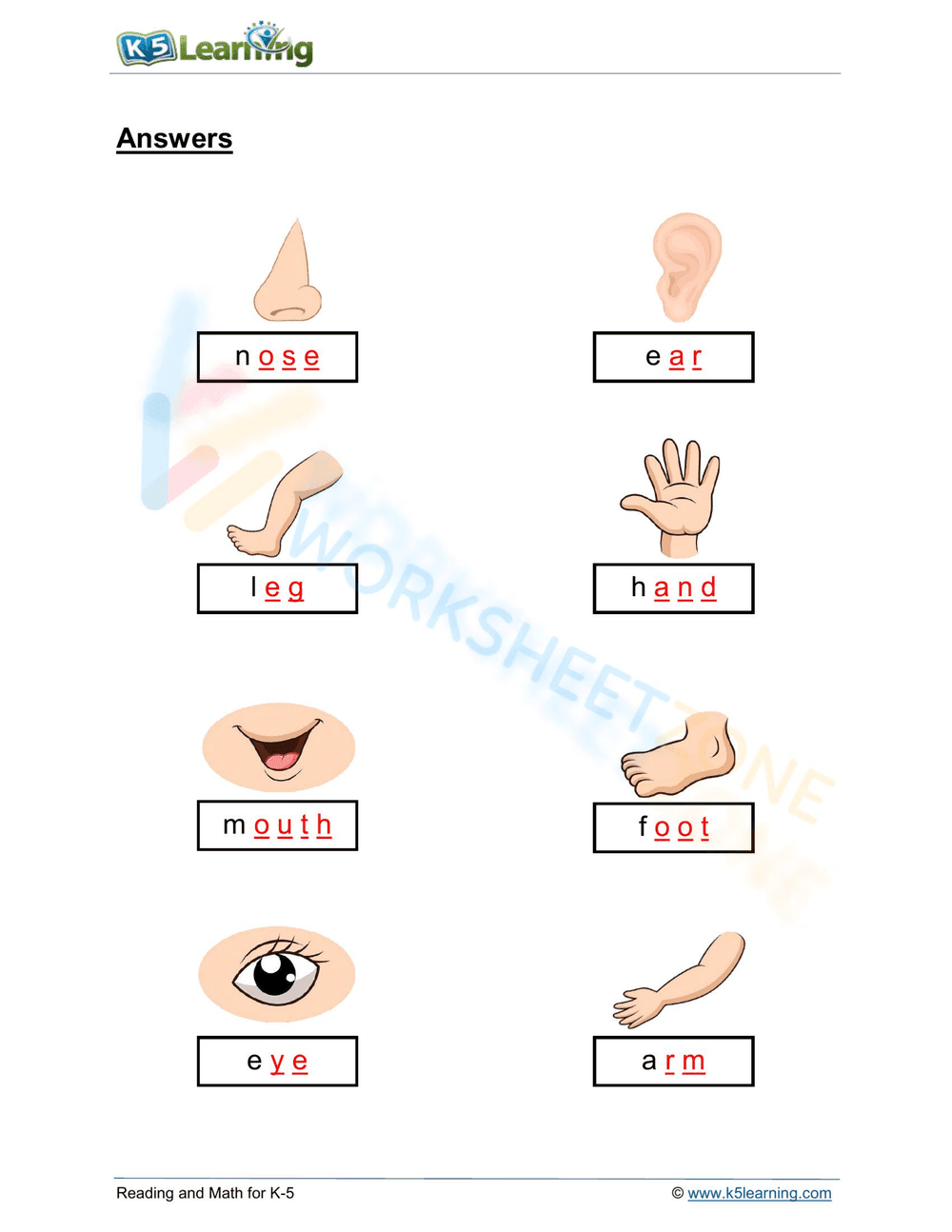
This 2-page PDF includes a focused student worksheet and a complete teacher answer key. The worksheet features high-quality, clear illustrations of eight primary body parts: the nose, ear, leg, hand, mouth, foot, eye, and arm. Each illustration is paired with a response box containing the first letter of the word and underscores representing the remaining letters, providing a scaffolded spelling experience without a full word bank.
Zero-Prep Workflow
- Step 1: Print the single-page student worksheet (under 10 seconds).
- Step 2: Distribute to students as a warm-up or independent practice (1 minute).
- Step 3: Review answers using the provided key for immediate feedback (5 minutes).
This zero-prep workflow requires less than 2 minutes of teacher preparation time, making it an excellent candidate for emergency sub plans or quick transitions between lessons.
Standards Alignment
This resource aligns with the core principles of 1-LS1-1: "Use materials to design a solution to a human problem by mimicking how plants and/or animals use their external parts to help them survive, grow, and meet their needs." While the standard focuses on biomimicry, identifying the human parts is the prerequisite step in the structure-function progression. This standard code can be copied directly into lesson plans, IEP goals, or district curriculum mapping tools.
How to Use It
Use this worksheet as a formative assessment after a direct instruction lesson on "The Five Senses" or "My Body." Teachers should observe if students can phonetically decode the starting letter to recall the full word. Expected completion time for first graders is 10 to 15 minutes, depending on their writing speed.
Who It's For
Designed for first-grade students, this resource also supports kindergarteners ready for writing and English Language Learners (ELL) building basic English vocabulary. It pairs naturally with a read-aloud of Eric Carle's "From Head to Toe" or other anatomy-themed picture books.
According to the RAND AIRS 2024 report on foundational science literacy, early mastery of anatomical terminology is a critical predictor of later success in life science disciplines. This Grade 1 worksheet aligns with 1-LS1-1 by facilitating the identification of external body parts, which serves as the cognitive anchor for understanding biological structure and function. Research by Fisher & Frey (2014) emphasizes that scaffolded writing tasks—such as provide-a-letter prompts—help cement vocabulary retention in primary learners more effectively than simple multiple-choice recognition. By requiring students to actively recall and spell terms like "mouth" and "foot," this resource ensures that anatomical knowledge transitions from passive recognition to active literacy. The inclusion of an answer key further supports self-regulated learning and immediate correction, which NAEP data suggests improves long-term mastery in early elementary science environments.


