


























Views
Downloads

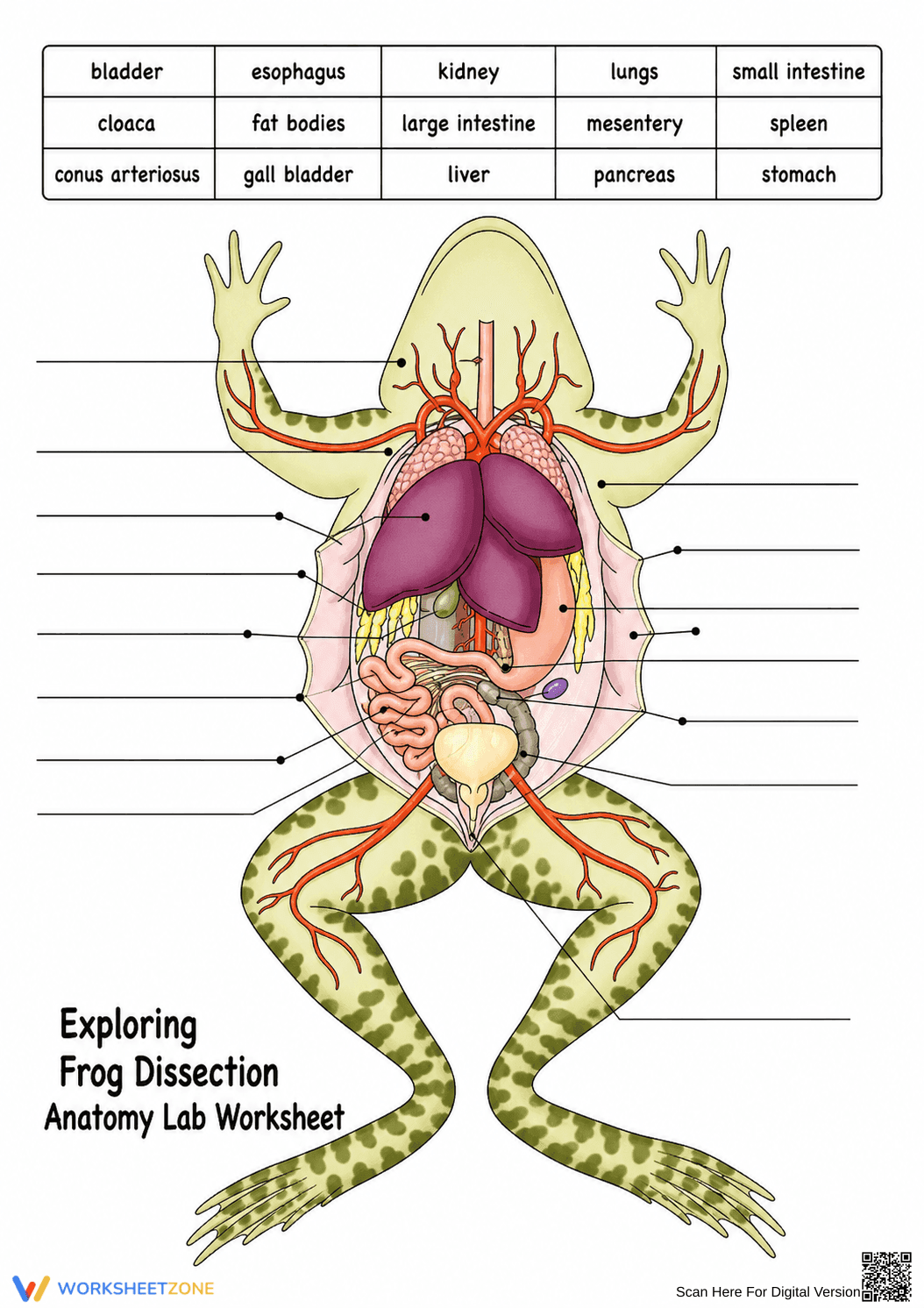

Printable Frog Dissection Pre-Lab | Grade 9-12 Biology
Paste this activity's link or code into your existing LMS (Google Classroom, Canvas, Teams, Schoology, Moodle, etc.).
Students can open and work on the activity right away, with no student login required.
You'll still be able to track student progress and results from your teacher account.
This printable frog dissection pre-lab worksheet prepares students to identify key anatomical structures and physiological functions before a physical lab. By completing virtual dissection questions and labeling internal organs, students build the foundational vocabulary and spatial awareness needed for a successful, safe, and educational biology dissection experience.
At a Glance
- Grade: 9 · Subject: Biology
- Standard:
HS-LS1-2— Illustrate the hierarchical organization of interacting systems- Skill Focus: Anatomy and Physiology
- Format: 2 pages · 31 problems · Answer key included · PDF
- Best For: Pre-lab preparation
- Time: 30–45 minutes
What's Inside
This two-page resource features a comprehensive mix of task types to engage students. The first page includes 17 short-answer and fill-in-the-blank questions covering biological classification, directional terms like dorsal and ventral, and virtual dissection steps. The second page provides a detailed internal anatomy diagram with a 14-term word bank, requiring students to accurately label organs such as the liver, gall bladder, and conus arteriosus.
Zero-Prep Workflow
- Print (1 minute): Simply print the two-page PDF. No special materials or complex teacher setup required.
- Distribute (1 minute): Hand out to students along with the link to the virtual dissection website.
- Review (5 minutes): Quickly go over the labeled diagram together to ensure anatomical accuracy before moving to the physical lab.
Total teacher prep time is under 2 minutes, making this an ideal resource for busy biology teachers or a highly effective science sub plan.
Standards Alignment
Aligned to HS-LS1-2: Develop and use a model to illustrate the hierarchical organization of interacting systems that provide specific functions within multicellular organisms. It also supports general scientific literacy and lab safety protocols. Both standard codes can be copied directly into lesson plans, IEP goals, or district curriculum mapping tools.
How to Use It
Assign this worksheet before direct instruction on physical dissection techniques to build essential background knowledge. It works perfectly as an independent webquest where students navigate the virtual lab at their own pace. As a formative assessment tip, check students' progress on the directional terms (anterior/posterior) to ensure they can correctly orient the specimen before handing out dissection tools. Expected completion time is 30 to 45 minutes.
Who It's For
This resource is designed for high school biology students preparing for their first major dissection. To differentiate for students needing extra support, allow them to work in pairs during the virtual webquest portion. It pairs naturally with introductory lessons on vertebrate anatomy or a classroom anchor chart detailing lab safety procedures.
Integrating structured pre-lab activities significantly improves student outcomes during complex biological investigations. According to a ScienceDirect TpT Analysis, providing students with targeted vocabulary and spatial orientation tasks before a physical lab reduces anxiety and increases instructional efficiency. This worksheet aligns with HS-LS1-2 by requiring students to illustrate the hierarchical organization of interacting systems through diagram labeling and functional analysis. By mastering plain-English skills like identifying anatomical structures and understanding physiological relationships, students transition smoothly from theoretical knowledge to hands-on application. The combination of virtual webquest questions and visual diagramming ensures that learners build a robust mental model of the specimen prior to the actual dissection. Utilizing this evidence-based approach maximizes the educational value of the dissection experience while minimizing wasted time, confusion, and materials in the busy high school laboratory setting.


