


























Views
Downloads

Essential Frindle Chapter 4 Questions | Grade 5 ELA
Paste this activity's link or code into your existing LMS (Google Classroom, Canvas, Teams, Schoology, Moodle, etc.).
Students can open and work on the activity right away, with no student login required.
You'll still be able to track student progress and results from your teacher account.
This Grade 5 reading comprehension worksheet provides focused practice for Andrew Clements' classic novel, Frindle. By answering specific questions about Chapter 4, students demonstrate their ability to locate explicit details and make logical inferences. This resource ensures learners remain engaged while sharpening essential literary analysis skills.
At a Glance
- Grade: 5 · Subject: ELA
- Standard:
CCSS.ELA-LITERACY.RL.5.1— Quote accurately from a text and explain what it says explicitly- Skill Focus: Inferential Thinking and Literal Textual Comprehension
- Format: 1 page · 5 problems · Answer key included · PDF
- Best For: Independent reading check or literacy center activity
- Time: 15–20 minutes
What's Inside
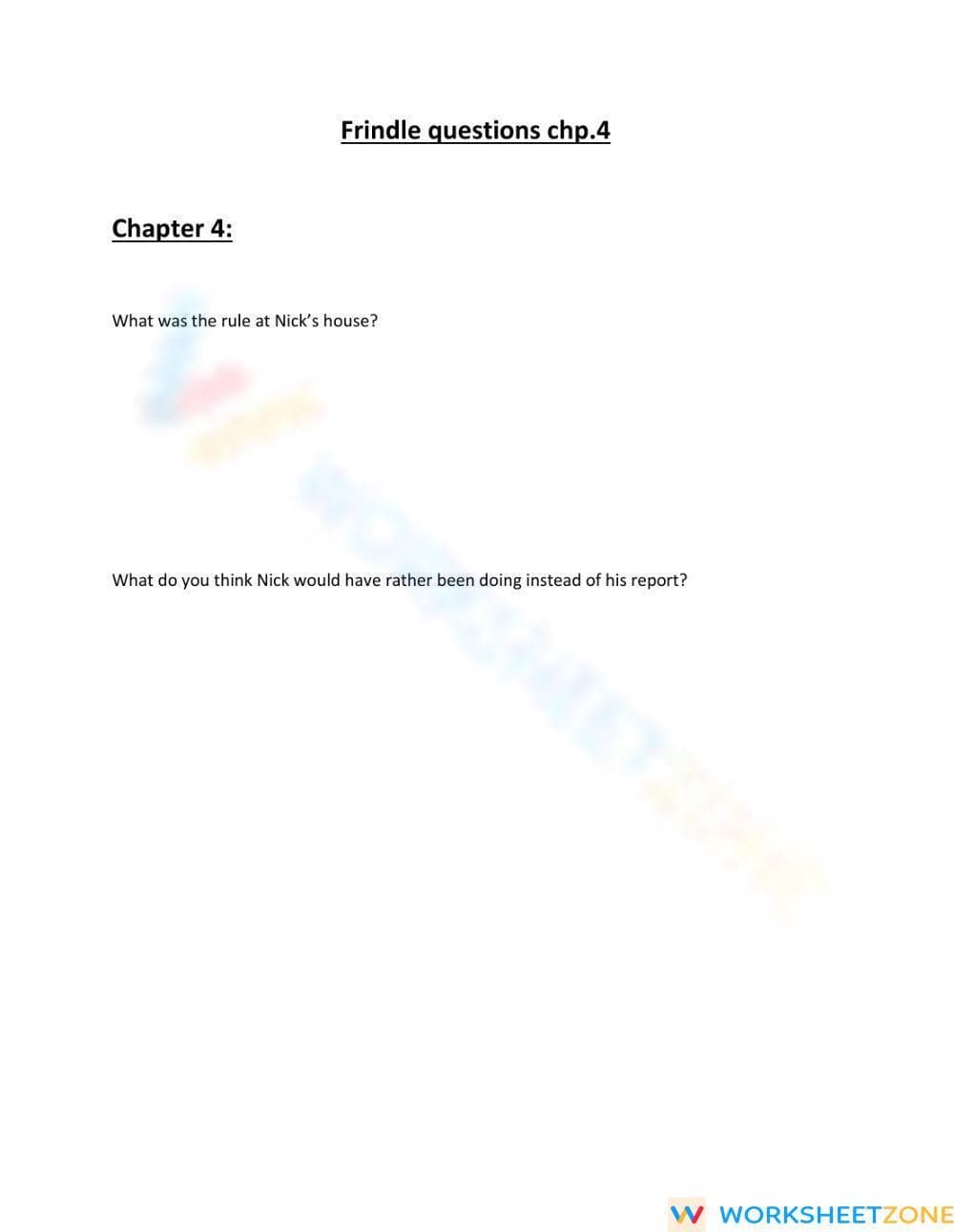
This single-page PDF contains a set of targeted questions designed specifically for the fourth chapter of Frindle. The layout is clean and spacious, providing ample room for students to write their responses. It includes a mix of literal recall questions, such as identifying household rules, and deeper inferential tasks regarding Nick Allen's perspective. A comprehensive answer key is provided to facilitate quick grading or self-correction.
Skill Progression
- Guided Practice: Students begin with literal recall grounding them in the text’s immediate facts and setting details.
- Supported Practice: Learners encounter interpretive questions that connect character actions with their underlying feelings or motivations.
- Independent Practice: Students synthesize their understanding to predict future plot developments based on Chapter 4 events.
This gradual release approach ensures comprehensive understanding for every learner as they master complex narrative structures.
Standards Alignment
This resource aligns to CCSS.ELA-LITERACY.RL.5.1, requiring students to quote accurately from a text when explaining explicit details and inferences. It also supports RL.5.3 by prompting students to analyze character interactions. Both standard codes can be copied directly into lesson plans, IEP goals, or district curriculum mapping tools.
How to Use It
Assign this worksheet immediately after students finish reading Chapter 4 to serve as a formative assessment check. During instruction, teachers can use these questions to spark a whole-class discussion about Nick’s home life versus his school persona. Observe whether students are flipping back through the book to find evidence, which is a key indicator of proficient reading habits. Completion typically takes between fifteen and twenty minutes.
Who It's For
This worksheet is ideal for Grade 4 and Grade 5 students who are reading Frindle as part of a literature circle or whole-class novel study. It offers helpful scaffolding for struggling readers while providing enough depth for advanced learners to express their insights. It pairs naturally with a character trait anchor chart or a direct instruction lesson to deepen the analysis of the protagonist's growth.
The Grade 5 Frindle Chapter 4 worksheet is a precision tool designed to meet the rigorous demands of CCSS.ELA-LITERACY.RL.5.1. By focusing on extracting textual evidence to support inferences, this resource addresses core competencies identified in the NAEP reading framework. Research from the RAND AIRS 2024 report emphasizes that structured, text-dependent questions are vital for closing the achievement gap in middle-grade literacy. By requiring students to articulate the reasoning behind character decisions, this worksheet moves beyond simple plot summary into authentic literary critique. Educators can rely on this document to provide a consistent data point for tracking progress toward state benchmarks. Its design reflects best practices in instructional design, ensuring every task serves a distinct pedagogical purpose. This worksheet stands as a reliable asset for classrooms committed to data-driven instruction and evidence-based reading strategies.


