


























Views
Downloads
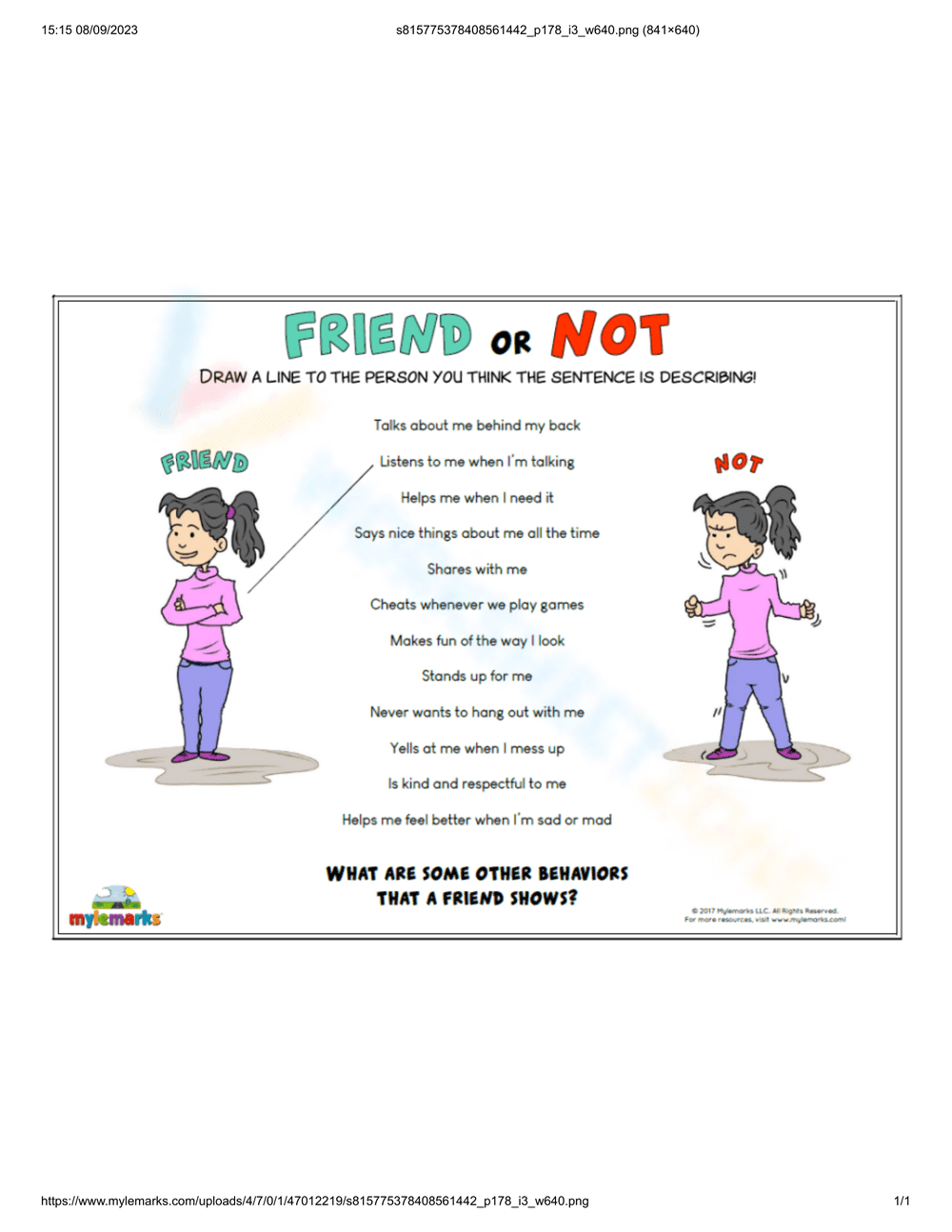

Friend or Not Social Skills Worksheet | Printable Grade 1
Paste this activity's link or code into your existing LMS (Google Classroom, Canvas, Teams, Schoology, Moodle, etc.).
Students can open and work on the activity right away, with no student login required.
You'll still be able to track student progress and results from your teacher account.
This printable social skills worksheet helps young students identify positive and negative peer behaviors by categorizing everyday actions. Students read short descriptive sentences and draw lines to match each behavior to either a "Friend" or "Not" character, building foundational social-emotional awareness and reading comprehension skills simultaneously.
At a Glance
- Grade: 1 · Subject: English / SEL
- Standard:
CCSS.ELA-LITERACY.L.1.5.A— Sort words and phrases into conceptual categories- Skill Focus: Identifying friendship behaviors
- Format: 1 page · 13 problems · Answer key included · PDF
- Best For: Morning work or SEL blocks
- Time: 10–15 minutes
Inside this resource, educators will find a single-page matching activity featuring two character illustrations representing a good friend and a poor friend. The core task includes twelve descriptive behavior sentences, such as "Shares with me" or "Makes fun of the way I look," which students connect to the appropriate character. The page concludes with an open-ended discussion question prompting students to brainstorm other positive friendship traits. A complete answer key is provided for quick grading.
This resource is designed for a zero-prep workflow, making it an ideal addition to any busy teacher's toolkit.
- Print (1 minute): Simply download the PDF and print a class set. No special materials or cutting required.
- Distribute (1 minute): Hand out the sheets during morning meeting or a dedicated social-emotional learning block.
- Review (3 minutes): Use the included answer key to quickly check student responses or review as a whole class.
With under two minutes of total teacher prep time, this self-explanatory activity is highly suitable for emergency sub plans or spontaneous classroom management resets.
This activity aligns with CCSS.ELA-LITERACY.L.1.5.A: "Sort words into categories (e.g., colors, clothing) to gain a sense of the concepts the categories represent." By categorizing complex social behaviors into positive and negative groups, students practice critical vocabulary sorting. Both standard codes can be copied directly into lesson plans, IEP goals, or district curriculum mapping tools.
Teachers can utilize this worksheet during a whole-group social-emotional learning lesson, specifically after direct instruction on what makes a good friend. It also serves as an excellent independent center activity for early finishers. As a formative assessment observation tip, watch how students categorize ambiguous statements; if a student struggles to identify "Talks about me behind my back" as a negative trait, it provides a natural opening for a targeted mini-lesson. Expected completion time ranges from ten to fifteen minutes.
This resource is primarily designed for kindergarten and first-grade students developing their foundational social skills and peer relationship awareness. It includes visual cues to support early readers and English Language Learners who might need help decoding the text. This worksheet pairs naturally with a read-aloud book about friendship or a classroom anchor chart detailing positive peer interactions.
Integrating structured social-emotional learning tasks into early elementary literacy blocks improves behavioral outcomes and reading comprehension. By aligning with CCSS.ELA-LITERACY.L.1.5.A to sort words and phrases into conceptual categories, this activity bridges vocabulary acquisition and practical social skills. According to a RAND AIRS 2024 report, early interventions combining literacy practice with explicit peer relationship modeling yield higher student engagement and reduced classroom disruptions. When young learners actively categorize behaviors, they develop critical cognitive schemas necessary for healthy social development. This dual-purpose approach ensures instructional minutes are maximized, providing essential reading practice while fostering a supportive classroom environment.


