




























Views
Downloads


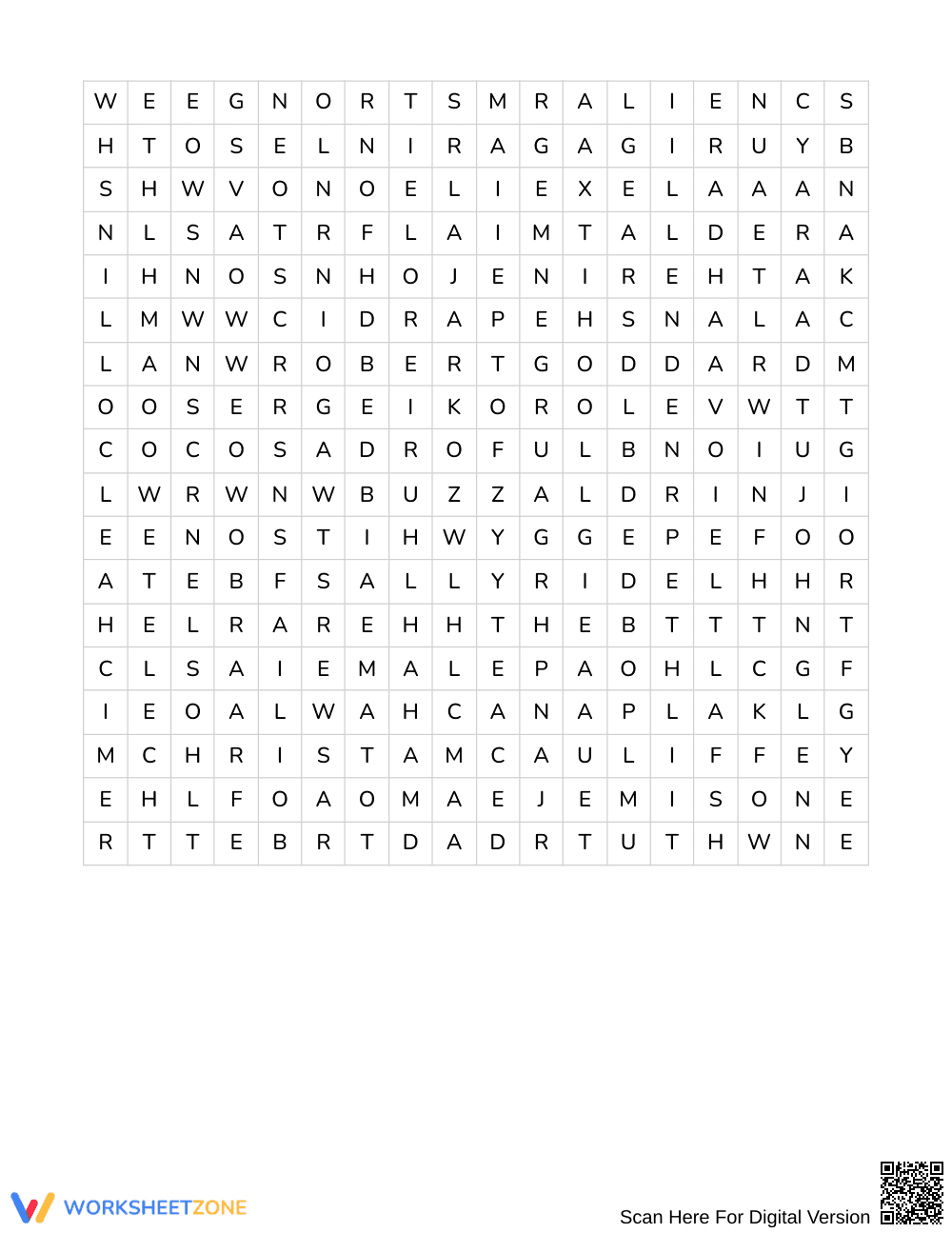

Free Space Pioneers Word Search | Grades 6–7 Social Studies

Paste this activity's link or code into your existing LMS (Google Classroom, Canvas, Teams, Schoology, Moodle, etc.).
Students can open and work on the activity right away, with no student login required.
You'll still be able to track student progress and results from your teacher account.
This space exploration pioneers word search challenges Grades 6–7 social studies students to identify and locate 16 foundational figures in world space history. By pairing biographical clues with puzzle retrieval, students reinforce historical memory, connecting pivotal missions like Apollo 11 and Vostok 1 directly to the scientists, engineers, and astronauts who achieved them.
At a Glance
- Grade: Grades 6–7 · Subject: Social Studies
- Standard: Not standards-assessed — vocabulary enrichment
- Skill Focus: Space exploration pioneers and historical milestones
- Format: 3 pages · 16 words · Answer key included · PDF
- Best For: World history unit review, early finishers, and sub plans
- Time: 25–35 minutes
What's Inside
This three-page printable resource delivers an engaging clue-based puzzle challenge designed without a traditional word bank. Students analyze 16 detailed biographical profiles to identify prominent figures before searching the grid. The document includes complete student worksheets and a comprehensive answer key spanning four pages, showing exact letter coordinates and highlighted placements.
Puzzle Mechanics
The activity features an 18 x 18 letter grid containing 16 hidden pioneer names. Words run in all eight compass directions: north, northeast, east, southeast, south, southwest, west, and northwest. Because no word bank is provided, learners must deduce names from descriptive clues detailing historical milestones, orbital mechanics, and mission commands before locating overlapping letter paths across the grid.
Standards Alignment
This resource serves as targeted vocabulary enrichment and is not aligned to a specific state or national content standard. It reinforces interdisciplinary literacy by asking students to integrate historical reading comprehension with domain-specific terminology across mid-twentieth-century world history and space science units.
How to Use It
Introduce this word search after direct instruction on the Space Race or twentieth-century scientific advancements to consolidate student understanding of key historical contributors. Alternatively, assign it as a zero-prep independent activity for substitute teacher plans or early finishers. While students work, circulate to observe whether they correctly match accomplishments to specific individuals before searching the grid. Completion time spans 25 to 35 minutes.
Who It's For
This activity is designed for Grades 6–7 social studies students studying modern world history or the Cold War. For learners needing additional support, provide a preliminary reference sheet listing the 16 names. Pair this activity naturally with a primary source reading on Project Mercury or an introductory timeline of lunar exploration.
Developing domain-specific vocabulary regarding space exploration pioneers reinforces historical recall and contextual understanding in middle school social studies. According to Fisher & Frey (2014), intentional exposure to academic terminology within meaningful contextual tasks strengthens long-term comprehension and accelerates student content mastery. Rather than relying on passive rote memorization, this clue-driven word search requires learners to evaluate concise biographical descriptions—spanning orbital calculations, pioneering spaceflights, and aerospace engineering milestones—before identifying corresponding historical figures. This active retrieval practice bridges informational reading with targeted vocabulary acquisition, prompting students to synthesize key facts about global space achievements. Educational research consistently highlights that integrating retrieval exercises with content-rich clues deepens conceptual connections for middle grade learners. By engaging with 16 distinct pioneer achievements across diverse historical contexts, students solidify their foundational knowledge of modern history while building vital disciplinary literacy skills essential for advanced secondary social studies coursework.


