


























Views
Downloads
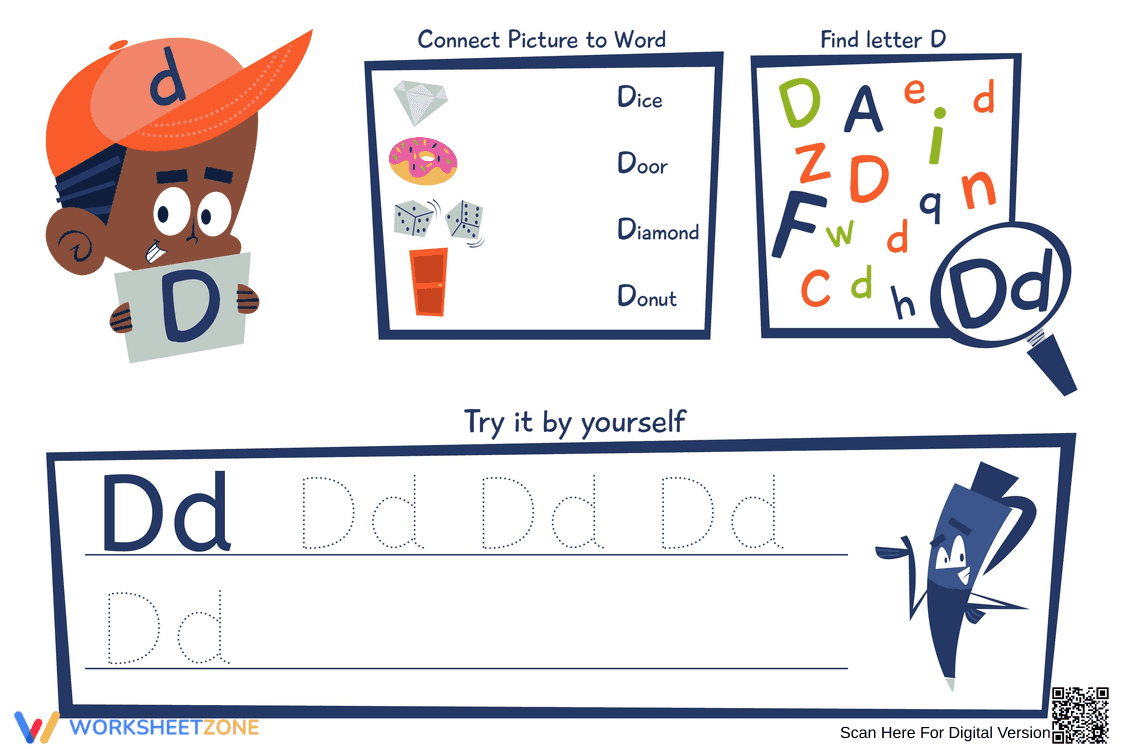

Printable Letter D Worksheet | Grade 1 English
Paste this activity's link or code into your existing LMS (Google Classroom, Canvas, Teams, Schoology, Moodle, etc.).
Students can open and work on the activity right away, with no student login required.
You'll still be able to track student progress and results from your teacher account.
This Grade 1 English worksheet provides focused practice on the letter D to build early literacy and handwriting skills. Students connect pictures to words, identify specific letters among distractors, and practice tracing uppercase and lowercase forms, establishing a strong foundation for reading and writing fluency.
At a Glance
- Grade: 1 · Subject: English
- Standard:
CCSS.ELA-LITERACY.L.1.1.A— Print all upper- and lowercase letters- Skill Focus: Letter Recognition and Tracing
- Format: 1 page · 3 tasks · No answer key needed · PDF
- Best For: Morning work or literacy centers
- Time: 10–15 minutes
This single-page resource features three distinct activities to reinforce letter knowledge. Students first connect four D-themed pictures (dice, door, diamond, donut) to their corresponding words. Next, a visual discrimination exercise asks learners to find and circle the uppercase and lowercase D hidden among distractors. Finally, the bottom section provides guided tracing lines for independent handwriting practice.
Zero-Prep Workflow
This worksheet requires zero teacher preparation.
- Print (1 minute): Simply download the PDF and print a class set.
- Distribute (1 minute): Hand out the sheets during morning routines or transition periods. The visual instructions allow students to begin immediately.
- Review (3 minutes): Quickly scan student work to verify correct letter formation and accurate picture-word associations.
With prep time under two minutes, it is perfect for emergency sub plans or independent work folders.
Standards Alignment
This resource is directly aligned to CCSS.ELA-LITERACY.L.1.1.A: Print all upper- and lowercase letters. By combining visual recognition with physical tracing, the worksheet reinforces the motor memory required for standard letter formation. It also supports early phonics skills by associating the target letter with familiar vocabulary words. Both standard codes can be copied directly into lesson plans, IEP goals, or district curriculum mapping tools.
How to Use It
This versatile printable can be utilized in multiple instructional contexts. Assign it as morning work to settle students into the day with a familiar, structured task. Alternatively, place it in a literacy center for independent practice while the teacher conducts small group guided reading sessions. For formative assessment, observe students during the tracing section to ensure they start strokes from the top line. Most complete this within 10 to 15 minutes.
Who It's For
This worksheet is ideal for first-grade students who are solidifying their alphabet knowledge and refining their fine motor skills. It serves as an excellent intervention tool for learners who struggle with letter reversals or visual discrimination. For differentiation, teachers can provide a tactile alphabet card for students who need extra sensory input before tracing. Pair this activity with a read-aloud book that heavily features the letter D to reinforce the phonetic connections made in the matching section.
Effective handwriting instruction requires a careful combination of visual discrimination, phonetic association, and guided motor practice to build lasting fluency. This resource directly targets CCSS.ELA-LITERACY.L.1.1.A by asking students to print all upper- and lowercase letters, with a specific focus on mastering the letter D. According to Fisher & Frey (2014), providing students with structured, gradual-release tasks—such as moving from identifying a target letter among distractors to independently tracing it on guided lines—significantly improves retention and automaticity in early literacy development. By integrating picture-word matching with dedicated handwriting exercises, this worksheet ensures that students actively connect the physical act of writing to meaningful vocabulary rather than merely copying abstract shapes. This multidimensional approach supports cognitive mapping, making it substantially easier for young learners to recall proper letter formations during independent writing assignments. The clear, distraction-free layout further minimizes cognitive load, allowing students to focus entirely on mastering these essential foundational skills.


