




























Views
Downloads


Free Compositional vs Mechanical Worksheet | Grade 8 Science

Paste this activity's link or code into your existing LMS (Google Classroom, Canvas, Teams, Schoology, Moodle, etc.).
Students can open and work on the activity right away, with no student login required.
You'll still be able to track student progress and results from your teacher account.
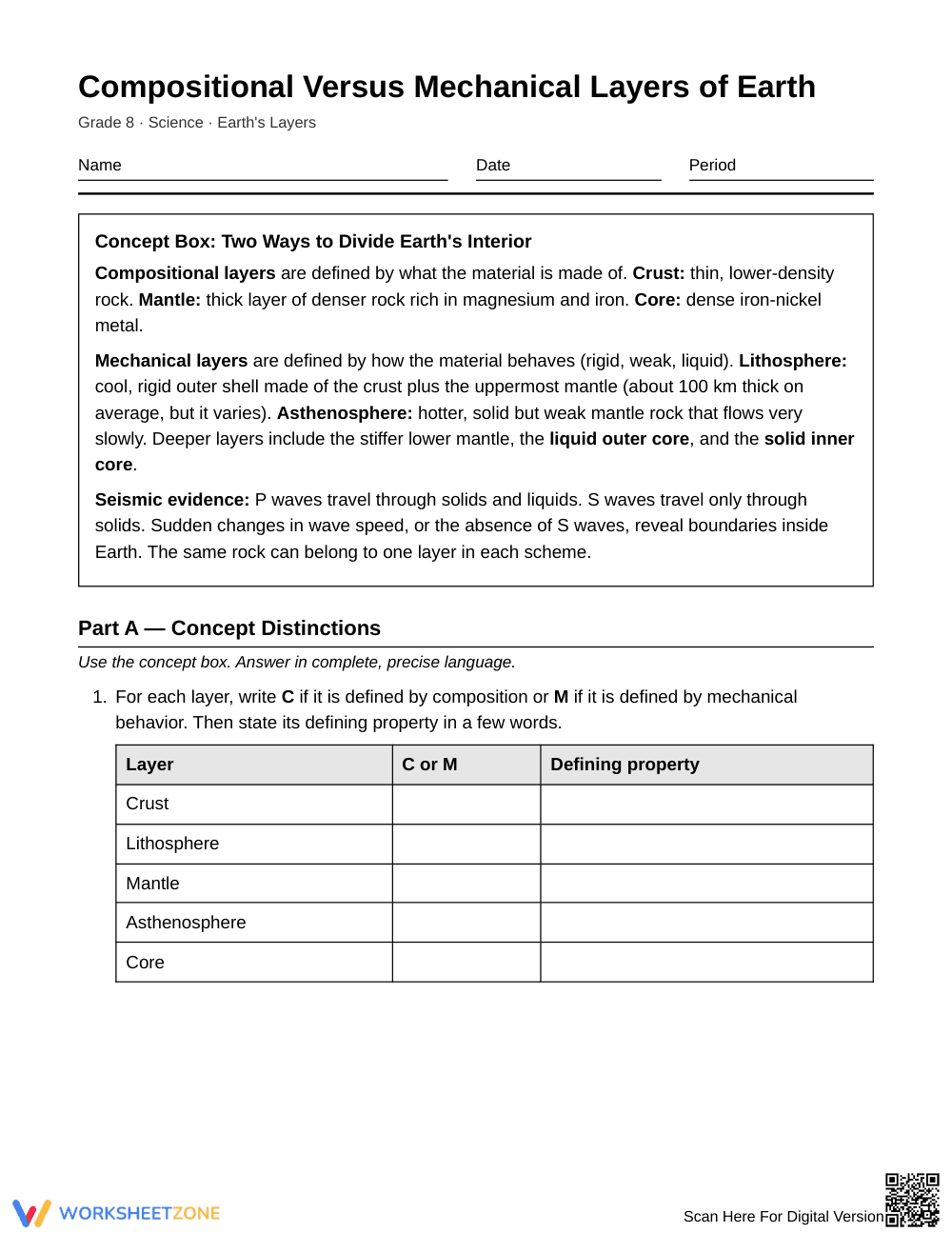
This worksheet teaches Grade 8 students to separate Earth's compositional layers from its mechanical layers and to explain why one rock can belong to both. Students use a concept box, calculations, and seismic data to justify their reasoning across 12 tasks.
At a Glance
- Grade: 8 · Subject: Science
- Standard: Distinguish Earth's layers by material versus behavior, using seismic evidence to support claims
- Skill Focus: Compositional versus mechanical layers
- Format: 5 pages · 12 problems · Answer key included · PDF
- Best For: Earth's Layers unit practice and review
- Time: 40–50 minutes
What's Inside
The worksheet opens with a concept box, then moves through three parts: concept distinctions (a classification table, multiple choice, and short explanations), mechanism applications (density, wave travel time, S-wave shadow zone, velocity data, plate motion, core geometry), and justified predictions. All data are synthetic but realistic. A 2-page answer key is included.
Skill Progression
- Guided practice: 4 tasks in Part A, supported directly by the concept box.
- Supported practice: 6 tasks in Part B, with formulas given and students showing work and units.
- Independent practice: 2 prediction tasks in Part C, where students build their own evidence-based argument.
This sequence follows gradual release: I Do, We Do, You Do.
Standards Alignment
No standard code was supplied for this worksheet. The tasks target a common Grade 8 Earth science expectation: students use evidence, including seismic waves, to describe Earth's internal structure and explain how layers are defined. Add your state or district code when copying this into lesson plans, IEP goals, or curriculum mapping tools.
How to Use It
- After direct instruction: Assign Parts A and B as independent practice on Earth's interior.
- Review before a unit test: Use Part C as a short-answer warm-up or exit task.
Formative tip: listen for students who treat the asthenosphere as liquid. Expect 40–50 minutes, or split the worksheet over two class periods.
Who It's For
Grade 8 Science students who have met the layers of Earth and are ready to compare two classification schemes. The concept box supports students who need a reference, while Part C stretches advanced learners. Pair it with a labeled cross-section diagram of Earth.
Compositional and mechanical layers of Earth describe the same interior in two ways: composition sorts material by what it is made of, while mechanical behavior sorts it by how it responds to stress. This Grade 8 Science worksheet asks students to classify layers, interpret P-wave and S-wave evidence, calculate density, travel time, and plate motion, and predict how changes in temperature or state alter layer boundaries. Its 12 tasks move from guided concept checks to independent predictions, following the gradual release of responsibility model described by Fisher & Frey (2014). Students learn that the lithosphere includes the crust and uppermost mantle, that the asthenosphere is solid but weak, and that the liquid outer core is a mechanical state rather than a separate composition. The five-page PDF includes a two-page answer key for quick, consistent scoring.


