


























Views
Plays


Fractions with Pictures Printable Worksheet | Grade 2 Math
Paste this activity's link or code into your existing LMS (Google Classroom, Canvas, Teams, Schoology, Moodle, etc.).
Students can open and work on the activity right away, with no student login required.
You'll still be able to track student progress and results from your teacher account.
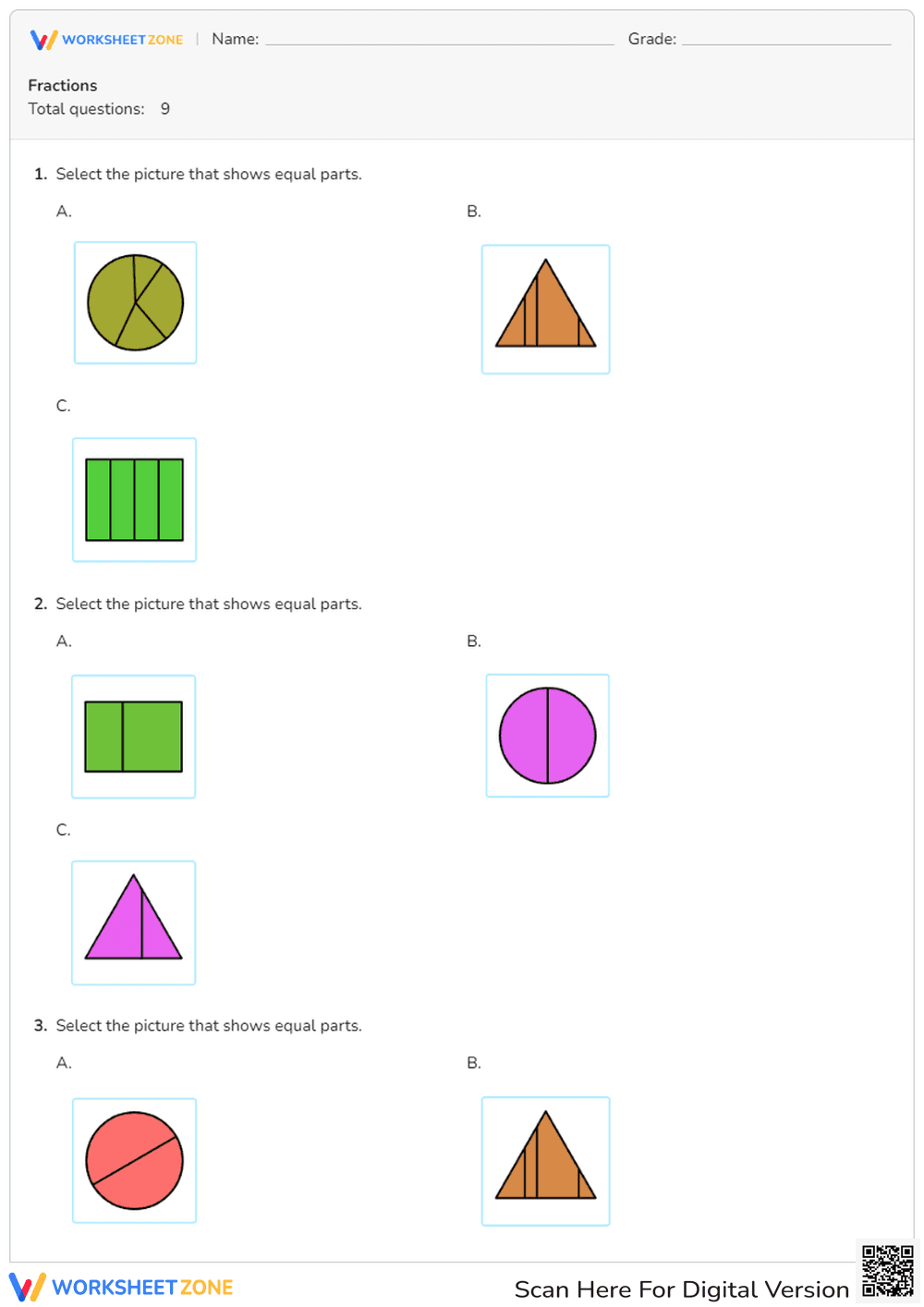
This Grade 2 fractions worksheet helps students master the concept of equal shares through visual identification. By analyzing shapes and real-world objects, learners develop the spatial reasoning necessary to recognize halves and fourths. This resource provides immediate practice in partitioning and identifying fractional parts within circles, rectangles, and familiar food items.
At a Glance
- Grade: 2 · Subject: Math
- Standard:
CCSS.MATH.CONTENT.2.G.A.3— Partition circles and rectangles into two or four equal shares- Skill Focus: Identifying halves and fourths
- Format: 3 pages · 9 problems · Answer key included · PDF
- Best For: Independent practice or quick formative assessment
- Time: 15–20 minutes
Inside this 3-page PDF, you will find 9 multiple-choice questions designed for clarity. The first page focuses on distinguishing equal parts from unequal parts. Subsequent pages challenge students to identify specific partitions, such as halves and fourths, using vibrant illustrations of tomatoes, limes, and pizzas. The layout is spacious, ensuring young learners have plenty of room to focus on each visual task.
The zero-prep workflow is designed for busy educators. First, print the three-page document in under 30 seconds. Second, distribute the worksheets to your students for independent work during your math block. Finally, use the included answer key to review responses or have students self-correct their work. Total teacher preparation time is under 2 minutes, making it an ideal sub-plan or emergency filler.
This resource is aligned with CCSS.MATH.CONTENT.2.G.A.3, which requires students to partition circles and rectangles into two or four equal shares and describe them using fractional language. It also supports foundational geometry skills by reinforcing the concept of equal parts versus unequal parts. Both standard codes can be copied directly into lesson plans, IEP goals, or district curriculum mapping tools.
Use this worksheet as a check for understanding immediately following a lesson on partitioning shapes. Alternatively, assign it as a morning work activity to reinforce previous learning. Teachers should observe if students can distinguish between a shape cut into two unequal pieces versus a true half. Completion typically takes 15 to 20 minutes depending on student familiarity with the vocabulary.
This worksheet is perfect for second-grade students beginning their geometry unit. It is also highly effective for first-grade enrichment or third-grade intervention for students struggling with the concept of equal shares. Pair this resource with physical manipulatives like fraction tiles or paper circles to provide a concrete-to-representational transition for diverse learners in your classroom.
Research from EdReports (2024) emphasizes that high-quality instructional materials must provide clear visual representations to bridge the gap between concrete objects and abstract mathematical notation. This worksheet addresses CCSS.MATH.CONTENT.2.G.A.3 by utilizing familiar real-world imagery, such as sliced fruit and pizza, to ground the concept of halves and fourths in a recognizable context. By focusing on the identification of equal shares, the resource supports the development of spatial reasoning and fractional fluency. Fisher & Frey (2014) highlight the importance of checks for understanding in the gradual release of responsibility model; these 9 targeted tasks serve as a reliable formative assessment tool. Educators can use the results to identify misconceptions regarding symmetry and partitioning before moving toward more complex fraction operations. This structured approach ensures that Grade 2 students build a robust foundation for future work with denominators and numerators.


