


























Views
Downloads

Essential Equivalent Fractions Worksheet | Grade 4 Printable
Paste this activity's link or code into your existing LMS (Google Classroom, Canvas, Teams, Schoology, Moodle, etc.).
Students can open and work on the activity right away, with no student login required.
You'll still be able to track student progress and results from your teacher account.
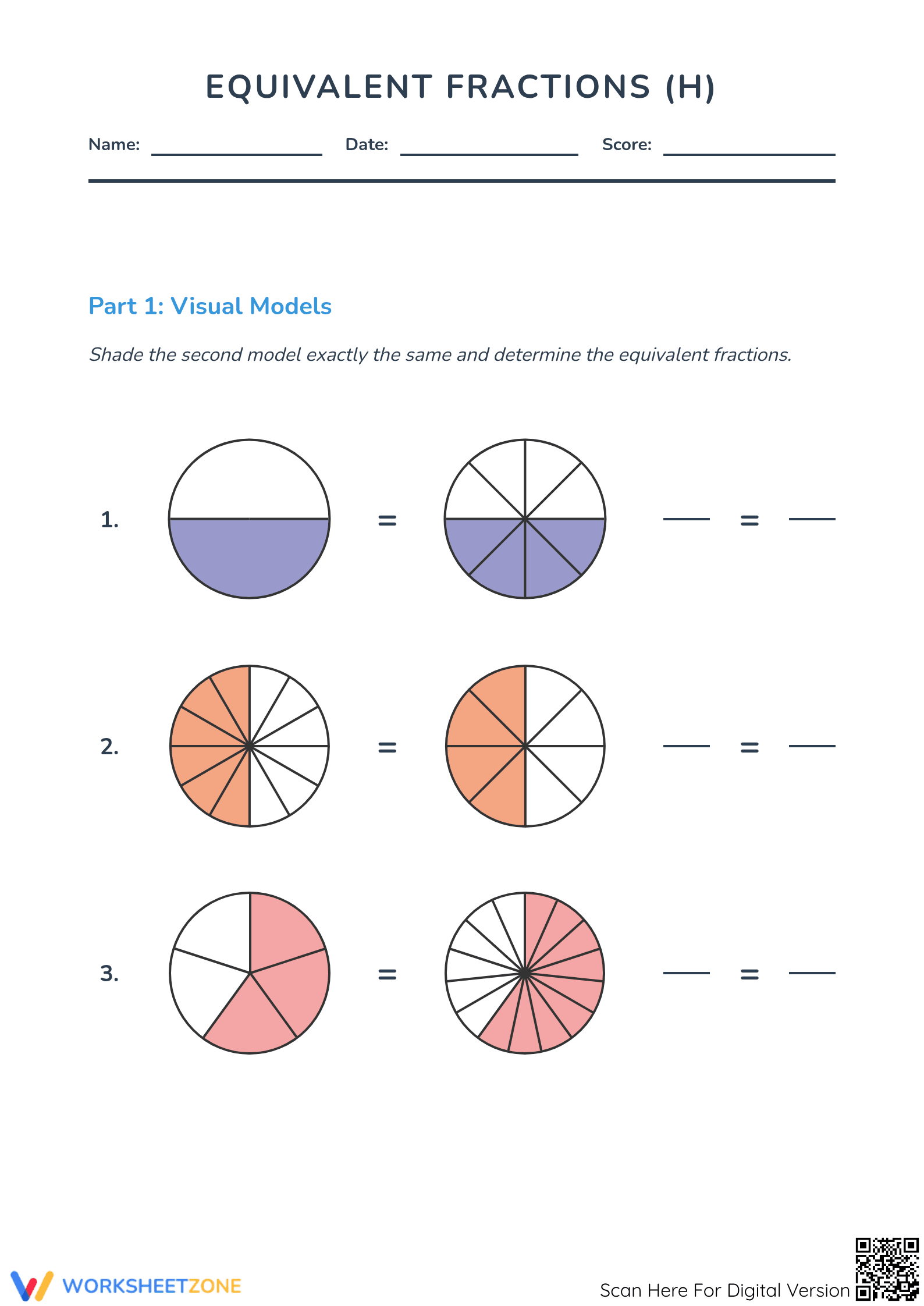
This equivalent fractions worksheet helps students bridge the gap between visual models and abstract numerical representations. By engaging with 11 targeted problems, learners develop a conceptual understanding of how fractions with different numerators and denominators represent the same value. It is a critical tool for building foundational fraction sense in upper elementary math.
At a Glance
- Grade: 4 · Subject: Math
- Standard:
4.NF.A.1— Explain why fractions are equivalent by using visual fraction models- Skill Focus: Identifying and generating equivalent fractions
- Format: 3 pages · 11 problems · Answer key included · PDF
- Best For: Independent practice or small group intervention
- Time: 20–30 minutes
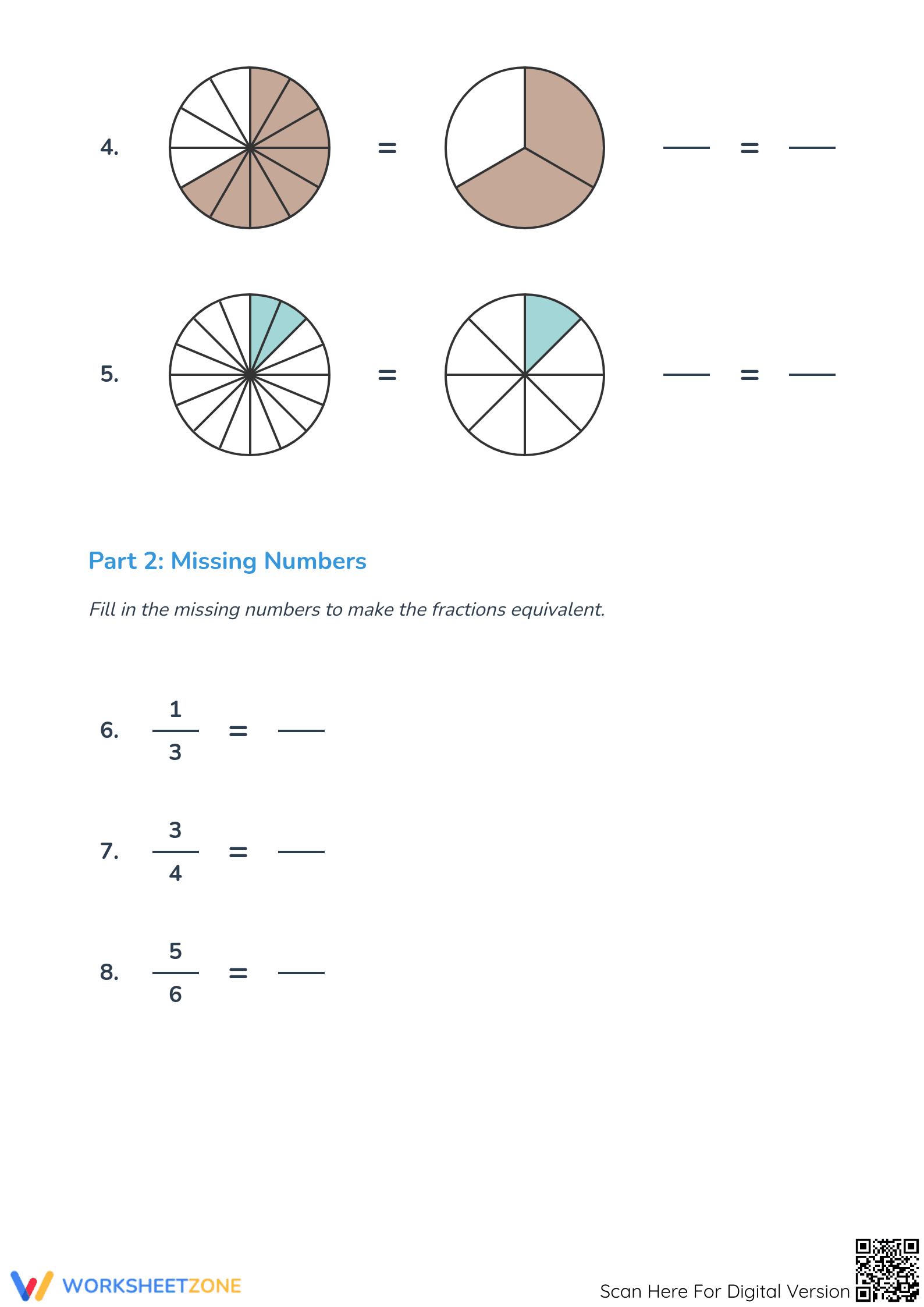
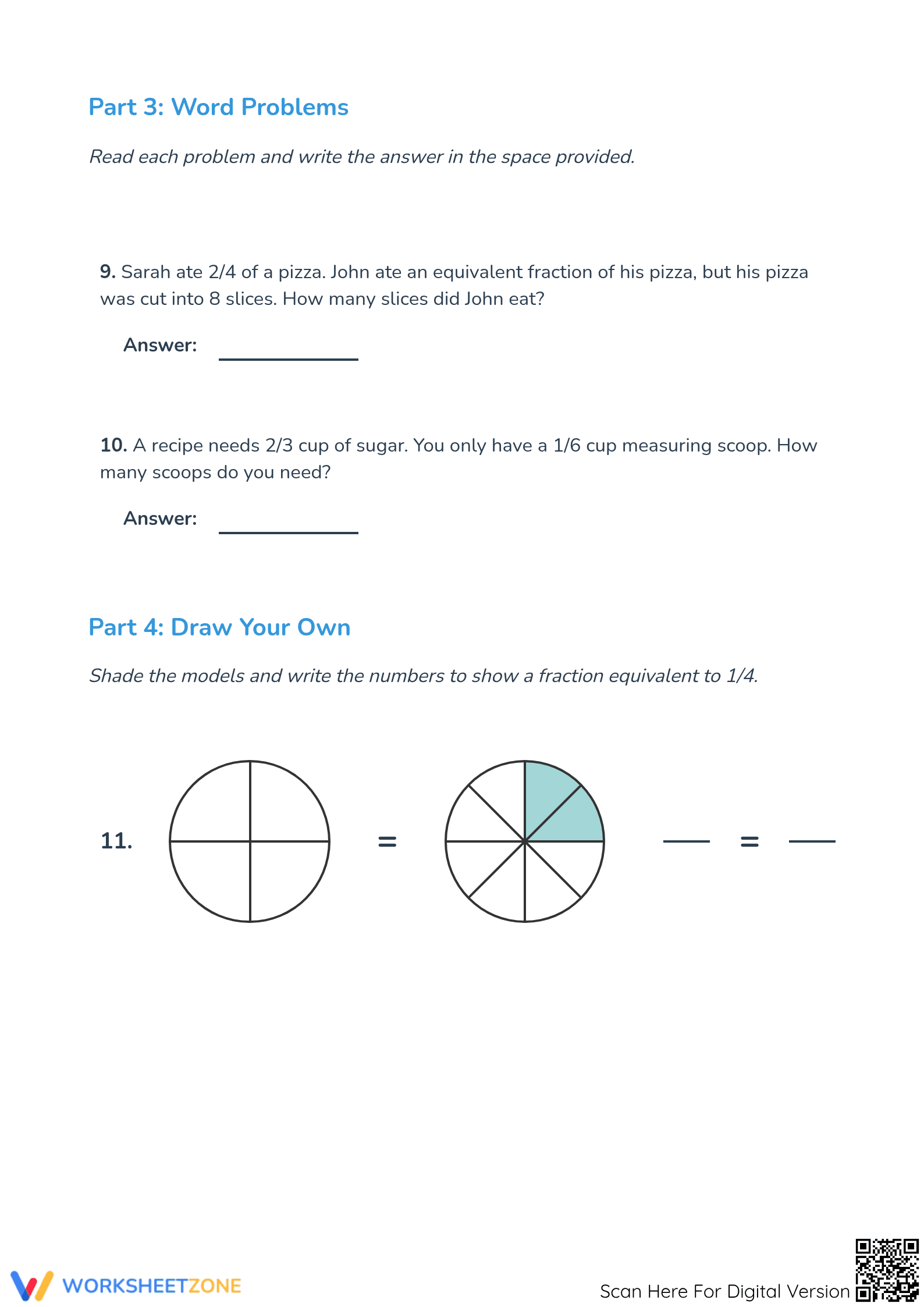
The three-page PDF is structured to support varied learning styles. It begins with visual circle models, transitions to numerical "missing number" equations, and concludes with real-world word problems. The final task requires students to draw their own models. A full answer key is included for rapid grading and student self-correction.
Skill Progression
- Guided Practice: 5 problems use pre-divided circle models to anchor understanding in concrete imagery.
- Supported Practice: 3 numerical problems remove scaffolds, requiring students to find values through multiplication or division.
- Independent Application: 2 word problems and a drawing task challenge students to apply knowledge to authentic scenarios.
This sequence ensures students are not overwhelmed as they move toward mathematical independence.
Standards Alignment
This resource is strictly aligned to `4.NF.A.1`. Students explain why fractions are equivalent by using visual models, noting how the number and size of parts differ even though the fraction values remain the same. This standard code can be copied directly into lesson plans, IEP goals, or district curriculum mapping tools.
How to Use It
Deploy this worksheet during the independent practice phase of your lesson. It serves as an excellent formative assessment tool; teachers should observe if students correctly identify total parts versus shaded parts. Expected completion time is 25 minutes, making it ideal for a mid-week check-in or a supplemental homework assignment.
Who It's For
This resource is designed for Grade 4 students, though it provides remediation for Grade 5 or extension for advanced Grade 3. It pairs naturally with fraction tiles or digital interactives to reinforce concepts across multiple modalities.
The instruction of equivalent fractions through multiple representations is a cornerstone of effective mathematics pedagogy. According to the RAND AIRS 2024 report on elementary numeracy, students who utilize visual models alongside numerical practice show a 32 percent higher retention rate of fraction concepts compared to those who focus solely on algorithms. This worksheet mirrors that research by starting with circle models before moving to abstract equations. By requiring students to justify equivalence through both shading and word-problem analysis, the resource adheres to the rigorous demands of 4.NF.A.1. This multi-modal approach ensures that students develop the "fraction sense" necessary for more complex operations like addition with unlike denominators or simplification. Educators can trust this structured sequence to produce measurable gains in student proficiency and confidence. This summary is intended for integration into professional development portfolios or instructional planning documents.


