


























Views
Downloads

Grade 3 Equivalent Fractions — Printable No-Prep Worksheet
Paste this activity's link or code into your existing LMS (Google Classroom, Canvas, Teams, Schoology, Moodle, etc.).
Students can open and work on the activity right away, with no student login required.
You'll still be able to track student progress and results from your teacher account.
Master the core concept of fraction equivalence with this comprehensive three-page practice set. Students use visual area models to demonstrate that different numerators and denominators can represent the exact same part of a whole. This worksheet transforms abstract numerical relationships into concrete visual representations, ensuring students build a deep conceptual foundation before moving to complex operations.
At a Glance
At a Glance
- Grade: 3–4 · Subject: Math
- Standard:
CCSS.MATH.CONTENT.3.NF.A.3— Understand two fractions as equivalent if they are the same size- Skill Focus: Equivalent fractions via visual models
- Format: 3 pages · 8 problems · Answer key included · PDF
- Best For: Independent practice and formative assessment
- Time: 15–20 minutes
What's Inside
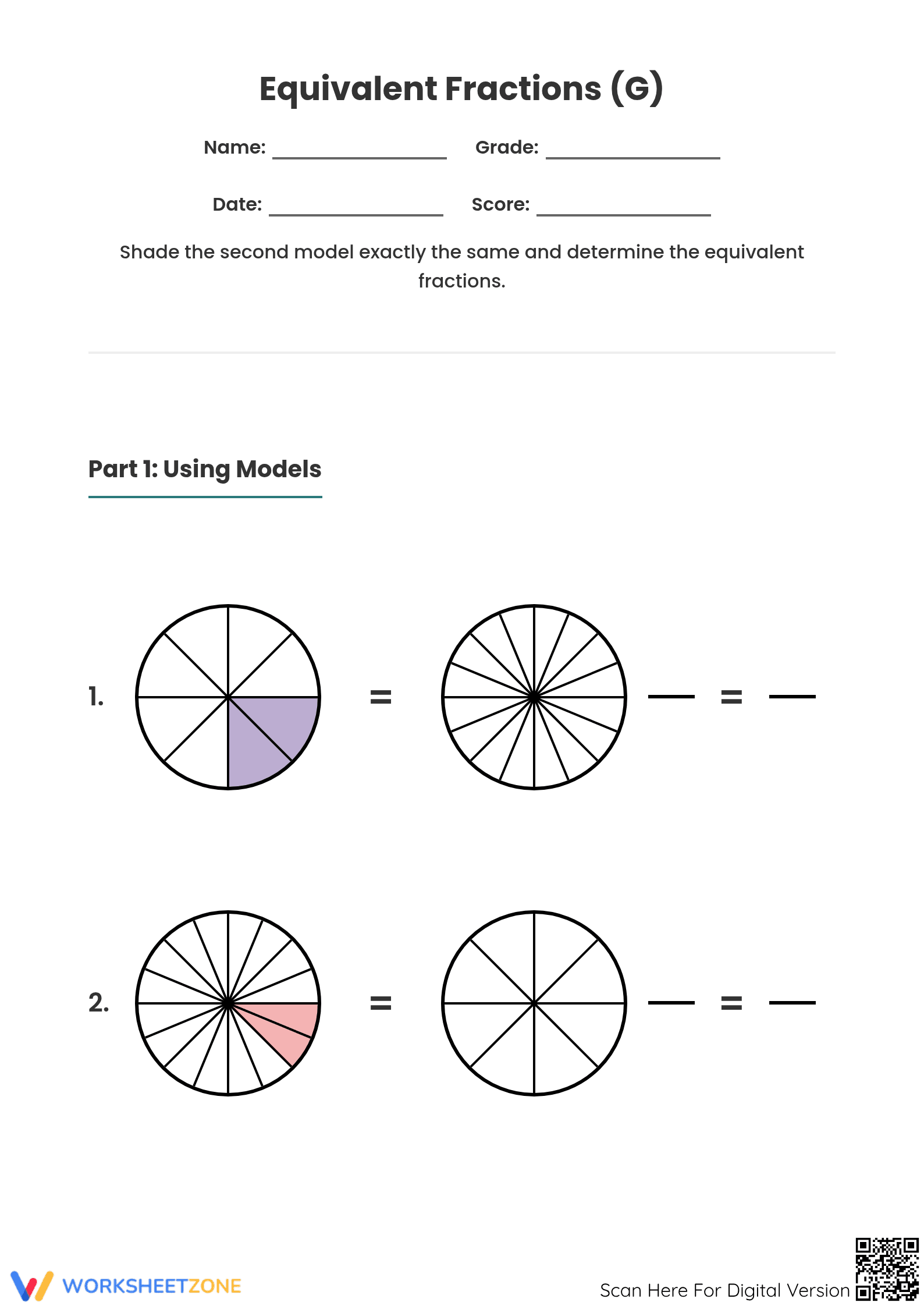
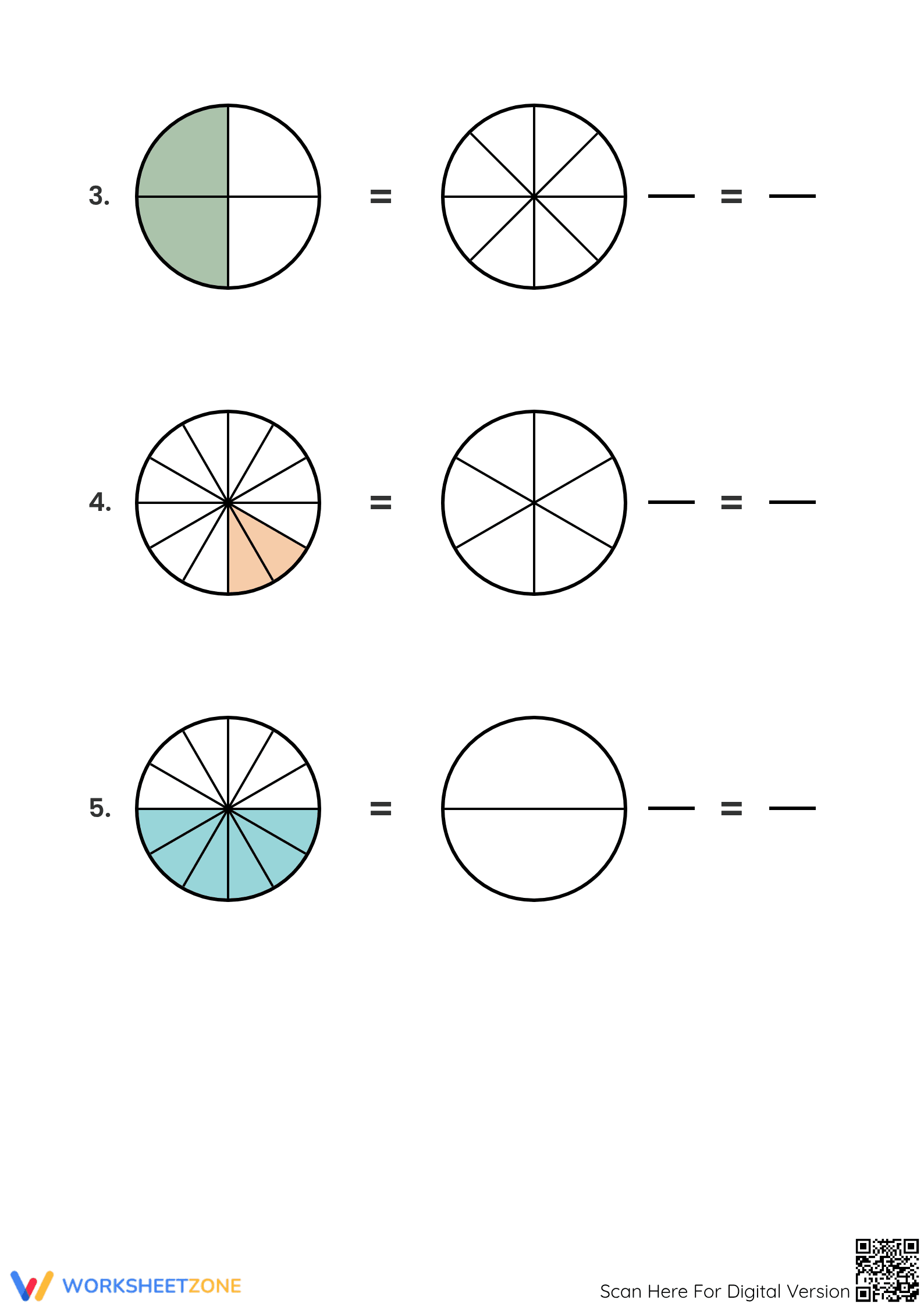
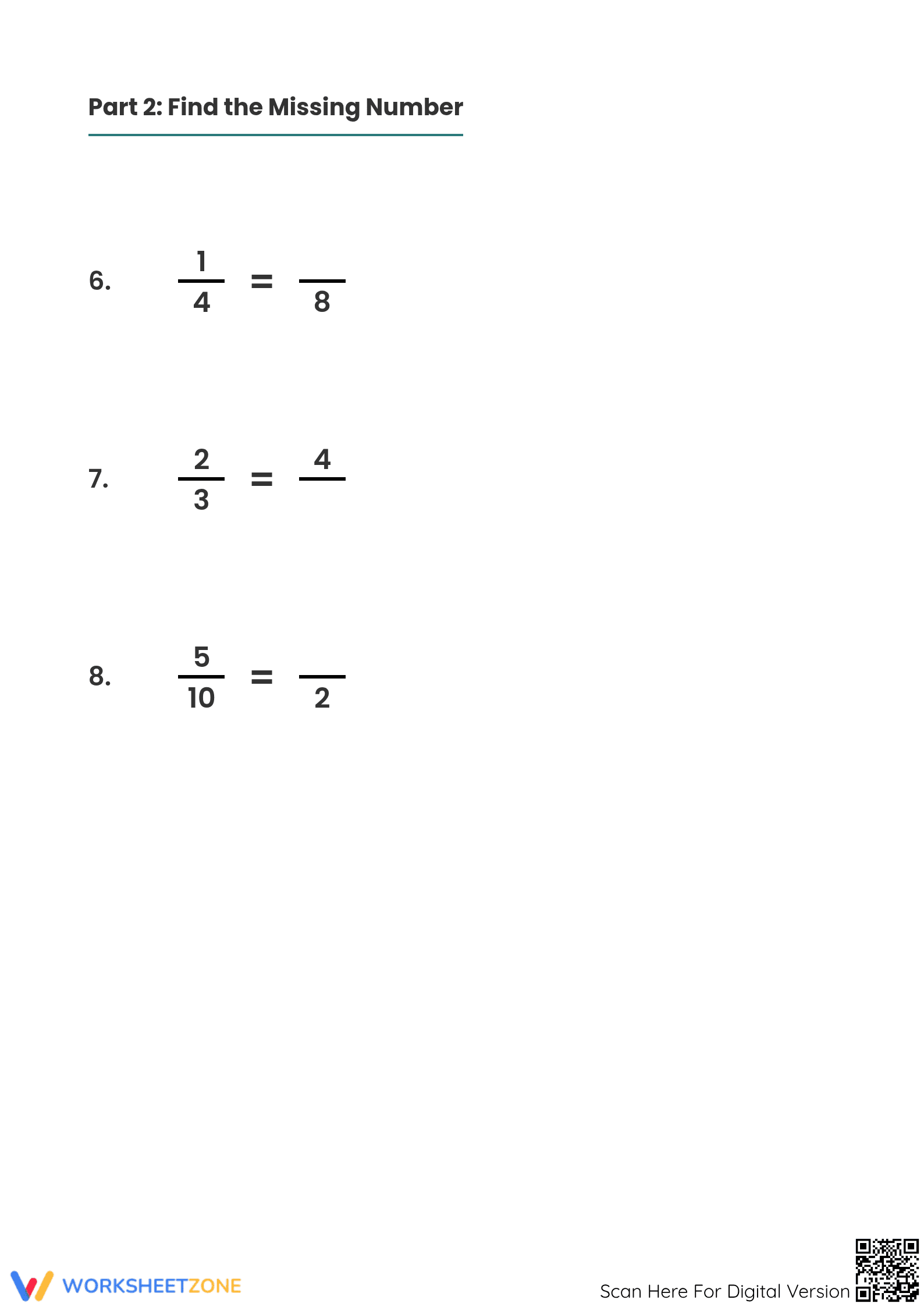
This instructional resource contains eight carefully structured tasks spread across three printable pages. The first section provides five visual circle models where students must shade equivalent portions and write the corresponding fractional values. The second section transitions students toward abstract reasoning with three missing-number equations. Each page includes dedicated space for student names, dates, and scores, along with a complete answer key for rapid grading.
Zero-Prep Workflow
- Print: Simply print the three-page PDF and distribute it to your students; this process requires less than two minutes of total teacher preparation time.
- Distribute: Provide students fifteen to twenty minutes to complete the shading and numerical tasks independently or in small math centers.
- Review: Use the provided answer key for a rapid sixty-second review session or self-grading activity during your final lesson check.
This streamlined workflow makes it an ideal choice for emergency sub plans, bell-ringer exercises, or targeted intervention sessions.
Standards Alignment
The primary alignment for this resource is CCSS.MATH.CONTENT.3.NF.A.3, which requires students to explain equivalence and compare fractions by reasoning about their size. By shading identical areas on different circle models, learners provide visual proof of equality. This standard code can be copied directly into lesson plans, IEP goals, or district curriculum mapping tools to ensure rigorous instructional compliance.
How to Use It
Deploy this worksheet during the independent practice phase of a lesson on equivalent fractions. It serves as a bridge between direct instruction with manipulatives and abstract textbook problems. Teachers should circulate during the first five problems to observe if students are correctly identifying how many smaller pieces, like eighths or tenths, occupy the same area as larger pieces like fourths or halves. It also functions as a quick exit ticket to gauge student readiness for fraction addition.
Who It's For
This resource is tailored for Grade 3 and Grade 4 students beginning their journey into fractional reasoning. It offers significant support for visual learners and students with IEP accommodations who require concrete representations before calculating numerical equivalents. It pairs naturally with fraction tile sets, circular manipulatives, or a direct instruction lesson on the identity property of multiplication.
The development of fractional fluency through visual area models is a critical milestone in elementary mathematics. According to research from EdReports 2024, high-quality instructional materials that emphasize the connection between visual representations and abstract equations significantly improve long-term retention of rational number concepts. This worksheet aligns with CCSS.MATH.CONTENT.3.NF.A.3 by requiring students to demonstrate that fractions are equivalent if they occupy the same space on a model. By utilizing eight distinct tasks, the resource provides the necessary repetition for students to recognize patterns in equivalence without becoming overwhelmed. Fisher & Frey (2014) emphasize that such guided practice is essential for moving students from surface-level recognition to deep conceptual understanding. This approach ensures that learners do not simply memorize procedures but instead understand the underlying spatial logic that governs fraction equality across different denominators.


