


























Views
Downloads


Essential Equivalent Fractions Worksheet | Grade 4 Math
Paste this activity's link or code into your existing LMS (Google Classroom, Canvas, Teams, Schoology, Moodle, etc.).
Students can open and work on the activity right away, with no student login required.
You'll still be able to track student progress and results from your teacher account.
This essential Grade 4 math worksheet focuses on the critical concept of equivalent fractions through high-contrast visual models and numerical completion tasks. By requiring students to shade and compare circular area models, the resource ensures learners see the physical equality between different fractional parts. The included 8 problems provide a clear path toward fraction mastery.
At a Glance
- Grade: 4 · Subject: Math
- Standard:
4.NF.A.1— Use visual models to explain why two different fractions are actually equal- Skill Focus: Equivalent fractions through area models
- Format: 3 pages · 8 problems · Answer key included · PDF
- Best For: Conceptual practice and quick formative assessment
- Time: 20–30 minutes
What's Inside
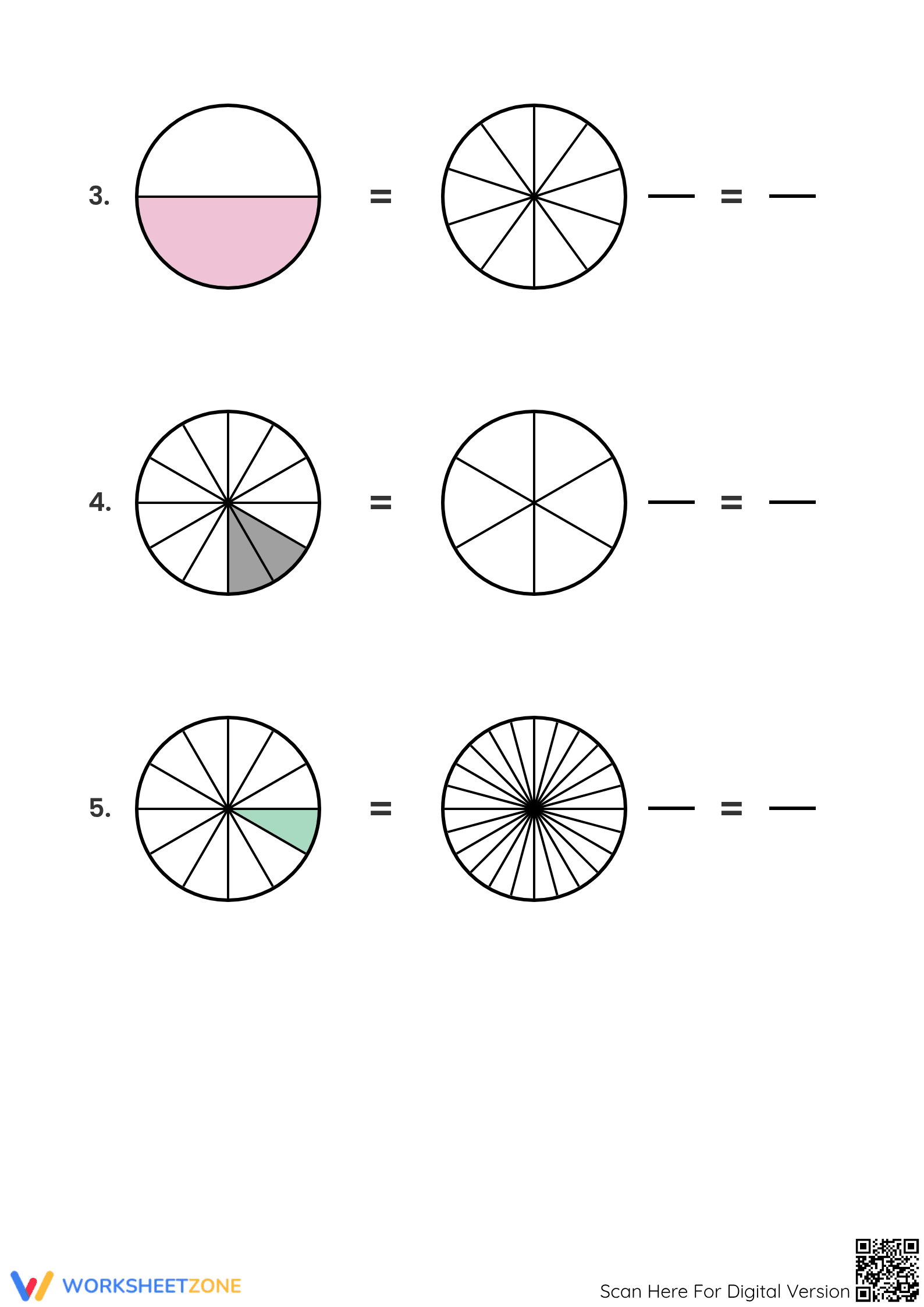
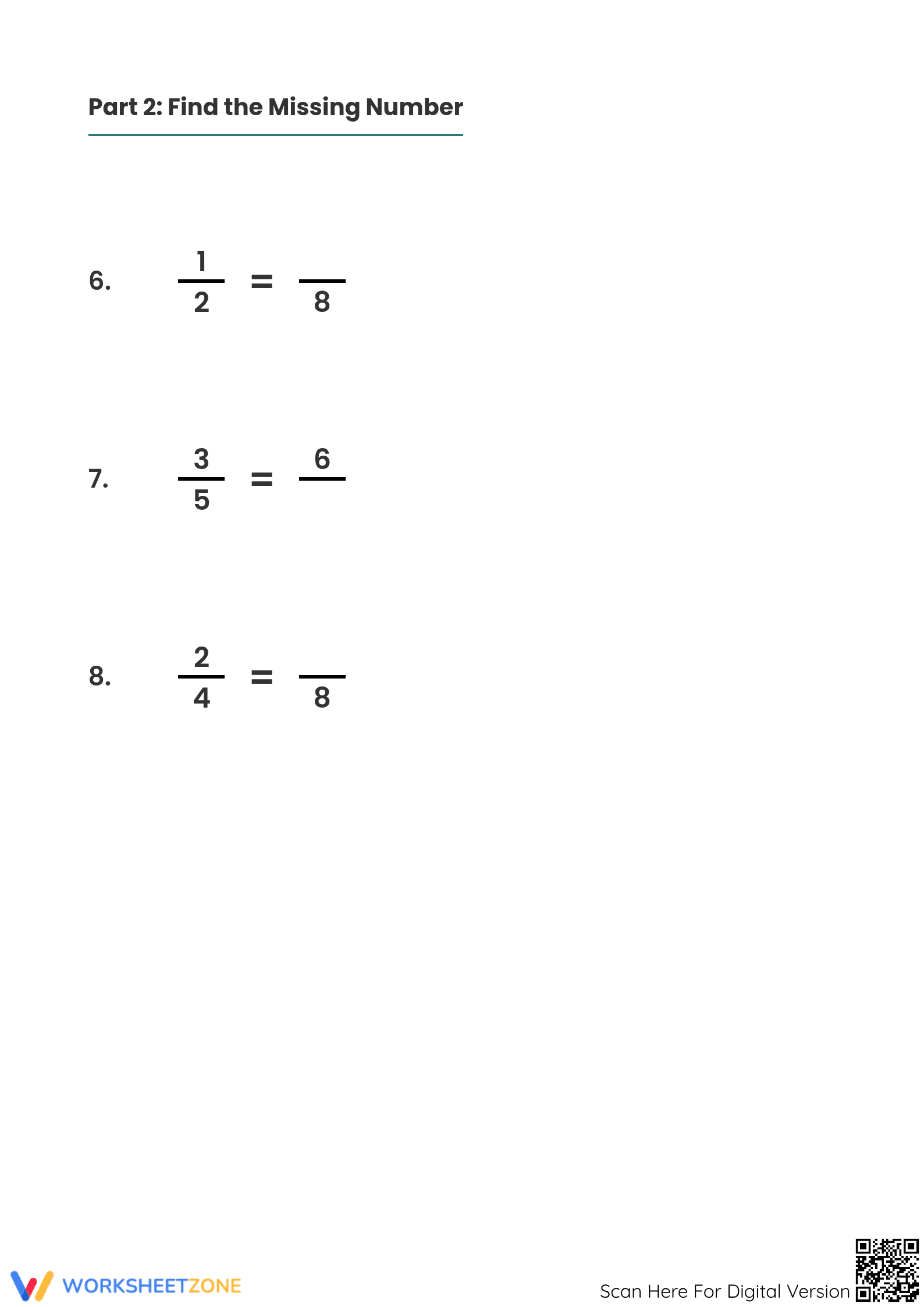
This 3-page printable PDF features two distinct sections designed to build conceptual depth. The first section presents five area model problems where students must shade circular regions to visualize equivalence. The final section contains three numerical problems requiring students to find missing numerators or denominators to create equal fractions. A full answer key facilitates rapid grading and self-correction.
Skill Progression
The sequence follows a gradual release model. Students begin by identifying pre-shaded equivalent fractions to build recognition. Next, they actively shade circular models to demonstrate that area remains constant regardless of partitioning. Finally, students solve numerical problems without visual scaffolds to prove mastery. This structured approach ensures learners transition smoothly from concrete visuals to abstract calculations.
Standards Alignment
The primary alignment for this resource is `4.NF.A.1`. This standard requires students to explain why a fraction a/b is equivalent to a fraction (n*a)/(n*b) by using visual fraction models. By focusing on the relationship between the number and size of parts, this worksheet meets the rigorous demands of the core curriculum. This standard code can be copied directly into lesson plans, IEP goals, or district curriculum mapping tools.
How to Use It
Use this resource as a formative assessment after introducing the concept of equivalent fractions with manipulatives. Teachers should observe students as they shade the circular models, checking for an understanding that the total area remains constant despite more divisions. Alternatively, assign the 3-page packet as a targeted remediation tool for students who struggle with the abstract concept of multiplying the numerator and denominator by the same value.
Who It's For
This worksheet is designed for Grade 4 students but serves as a review for Grade 5 learners. It provides scaffolding for students requiring visual supports to grasp mathematical abstractions. Pair this with circular fraction tiles or an anchor chart for maximum instructional impact.
The CCSS.MATH.CONTENT.4.NF.A.1 standard emphasizes that conceptual understanding of equivalent fractions must precede procedural fluency. This worksheet supports this trajectory by requiring students to interact with area models before transitioning to numerical computation. Fisher & Frey (2014) indicate that students benefit from multiple representations of a single mathematical concept to build cognitive flexibility. By shading circle models to demonstrate that fractions like 1/3 and 4/12 occupy the same physical space, learners verify the principle that identity is preserved despite partition changes. This 3-page resource provides the scaffolding needed to bridge the gap between concrete visual evidence and abstract fraction arithmetic. Teachers can use the 8 provided tasks to identify misconceptions, such as the common error of treating numerators and denominators as independent whole numbers. This data-driven approach ensures students develop a robust foundation for more complex operations with rational numbers.


