


























Views
Downloads

Essential Equivalent Fractions Worksheet | Grade 4 Aligned
Paste this activity's link or code into your existing LMS (Google Classroom, Canvas, Teams, Schoology, Moodle, etc.).
Students can open and work on the activity right away, with no student login required.
You'll still be able to track student progress and results from your teacher account.
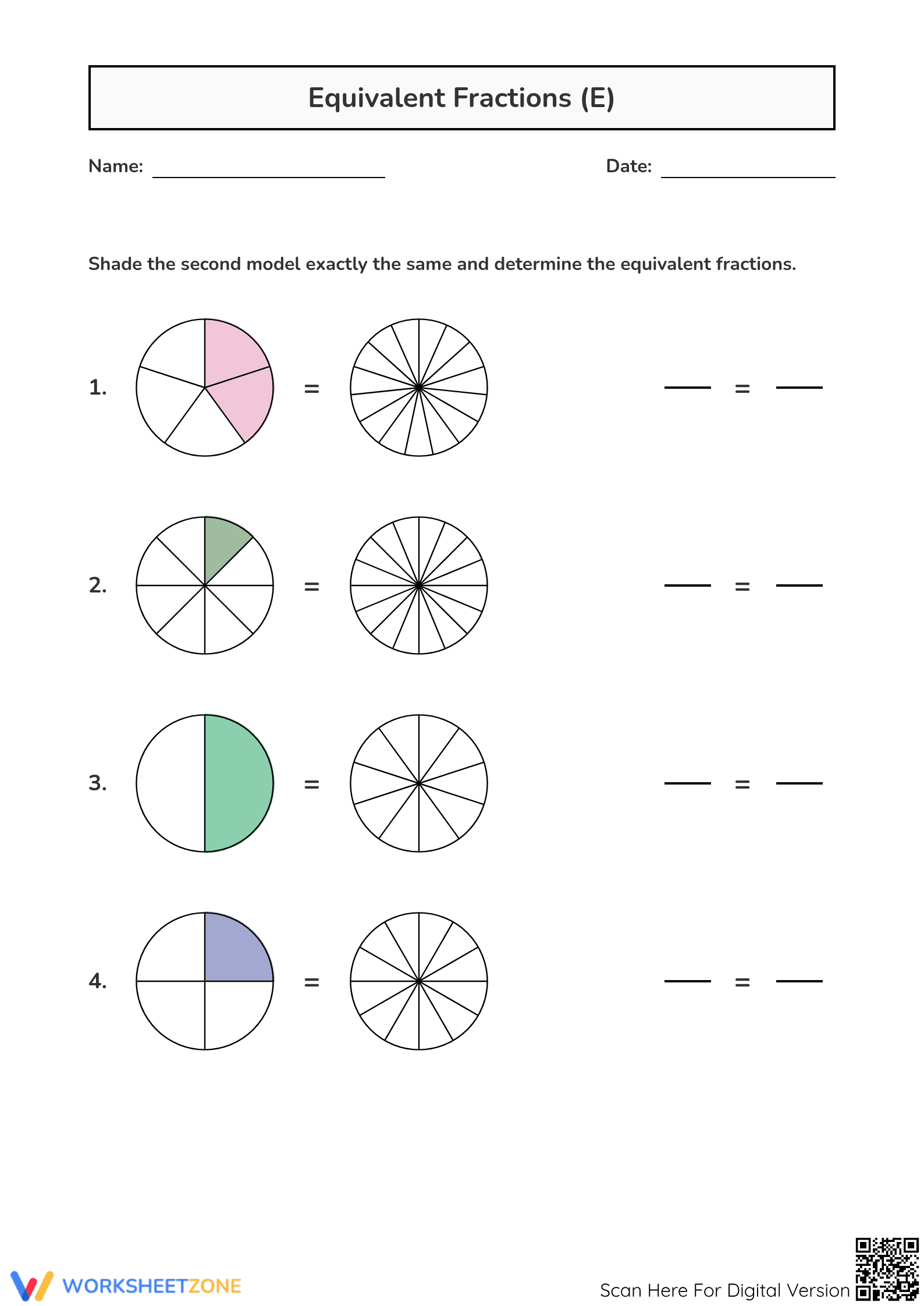
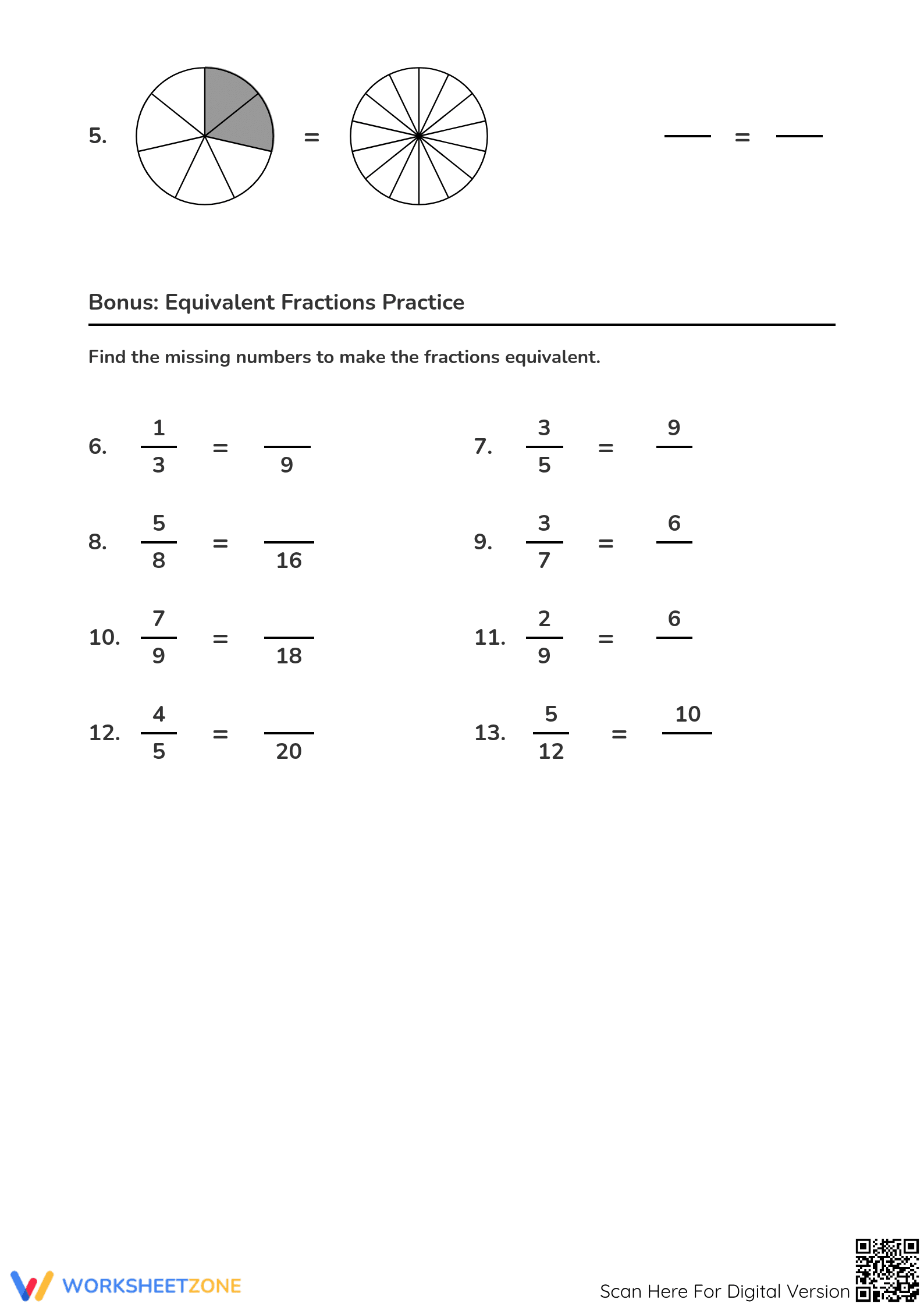
This comprehensive Grade 4 math resource provides structured practice for students learning to identify and generate equivalent fractions. By combining visual area models with numerical computation, the worksheet ensures that learners develop a deep conceptual understanding of how different fractions can represent the same part of a whole. Students begin by interacting with geometric representations, shading models to match proportions, and then progress to solving algebraic equivalency problems.
At a Glance
- Grade: 4 · Subject: Math
- Standard:
4.NF.A.1— Explain fraction equivalence using visual models to show how parts change size- Skill Focus: Visual and Numerical Fraction Equivalence
- Format: 2 pages · 13 problems · Answer key included · PDF
- Best For: Formative assessment or independent practice
- Time: 20–30 minutes
The worksheet is divided into two distinct pedagogical phases across two pages. The first page and the start of the second focus on visual models, where students must shade circular diagrams and determine the corresponding fraction. The latter half of the second page introduces a "Bonus" section containing eight numerical problems. In these tasks, students must identify missing numerators or denominators to balance equations, successfully transitioning from concrete visuals to abstract mathematical thinking.
Zero-Prep Workflow
Designed for immediate classroom implementation, this resource requires zero teacher preparation. Simply print the two-page PDF, distribute to students with a brief overview of shading expectations, and use the included answer key for rapid grading or peer-review. This streamlined workflow is ideal for emergency sub plans or bell-ringer activities.
Standards Alignment
The primary focus of this activity is CCSS.MATH.CONTENT.4.NF.A.1, which requires students to explain why a fraction is equivalent to another by using visual fraction models. By focusing on how the number and size of the parts differ even though the two fractions themselves are the same size, students build a foundation for later work with fraction addition and subtraction. This standard code can be copied directly into lesson plans, IEP goals, or district curriculum mapping tools.
How to Use It
Use this worksheet as a formative assessment following a lesson on fraction circles. During the shading phase, observe students to ensure understanding that total area remains constant despite increased partitions. With an expected completion time of 25 minutes, it serves as an ideal mid-lesson check. For students struggling with the numerical bonus section, utilize visual models from the first page to explain the multiplication rule of equivalence.
Who It's For
Tailored for Grade 4, this resource also enriches Grade 3 students or intervenes for Grade 5 learners needing support with fractional concepts. It pairs naturally with manipulatives like fraction tiles or an anchor chart for common equivalencies (1/2, 2/4, 4/8). Its clear layout and structured tasks suit English Language Learners benefiting from visual math instruction.
Research emphasizes visual representation as fundamental for conceptual understanding in middle elementary mathematics. This worksheet directly applies these findings, requiring students to engage with area models before moving to abstract numerical operations. By shading models and determining equivalence, learners bridge the gap between concrete and symbolic math, a progression critical for long-term retention of fractional concepts (Fisher & Frey, 2014). The design, featuring both guided visual tasks and independent numerical practice, effectively manages cognitive load, allowing students to build fluency. This standard-aligned resource provides the repeated exposure necessary for mastery, supporting diverse learners in achieving 4.NF.A.1 competency through structured, evidence-based practice.


