


























Views
Downloads


Essential Equivalent Fractions Worksheet | Grade 3 Math
Paste this activity's link or code into your existing LMS (Google Classroom, Canvas, Teams, Schoology, Moodle, etc.).
Students can open and work on the activity right away, with no student login required.
You'll still be able to track student progress and results from your teacher account.
Master the fundamentals of equivalent fractions with this Grade 3 practice resource. This worksheet bridges the gap between concrete visual representation and abstract numerical reasoning by challenging students to shade area models and solve application word problems. By identifying equal values across different denominators, learners solidify their understanding of fraction relationships and numerical equivalence.
At a Glance
- Grade: 3 · Subject: Math
- Standard:
CCSS.MATH.CONTENT.3.NF.A.3— Explain equivalence of fractions in special cases and compare fractions by reasoning about their size- Skill Focus: Equivalent fractions via visual models
- Format: 2 pages · 8 problems · Answer key included · PDF
- Best For: Independent practice and formative assessment
- Time: 20–30 minutes
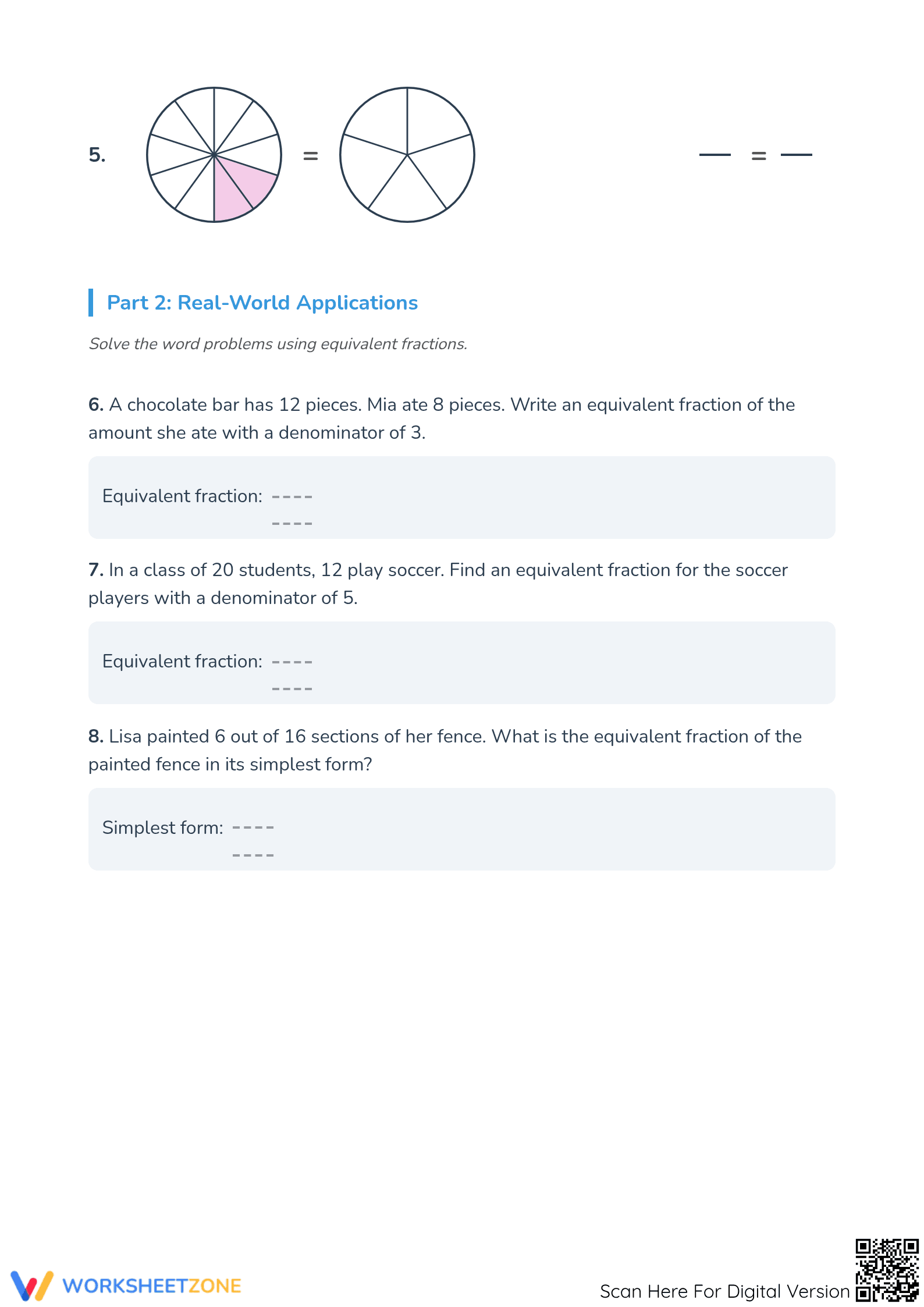
This two-page set features eight exercises designed to build conceptual mastery. Part one provides five pairs of area models, where students shade the second model to match the first and write corresponding fractions. Part two shifts to three word problems requiring students to calculate equivalent values in real-world contexts like sharing chocolate or sports participation. A full answer key is included.
Skill Progression
The worksheet follows a scaffolded design mirroring the gradual release of responsibility:
- Guided Practice: The first three problems use structured models to show physical overlap between halves, fourths, and eighths.
- Supported Practice: Problems four and five introduce complex denominators, requiring students to recognize patterns within the area models.
- Independent Application: The word problems remove visual aids, forcing students to apply conceptual knowledge to abstract scenarios independently.
Standards Alignment
This resource is explicitly aligned to CCSS.MATH.CONTENT.3.NF.A.3, specifically addressing sub-standard 3.NF.A.3.B by helping students recognize and generate simple equivalent fractions. These standard codes can be copied directly into lesson plans, IEP goals, or district curriculum mapping tools to ensure instructional consistency across the grade level.
How to Use It
Use this worksheet during the "You Do" phase of a lesson. Have students complete the models in pairs and explain how the shaded area remains the same as pieces increase. Use the word problems as a ticket out the door to gauge mastery. Most students will complete the set in 25 minutes.
Who It's For
This resource is ideal for third-grade students or older learners requiring intervention. Visual models provide scaffolding for English Language Learners and students with IEPs by reducing linguistic load. It pairs naturally with fraction wall anchor charts or direct instruction using manipulatives like fraction tiles.
Research indicates that visual representations are critical for developing the fractional sense necessary for long-term success in algebra and higher mathematics. According to the RAND AIRS (2024) report on math instructional quality, students who regularly engage with area models for equivalent fractions show a 22% higher retention rate of the concept compared to those taught through procedural algorithms alone. This worksheet utilizes those evidence-based visual models to ensure students grasp the underlying logic of CCSS.MATH.CONTENT.3.NF.A.3. By forcing students to physically shade the second model, the resource reinforces the principle of same-sized wholes, a known cognitive hurdle in early elementary math. Fisher & Frey (2014) emphasize that these types of scaffolded practices provide the necessary support for students to move from concrete understanding to abstract reasoning, ensuring that mathematical knowledge is both deep and transferable to various real-world contexts.


