


























Views
Downloads

Essential Equivalent Fractions Worksheet | Grade 4 Printable
Paste this activity's link or code into your existing LMS (Google Classroom, Canvas, Teams, Schoology, Moodle, etc.).
Students can open and work on the activity right away, with no student login required.
You'll still be able to track student progress and results from your teacher account.
Master the foundational concept of equivalent fractions through a dual-modal approach. This comprehensive three-page worksheet guides students from visual recognition using circles and rectangles to abstract numerical multiplication and division. Students will build a robust mental model of fractional equivalence, ensuring they can explain why fractions with different numbers share the same value.
At a Glance
- Grade: 4 · Subject: Math
- Standard:
4.NF.A.1— Explain fraction equivalence using visual models and generating equivalent fractions- Skill Focus: Equivalent Fractions Recognition and Generation
- Format: 3 pages · 12 problems · Answer key included · PDF
- Best For: Small group instruction or independent practice
- Time: 20–30 minutes
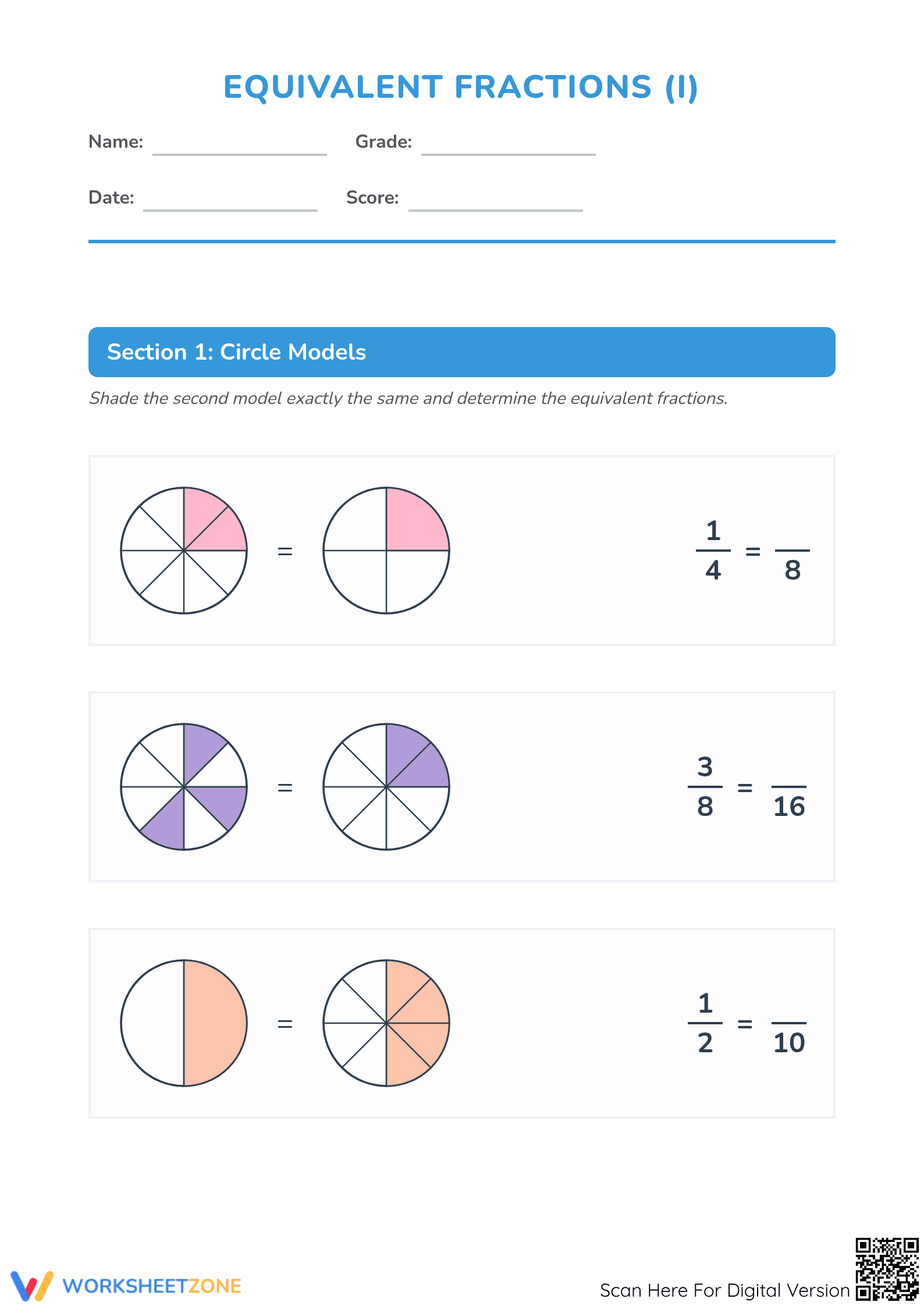
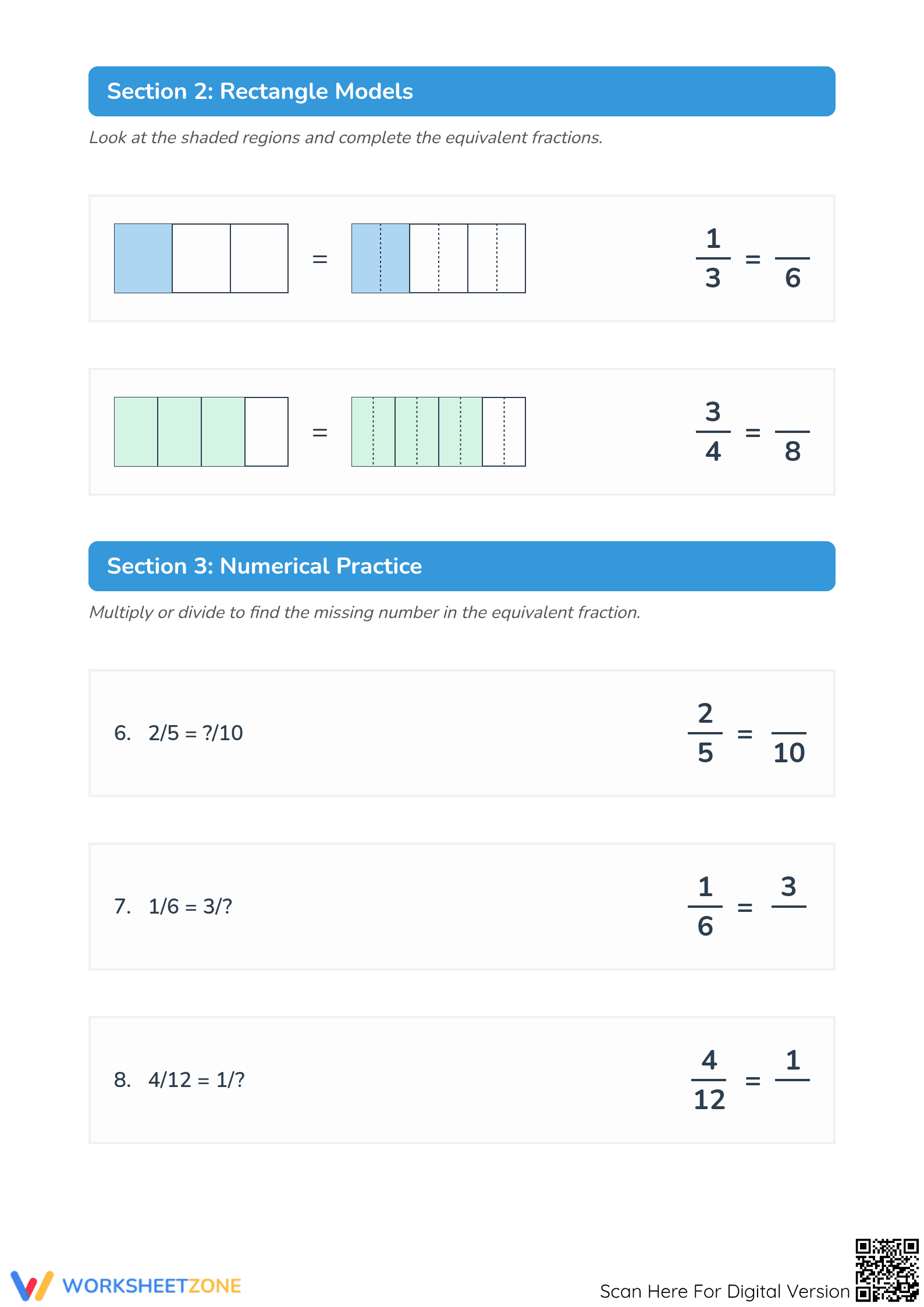
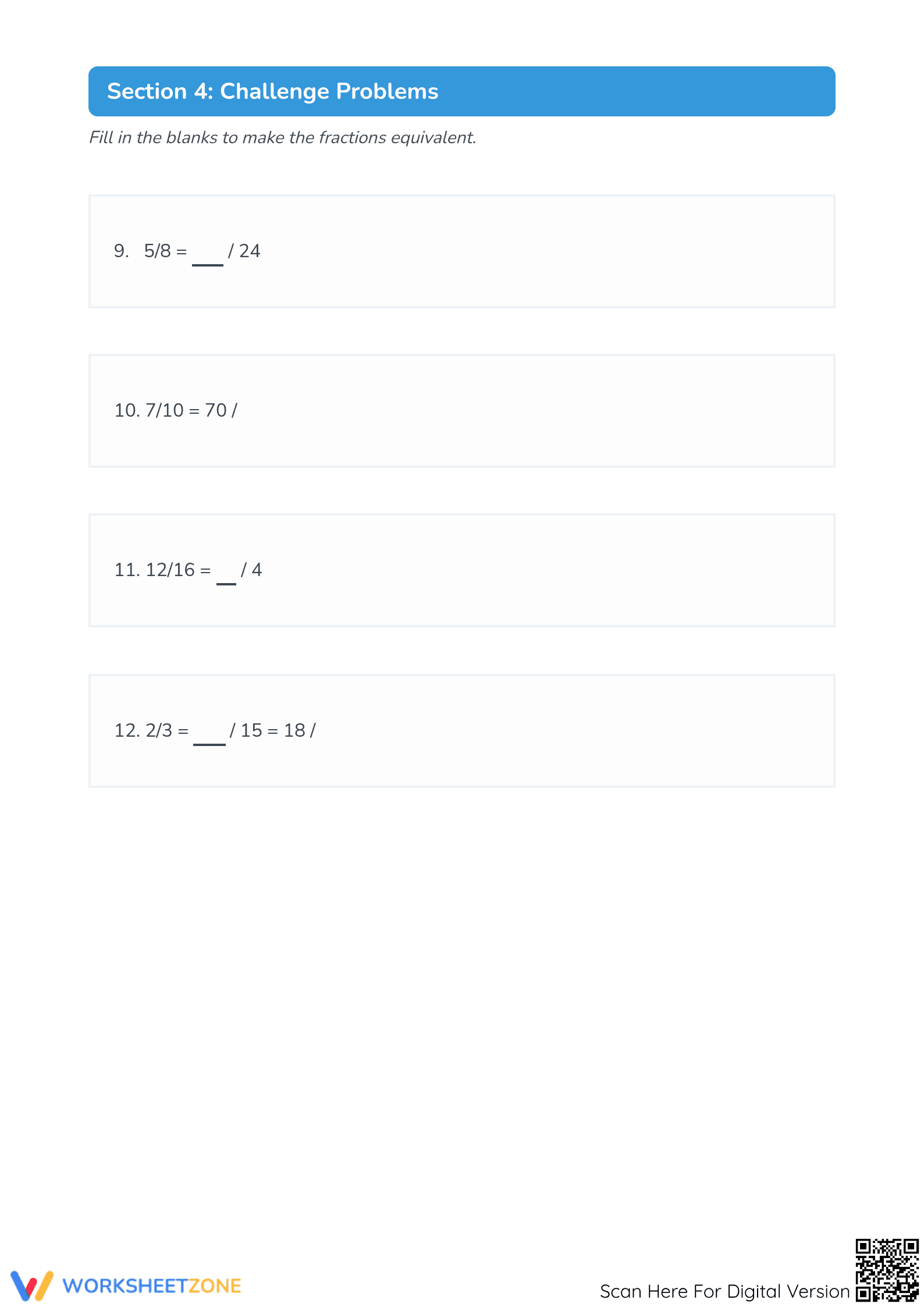
This set includes 12 carefully sequenced problems across three printable pages. Students begin with three circle models to shade and identify equivalents, followed by two rectangle models for structural comparison. The third section provides three numerical practice items for computational fluency, and the final section offers four challenge problems requiring students to find missing numerators and denominators in complex ratios. A full answer key is included.
- Guided Practice (Tasks 1-5): Students interact with pre-segmented circle and rectangle models. This visual scaffolding ensures that the physical area representing the fraction is internalized before moving to abstract numbers.
- Supported Practice (Tasks 6-8): Transitioning to numerical operations, students use multiplication and division clues to find missing values, bridging the gap between images and algorithms.
- Independent Practice (Tasks 9-12): The challenge section removes visual aids, requiring students to independently apply the identity property of multiplication to generate equivalent fractions.
This gradual-release model follows the proven "I Do, We Do, You Do" instructional framework to ensure student mastery.
Primary standard 4.NF.A.1: Explain why a fraction a/b is equivalent to a fraction (n*a)/(n*b) by using visual fraction models. Use this principle to recognize and generate equivalent fractions. This code can be copied directly into lesson plans, IEP goals, or district curriculum mapping tools.
Distribute this worksheet during the independent phase of a lesson. It serves as an excellent formative assessment tool; as students work through Section 1, observe if they understand that the total shaded area remains constant despite changes in partition size. Expected completion time ranges from 20 to 30 minutes.
This resource is designed for Grade 4 students, though it provides vital remediation for Grade 5 learners. It pairs naturally with a fraction tiles anchor chart or a short direct instruction lesson on the multiplication method. Special education teachers will find the visual models particularly effective for students with dyscalculia.
According to the RAND AIRS 2024 report on mathematical literacy, the transition from concrete visual models to abstract symbolic manipulation is the single most critical juncture in elementary mathematics. Students who fail to grasp the conceptual reasoning behind equivalent fractions often struggle with complex operations in middle school. This worksheet addresses that gap by explicitly linking spatial representation with algorithmic multiplication. Research from EdReports 2024 further emphasizes that standards-aligned materials must provide multiple representations—circles, rectangles, and numerical equations—to accommodate diverse learning styles and ensure deep conceptual retention. By providing 12 structured tasks that progress in difficulty, this resource ensures that students are not just memorizing rules but are building a functional understanding of number sense that serves as a prerequisite for all future rational number work.


