


























Views
Downloads
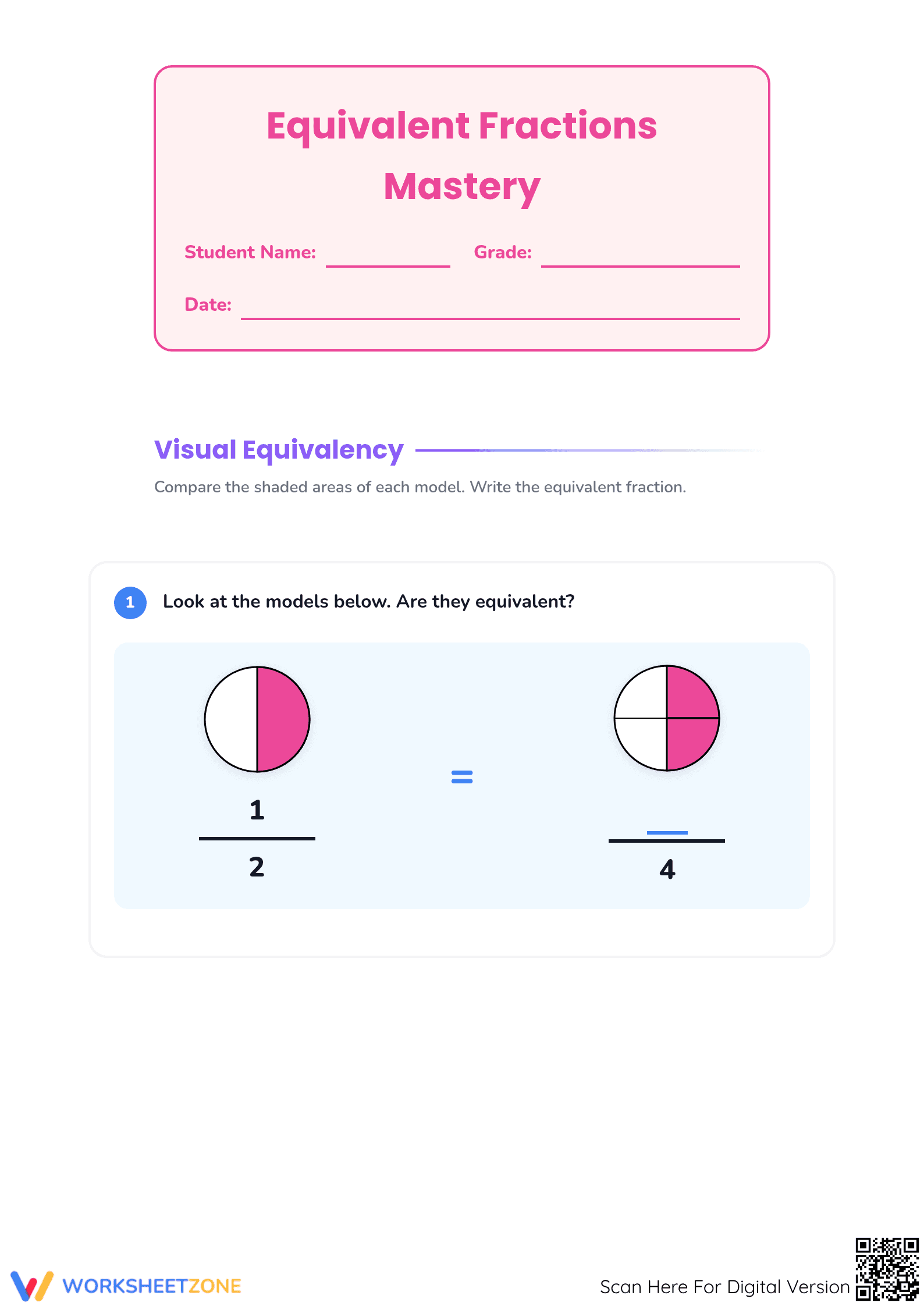
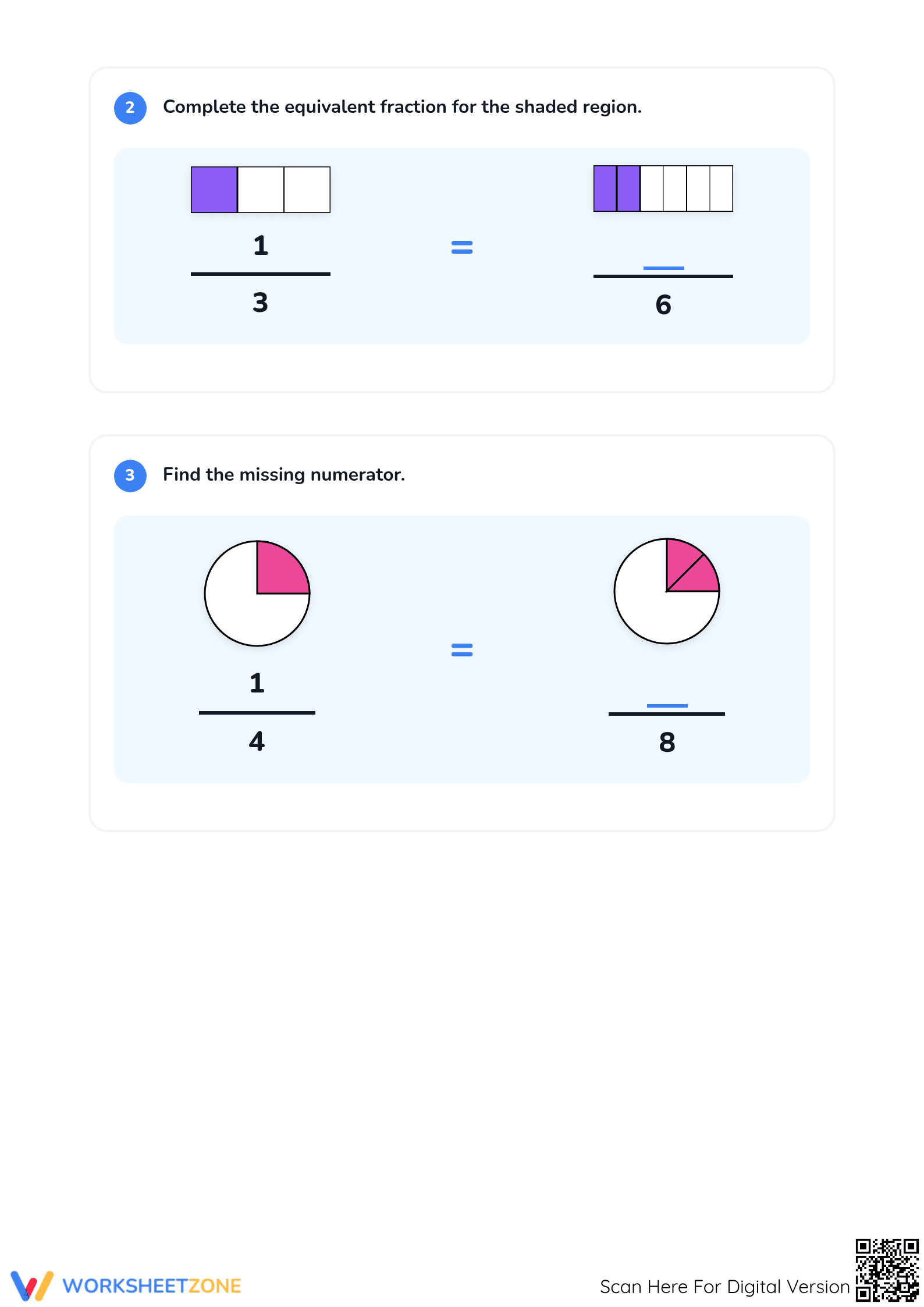


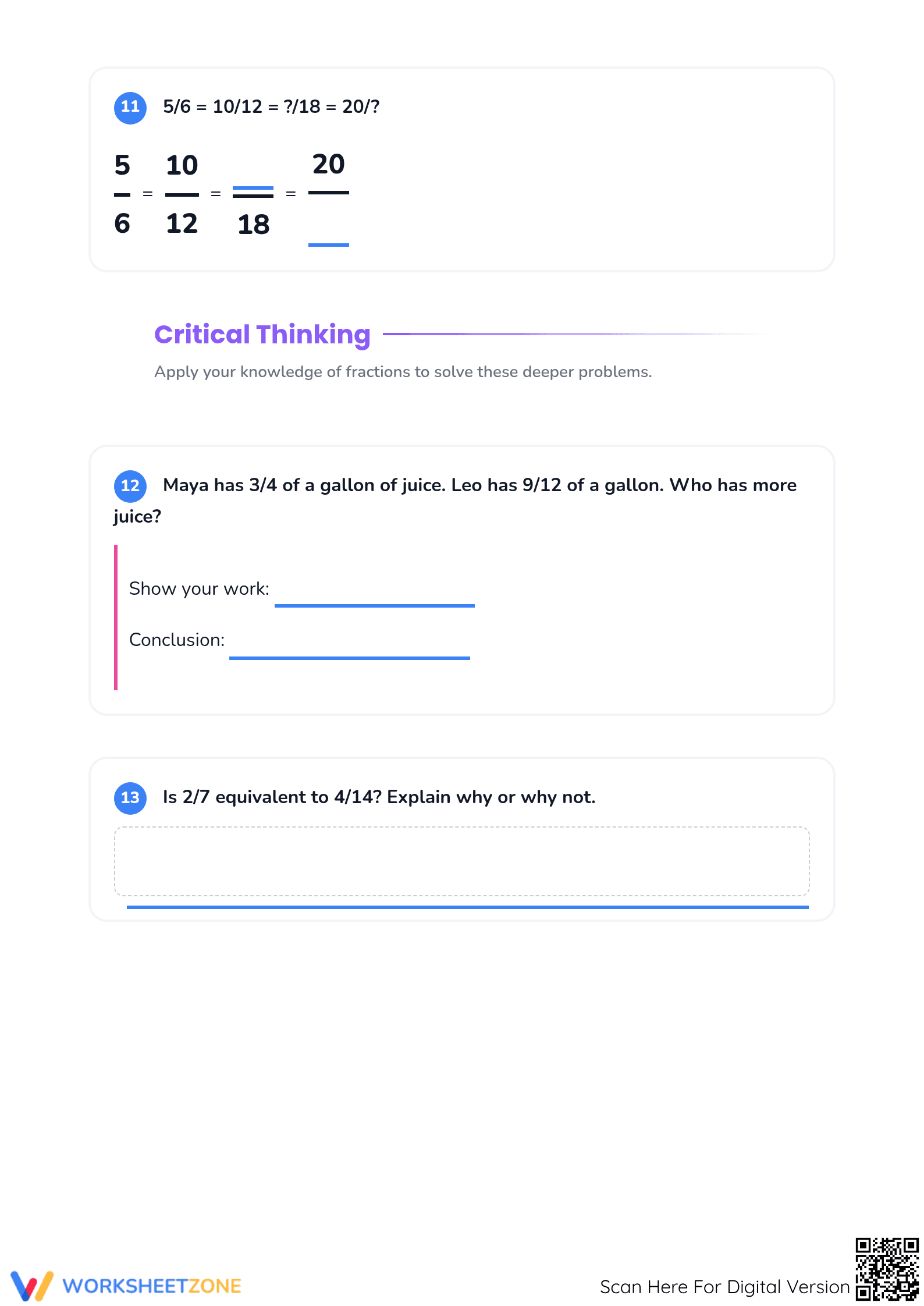

Essential 4.NF.A.1 Worksheet: Equivalent Fractions Mastery
Paste this activity's link or code into your existing LMS (Google Classroom, Canvas, Teams, Schoology, Moodle, etc.).
Students can open and work on the activity right away, with no student login required.
You'll still be able to track student progress and results from your teacher account.
Understand the fundamental concept of numerical equality with this comprehensive equivalent fractions mastery pack. This resource provides students with a structured path to recognize and generate fractions of the same value using multiple representational models. By moving from visual intuition to abstract reasoning, learners develop the fluency required for advanced rational number operations.
At a Glance
- Grade: 3-5 · Subject: Math
- Standard:
4.NF.A.1— Use visual fraction models to explain why fractions are equivalent- Skill Focus: Equivalent Fraction Identification & Generation
- Format: 5 pages · 13 problems · Answer key included · PDF
- Best For: Formative assessment and mastery tracking
- Time: 25–35 minutes
This 5-page PDF contains 13 unique tasks designed to bridge the gap between visual models and mathematical logic. The packet includes circular and rectangular area models, number line logic puzzles, pattern-based chains, and high-order critical thinking questions. Every problem is clearly numbered and spaced for student work, accompanied by a comprehensive answer key for efficient grading.
Each task in this set is strategically mapped to standard proficiency levels. Initial problems provide "Meeting" level evidence through direct visual comparison, while the logic-based patterns and word problems serve as "Exceeding" level indicators. Teachers can utilize the final explanation-based questions to gauge deeper conceptual understanding. Results can be directly entered into standards-based gradebooks or used as data points for IEP progress monitoring and instructional grouping.
The primary alignment is 4.NF.A.1: "Explain why a fraction a/b is equivalent to a fraction (n × a)/(n × b) by using visual fraction models, with attention to how the number and size of the parts differ even though the two fractions themselves are the same size." This resource also supports 3.NF.A.3 by reinforcing the comparison of fractions with identical area representations. Both standard codes can be copied directly into lesson plans, IEP goals, or district curriculum mapping tools.
Use this worksheet as a formal end-of-unit assessment or a mid-unit check-in during the "guided practice" phase of instruction. During the lesson, observe students as they transition from the visual models on page 1 to the numerical patterns on page 4; a student struggling with the pattern chains may need additional concrete modeling. Most students complete the full 13-item set in approximately 30 minutes.
This resource is ideal for upper elementary students in grades 3 through 5, though it serves as an excellent remedial tool for middle school learners. It pairs naturally with fraction tiles or virtual manipulatives for students requiring additional kinesthetic support. The inclusion of word problems makes it suitable for "Ready for Grade Level" enrichment groups.
The "Equivalent Fractions Mastery" worksheet is a scientifically structured tool for building rational number sense. By integrating visual area models with symbolic notation, it adheres to the Concrete-Representational-Abstract (CRA) sequence, a framework validated by research in Fisher & Frey (2014). This approach ensures that learners do not merely memorize procedural algorithms but understand the underlying ratio properties that define equivalency. According to EdReports 2024 analyses of high-quality instructional materials, the use of diverse models is critical for preventing common misconceptions, such as viewing the numerator and denominator as independent whole numbers. This 5-page assessment provides the necessary rigor for 4.NF.A.1 mastery, allowing educators to collect actionable data on student performance. As noted in ScienceDirect TpT Analysis, worksheets that move beyond simple identification into explanation-based tasks significantly improve long-term retention of mathematical concepts. This resource fulfills that demand through its critical thinking section and word problem applications.


