


























Views
Downloads

Essential Equivalent Fractions Worksheet | Grades 3-5 Ready
Paste this activity's link or code into your existing LMS (Google Classroom, Canvas, Teams, Schoology, Moodle, etc.).
Students can open and work on the activity right away, with no student login required.
You'll still be able to track student progress and results from your teacher account.
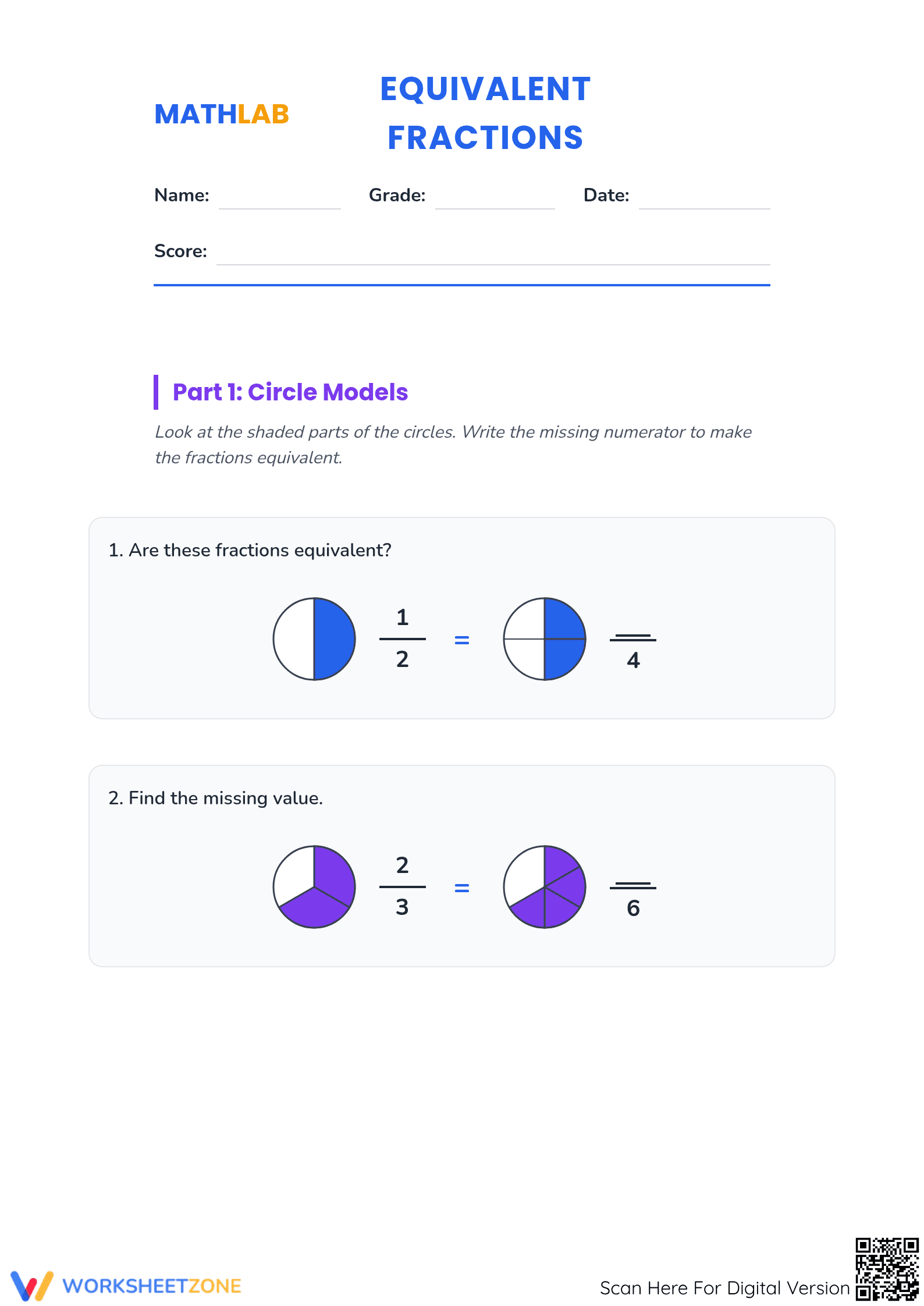
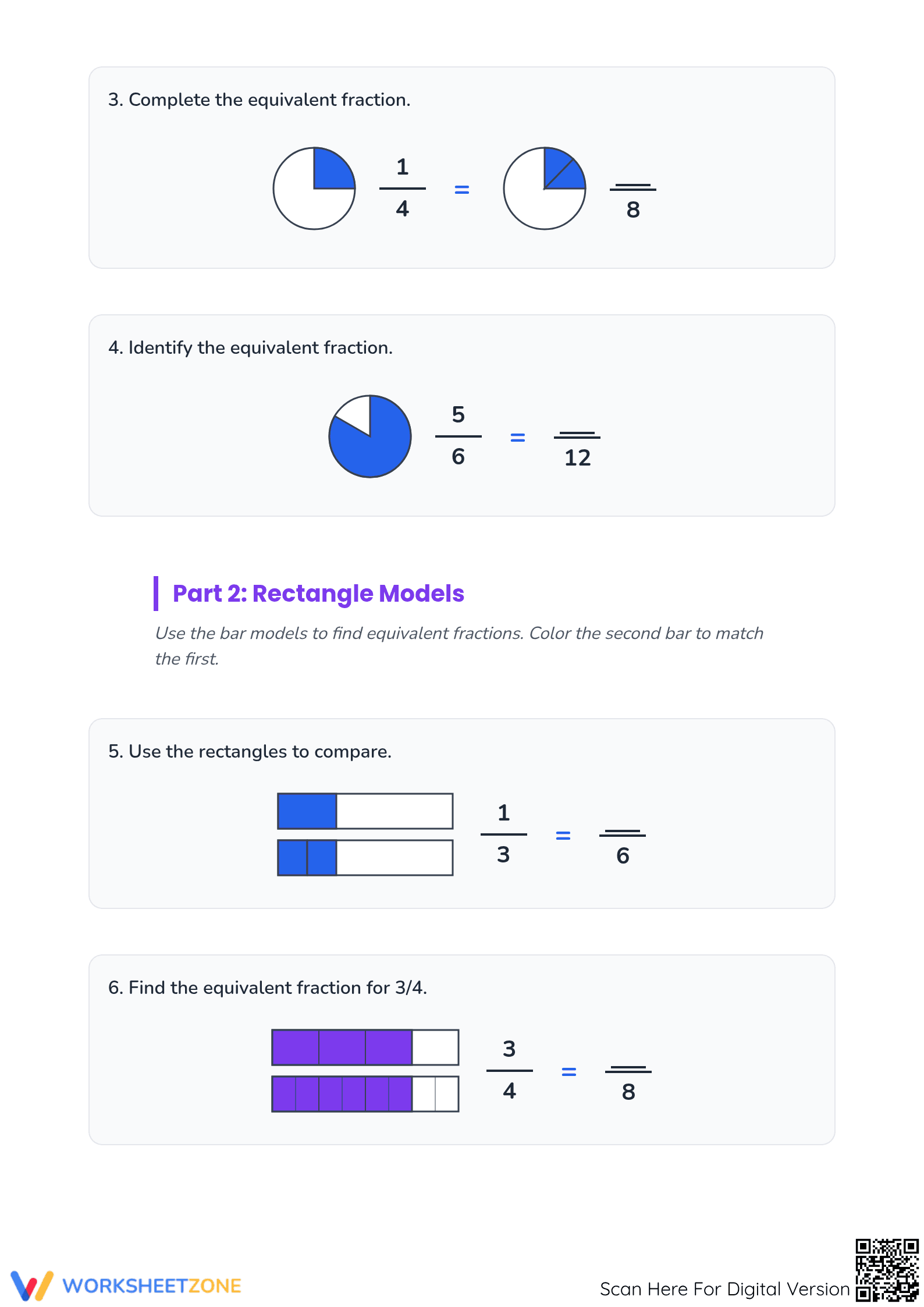
Master the concept of equivalent fractions through visual representation and logical reasoning. This comprehensive 5-page worksheet guides students from basic circle models to complex word problems and numerical sequences. By visualizing fractions as parts of a whole, students develop the deep conceptual foundation required for advanced rational number operations and algebraic thinking.
At a Glance
- Grade: 4 · Subject: Math
- Standard:
4.NF.A.1— Explain fraction equivalence using visual models to show how parts differ in size- Skill Focus: Equivalent fractions via area models
- Format: 5 pages · 18 problems · Answer key included · PDF
- Best For: Independent practice and formative assessment
- Time: 30–45 minutes
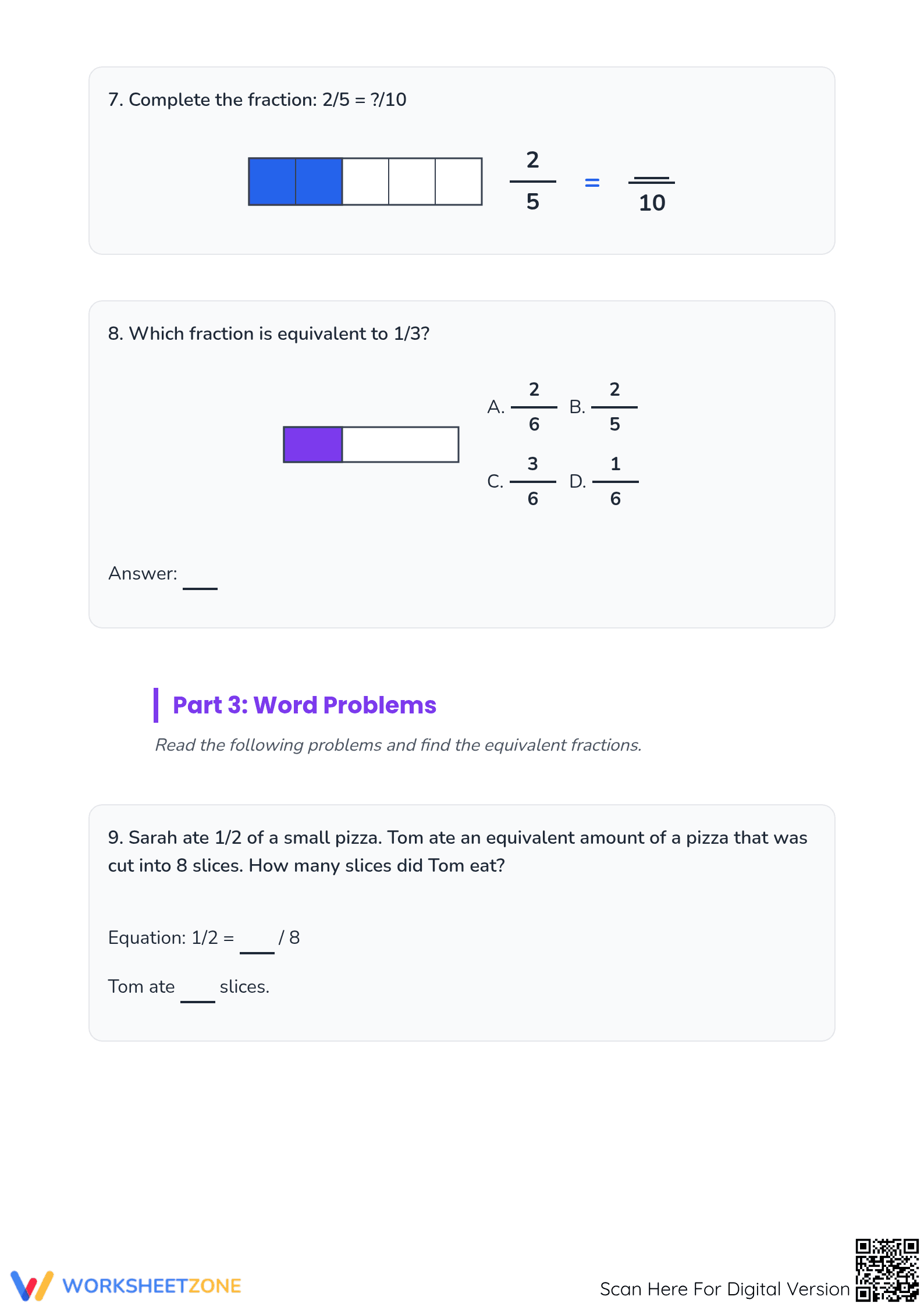
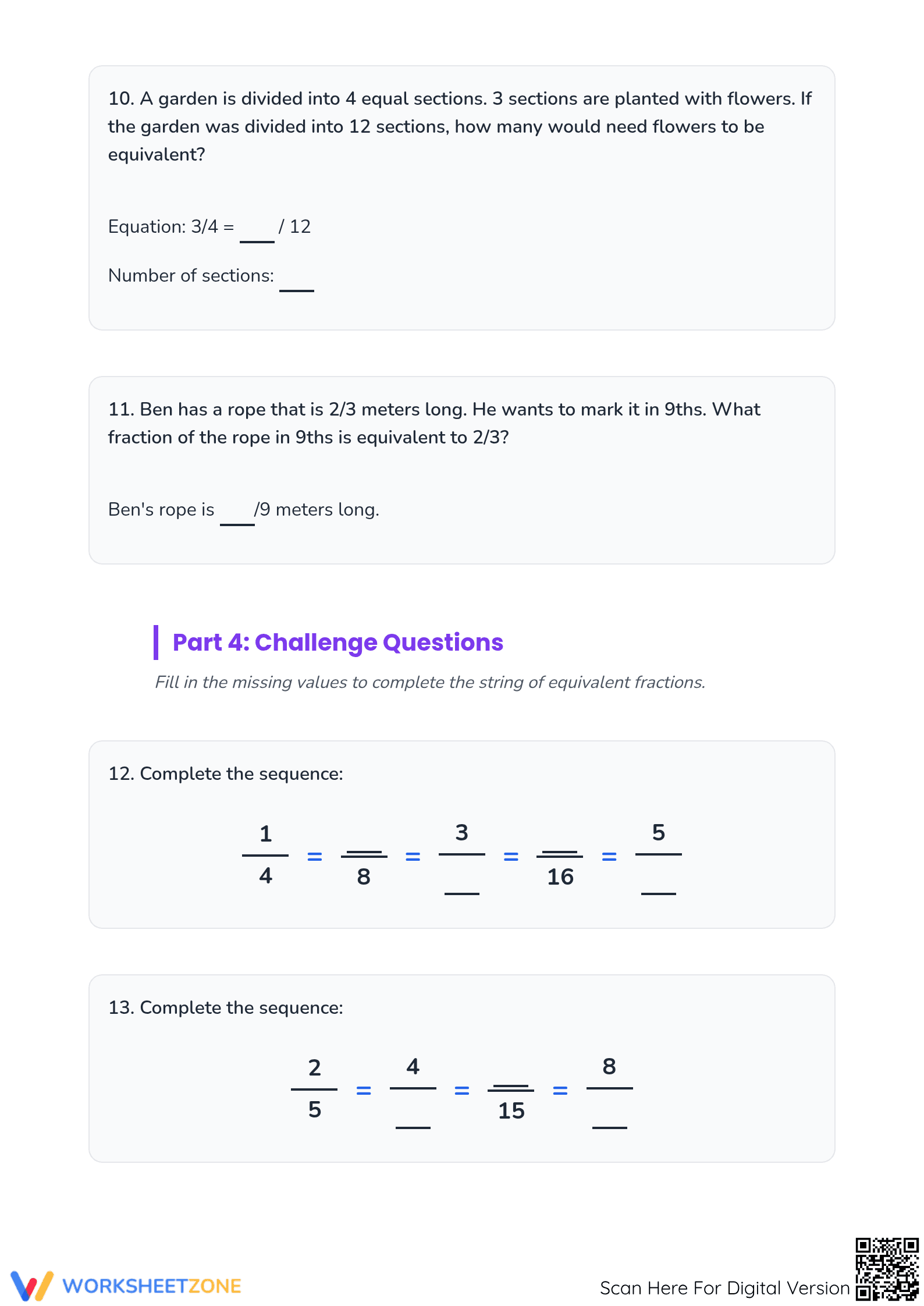
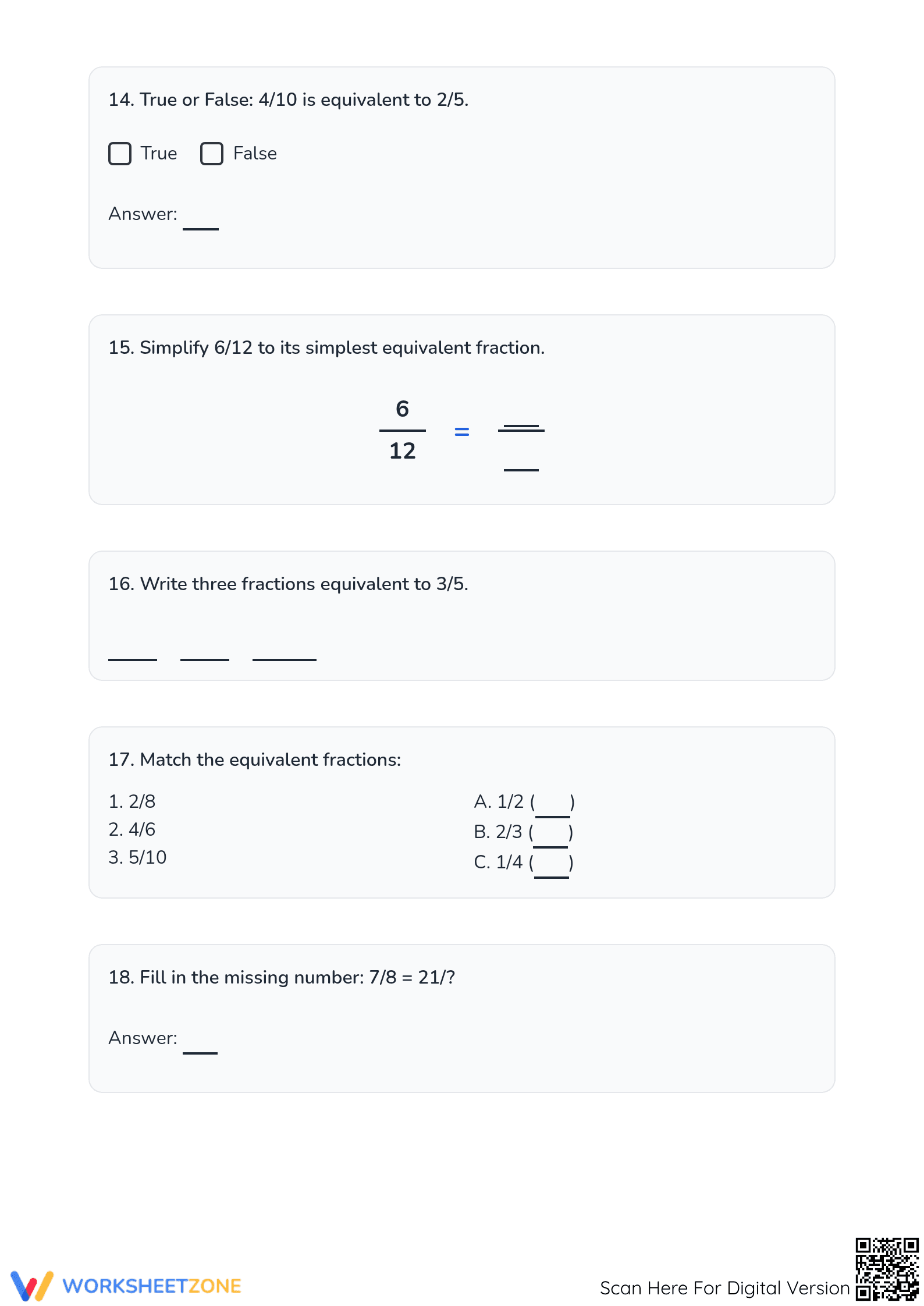
This 5-page packet features 18 varied tasks structured into four distinct parts. It begins with circle models to establish visual equivalence, transitions to bar models for linear comparison, applies skills to real-world word problems, and concludes with challenge sequences and simplifying tasks. The layout provides ample workspace for calculations and includes a full answer key for efficient grading.
Zero-Prep Workflow
Designed for the busy educator, this resource requires zero setup time beyond standard printing. Follow these three simple steps to integrate this into your math block:
- Print: Click print and generate copies for your entire class in under 60 seconds.
- Distribute: Hand out the 5-page packets as a complete lesson or separate them into daily warm-ups.
- Review: Utilize the included answer key to provide immediate feedback or enable student self-correction during independent work.
The logical progression makes it an ideal sub plan or a plug-and-play enrichment activity for your fractions unit.
Standards Alignment
The primary focus is `4.NF.A.1`, which requires students to explain why a fraction is equivalent to another by using visual fraction models. Students demonstrate how the number and size of the parts differ even though the two fractions themselves are the same size. Supporting standard `3.NF.A.3` is addressed through identifying simple equivalent cases. Both standard codes can be copied directly into lesson plans, IEP goals, or district curriculum mapping tools.
How to Use It
Use this packet as a summative assessment following a unit on fraction models. During the word problems section, circulate and observe if students are correctly translating the "small pizza" or "garden sections" into mathematical equations. This provides a clear window into their ability to apply abstract concepts to concrete scenarios. Alternatively, assign individual pages as tiered homework assignments to reinforce specific model types.
Who It's For
This resource is tailored for Grade 4 students but serves as excellent remediation for Grade 5-6 learners or extension for Grade 3. It naturally pairs with manipulatives like fraction tiles or a direct instruction lesson on multiplying numerators and denominators by the same number to maintain equivalence.
According to the NAEP framework, the ability to recognize and generate equivalent fractions using visual models is a critical milestone in elementary mathematics that predicts success in middle-school algebra. This worksheet leverages area models—circles and rectangles—to bridge the gap between concrete representation and abstract numerical manipulation. Research from Fisher & Frey (2014) emphasizes the importance of scaffolds like the ones provided in Part 1 and Part 2, which allow students to build mental models before tackling the challenge questions in Part 4. By aligning with standard 4.NF.A.1, this tool ensures that students are not merely memorizing cross-multiplication tricks but are instead developing a robust understanding of fraction magnitude. The inclusion of word problems satisfies the demand for contextual application, while the sequential patterns foster algebraic reasoning. This data-driven approach supports high-quality Tier 1 instruction and provides measurable evidence for progress monitoring.


