


























Views
Downloads


3.NF.A.3.B Worksheet: Equivalent Fractions — Essential Test
Paste this activity's link or code into your existing LMS (Google Classroom, Canvas, Teams, Schoology, Moodle, etc.).
Students can open and work on the activity right away, with no student login required.
You'll still be able to track student progress and results from your teacher account.
Mastering equivalent fractions is a foundational milestone in upper elementary mathematics. This printable assessment provides a comprehensive way for students to demonstrate their understanding of how different numerators and denominators can represent the same value. By transitioning from visual models to abstract word problems, students solidify their conceptual grasp of numerical equivalence and fractional relationships.
At a Glance
- Grade: 3 · Subject: Math
- Standard:
CCSS.MATH.CONTENT.3.NF.A.3.B— Recognize and generate simple equivalent fractions by using a visual fraction model- Skill Focus: Visual Fraction Equivalence Mastery
- Format: 4 pages · 25 problems · Answer key included · PDF
- Best For: Summative assessment, unit test preparation, or intervention checks
- Time: 30–45 minutes of focused student work
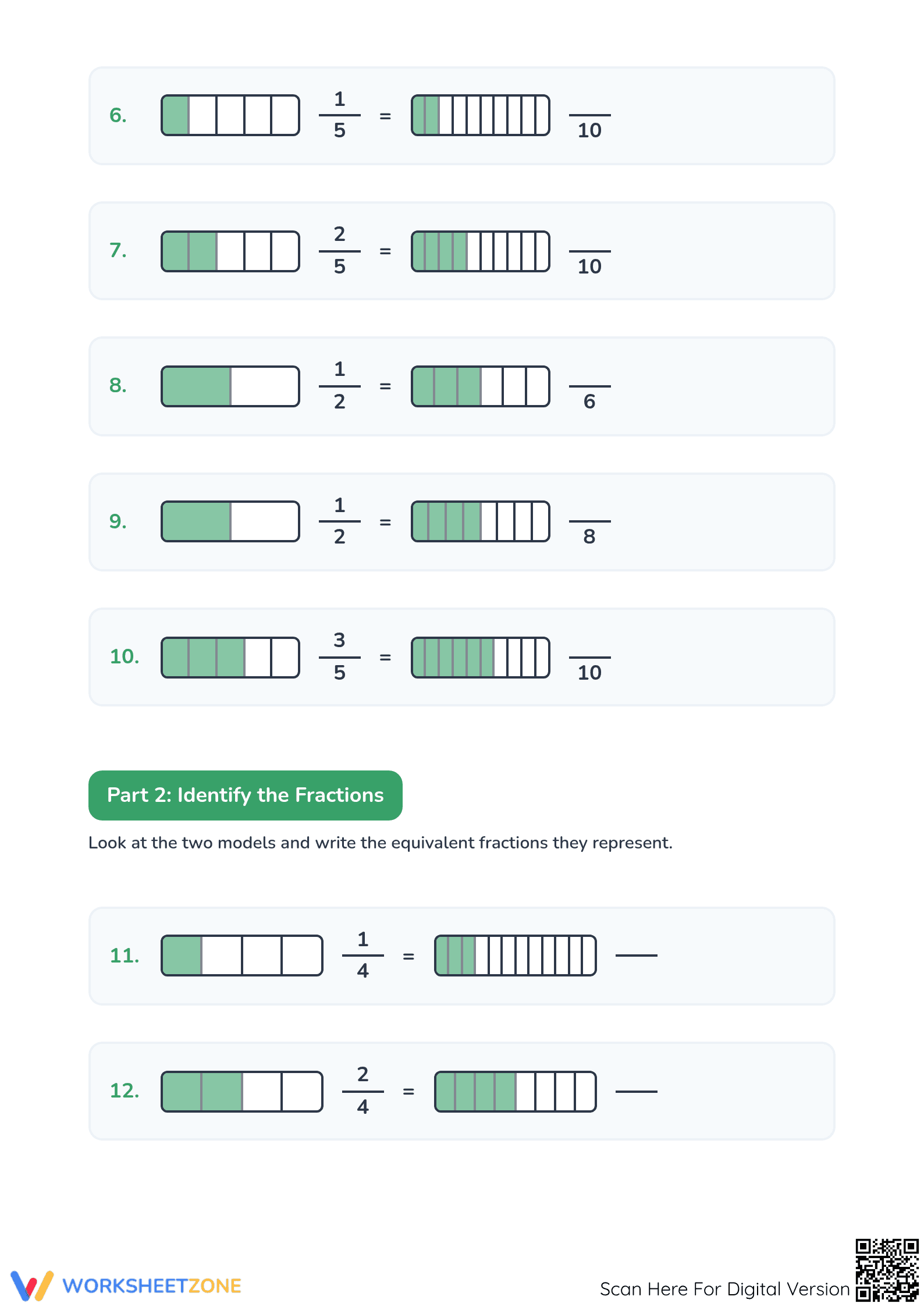
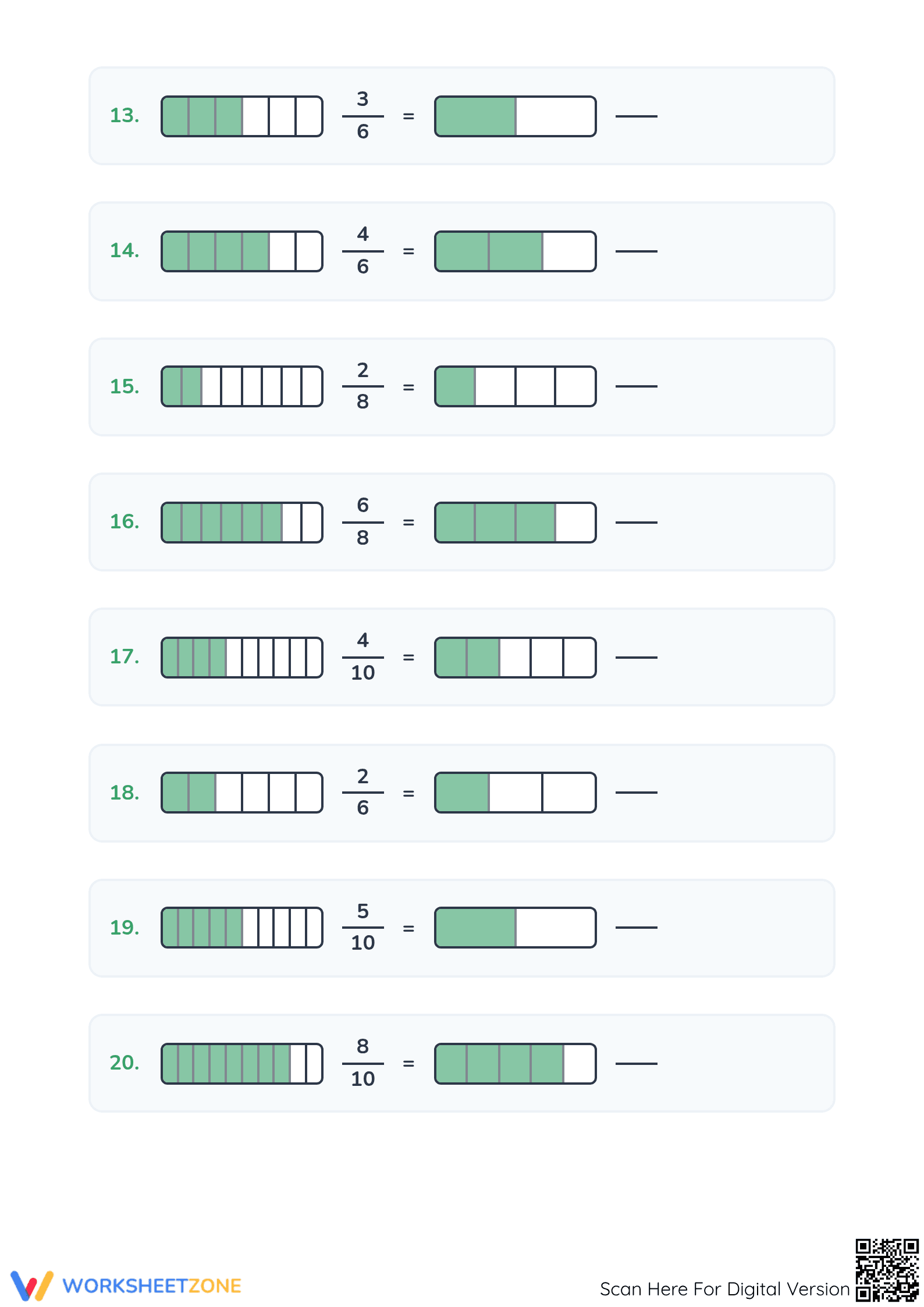
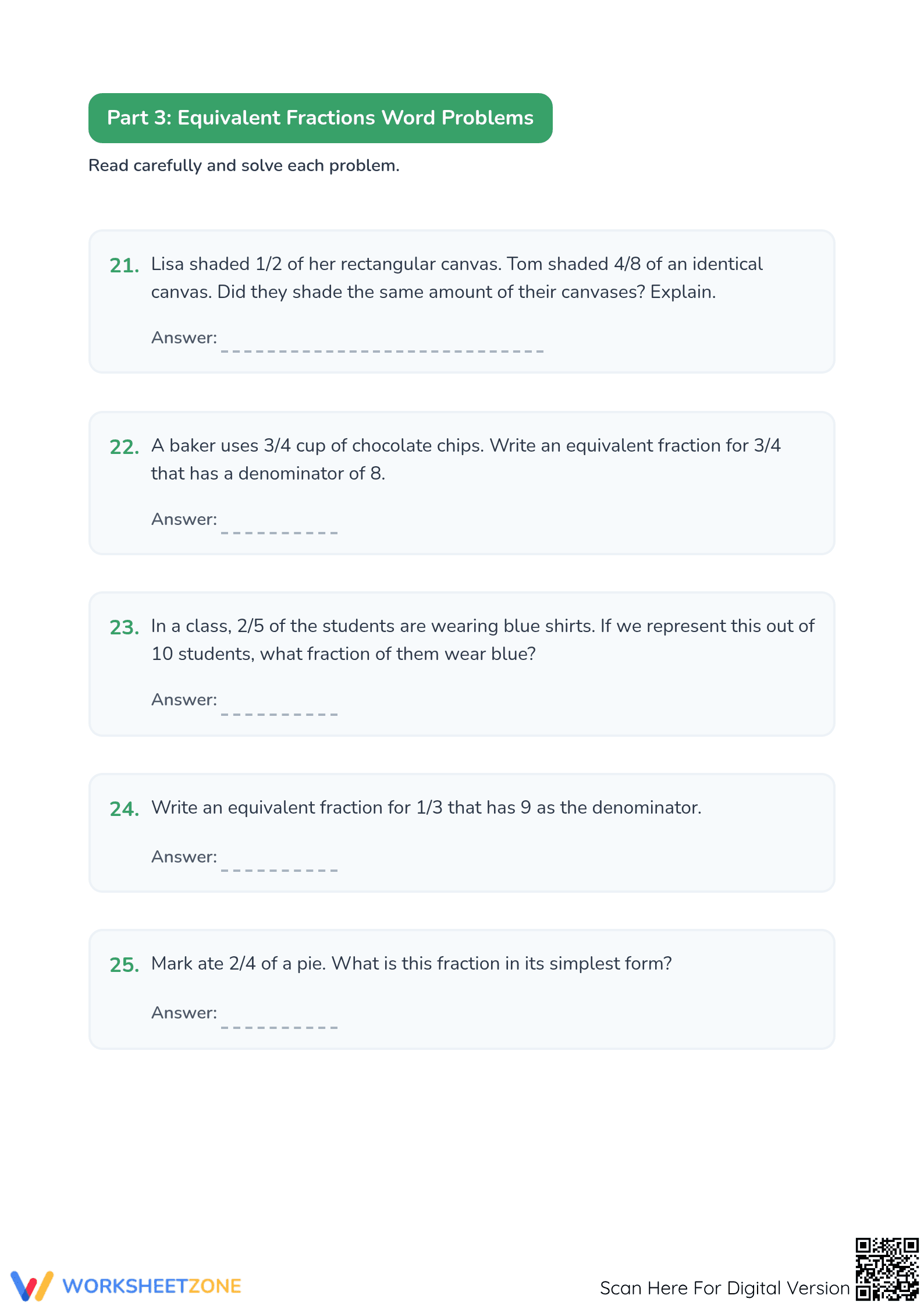
This high-quality assessment consists of 25 structured tasks divided into three distinct parts across four printable pages. Part 1 features 10 problems where students must complete the numerator or denominator by observing shaded bar models. Part 2 requires students to identify and write both fractions shown in comparison models. Part 3 challenges students with five contextual word problems, requiring them to apply their knowledge to real-world scenarios. A full answer key is included for rapid grading.
As a T2 Standards Navigator resource, this test is designed to provide clear evidence of student proficiency. The three-part structure allows teachers to categorize performance: Part 1 assesses Approaching proficiency through completion tasks, Part 2 measures Meeting standards through identification, and Part 3 evaluates Exceeding expectations through application in word problems. Results can be entered directly into gradebooks or used to inform IEP progress notes for specific learning goals related to fractional reasoning.
The primary focus of this worksheet is `CCSS.MATH.CONTENT.3.NF.A.3.B`, which states: "Recognize and generate simple equivalent fractions, e.g., 1/2 = 2/4, 4/6 = 2/3. Explain why the fractions are equivalent, e.g., by using a visual fraction model." It also supports `3.NF.A.3.A` by emphasizing that equivalent fractions refer to the same size. Both standard codes can be copied directly into lesson plans, IEP goals, or district curriculum mapping tools.
This resource is best utilized as a summative assessment at the end of a unit on equivalent fractions or as a rigorous check for understanding during mid-unit reviews. During administration, observe if students are counting the individual segments of the models or if they are beginning to see the multiplicative relationships between the denominators. Expect students to complete the 25 problems in approximately 35 minutes, depending on their familiarity with word problem decoding.
This worksheet is designed for Grade 3 students but serves as an excellent intervention tool for Grade 4 or Grade 5 learners who require additional reinforcement of fractional concepts. It pairs naturally with a direct instruction lesson using manipulative fraction tiles or a digital interactive whiteboard session where different representations of 1/2, 1/3, and 1/4 are compared.
Research from RAND AIRS 2024 highlights that visual models are critical for students to move beyond rote memorization toward conceptual understanding. This assessment requires students to interact with shaded bar models before attempting abstract word problems. By scaffolding tasks from visual completion to application, the worksheet follows an instructional design that reduces cognitive load. The inclusion of 25 problems ensures a sufficient sample size to determine mastery of the `CCSS.MATH.CONTENT.3.NF.A.3.B` standard. Teachers can use the results of this Form B assessment to identify gaps in reasoning, particularly in the transition from recognizing equivalents to generating them independently. This data-driven approach is essential for curriculum mapping and ensuring that students are prepared for complex fractional operations in subsequent grades. The rigorous format ensures that evidence of student achievement is both reliable and valid for instructional planning. It serves as a definitive tool.


