


























Views
Downloads



Printable Equivalent Fractions Test | Grade 3 Math
Paste this activity's link or code into your existing LMS (Google Classroom, Canvas, Teams, Schoology, Moodle, etc.).
Students can open and work on the activity right away, with no student login required.
You'll still be able to track student progress and results from your teacher account.
This assessment evaluates student proficiency in identifying and generating equivalent fractions through visual area models and real-world application. Students demonstrate mastery by completing fractions, identifying equivalencies from shaded rectangles, and solving complex word problems. This comprehensive resource ensures learners grasp the fundamental concept that different fractions can represent the same value.
At a Glance
- Grade: Grade 3 · Subject: Math (Fractions)
- Standard:
CCSS.MATH.CONTENT.3.NF.A.3— Understand two fractions as equivalent if they are the same size- Skill Focus: Equivalent fractions via visual models
- Format: 4 pages · 25 problems · Answer key included · PDF
- Best For: End-of-unit summative assessment or intensive practice
- Time: 45–60 minutes
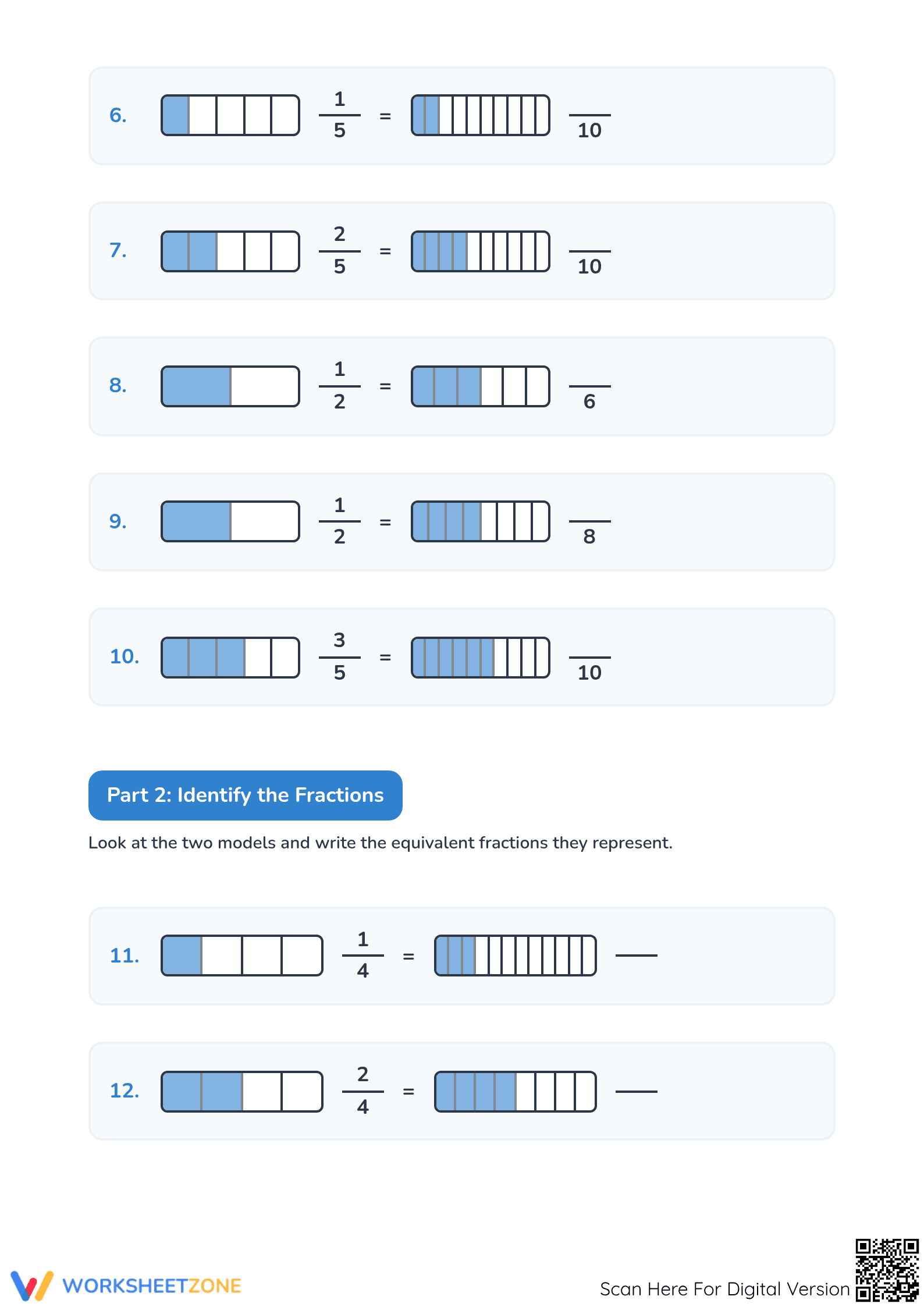
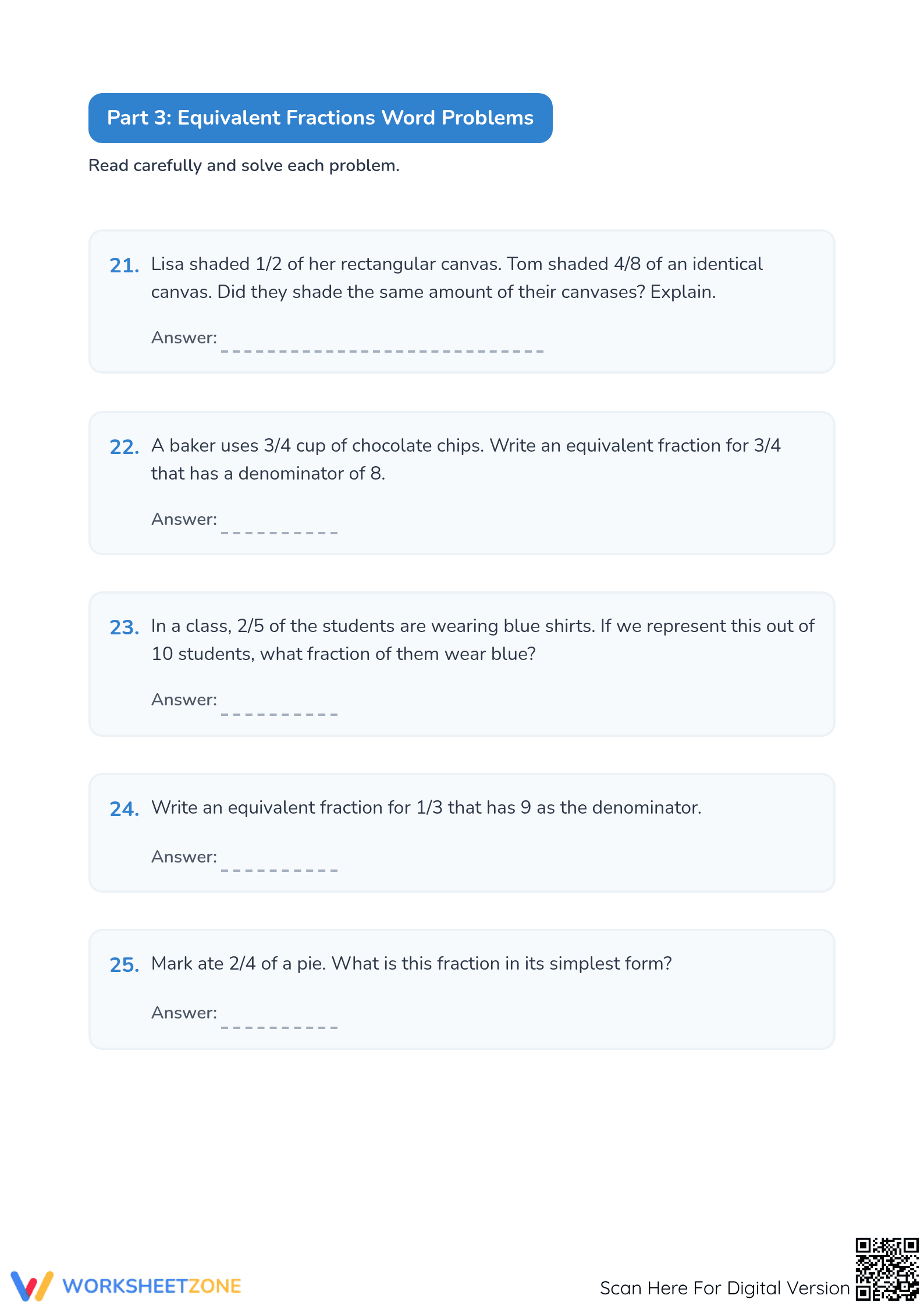
The assessment is structured across four high-quality pages, beginning with ten "Complete the Fraction" tasks where students fill in missing numerators or denominators based on provided area models. Part two features ten more identification problems, requiring students to write both fractions represented by comparative models. Finally, five word problems challenge students to apply their knowledge to realistic scenarios, such as sharing canvases or baking.
Zero-Prep Workflow
This resource is designed for immediate classroom use with three simple steps. First, print the four-page PDF for your class (1 minute). Second, distribute the forms for a quiet, independent assessment (2 minutes). Third, use the included answer key for rapid grading or peer review (10 minutes). The clear formatting and self-explanatory instructions make it an ideal choice for emergency sub plans or last-minute data collection.
Standards Alignment
The primary focus is `CCSS.MATH.CONTENT.3.NF.A.3`, which requires students to: "Understand two fractions as equivalent (equal) if they are the same size, or the same point on a number line." The word problems also touch upon `CCSS.MATH.CONTENT.3.NF.A.3.D` by asking students to explain their reasoning. Both standard codes can be copied directly into lesson plans, IEP goals, or district curriculum mapping tools.
How to Use It
Deploy this worksheet during the final stage of your fractions unit as a summative assessment to gauge mastery. Alternatively, use it during small-group instruction for students needing scaffolded practice. During the assessment, observe if students count the total parts correctly before identifying shaded sections. Expect students to spend 45 to 60 minutes on completion, providing a robust window for formative observation.
Who It's For
This resource is tailored for third-grade students, though it serves as an excellent review for fourth graders. It provides visual support for English Language Learners and students with IEPs through consistent modeling. Pair this assessment with fraction tile manipulatives to reinforce spatial relationships before students transition to the abstract word problems included in the final part of the test.
Mastering equivalent fractions through visual models is a critical milestone in early mathematics, serving as the foundation for advanced operations. Research from the NAEP highlights that students who develop conceptual understanding via area models show higher retention when transitioning to symbolic manipulation. This assessment, aligned with `CCSS.MATH.CONTENT.3.NF.A.3`, systematically moves students from concrete observation to abstract reasoning across 25 tasks. By requiring students to interpret shaded models and apply logic to word problems, the resource ensures a comprehensive evaluation of their ability to recognize equal portions. Educational frameworks, such as Fisher & Frey (2014), emphasize the importance of this scaffolded approach, which is mirrored here as students move from completion to independent problem-solving. This evidence-based design provides educators with reliable data for instructional planning and growth monitoring, essential for success in later grades.


