


























Views
Downloads

Essential Equivalent Fractions Worksheet | Grade 4 Math
Paste this activity's link or code into your existing LMS (Google Classroom, Canvas, Teams, Schoology, Moodle, etc.).
Students can open and work on the activity right away, with no student login required.
You'll still be able to track student progress and results from your teacher account.
This Grade 4 equivalent fractions worksheet provides students with targeted practice to master relationships between fractional representations. By combining visual area models with real-world word problems, students develop a deep conceptual understanding of why fractions with different numerators and denominators represent the same value.
At a Glance
- Grade: 4 · Subject: Math
- Standard:
CCSS.MATH.CONTENT.4.NF.A.1— Explain why fractions are equivalent using visual models and proportional reasoning- Skill Focus: Visual Modeling & Word Problems
- Format: 2 pages · 8 problems · Answer key included · PDF
- Best For: Small group instruction and formative assessment
- Time: 15–20 minutes
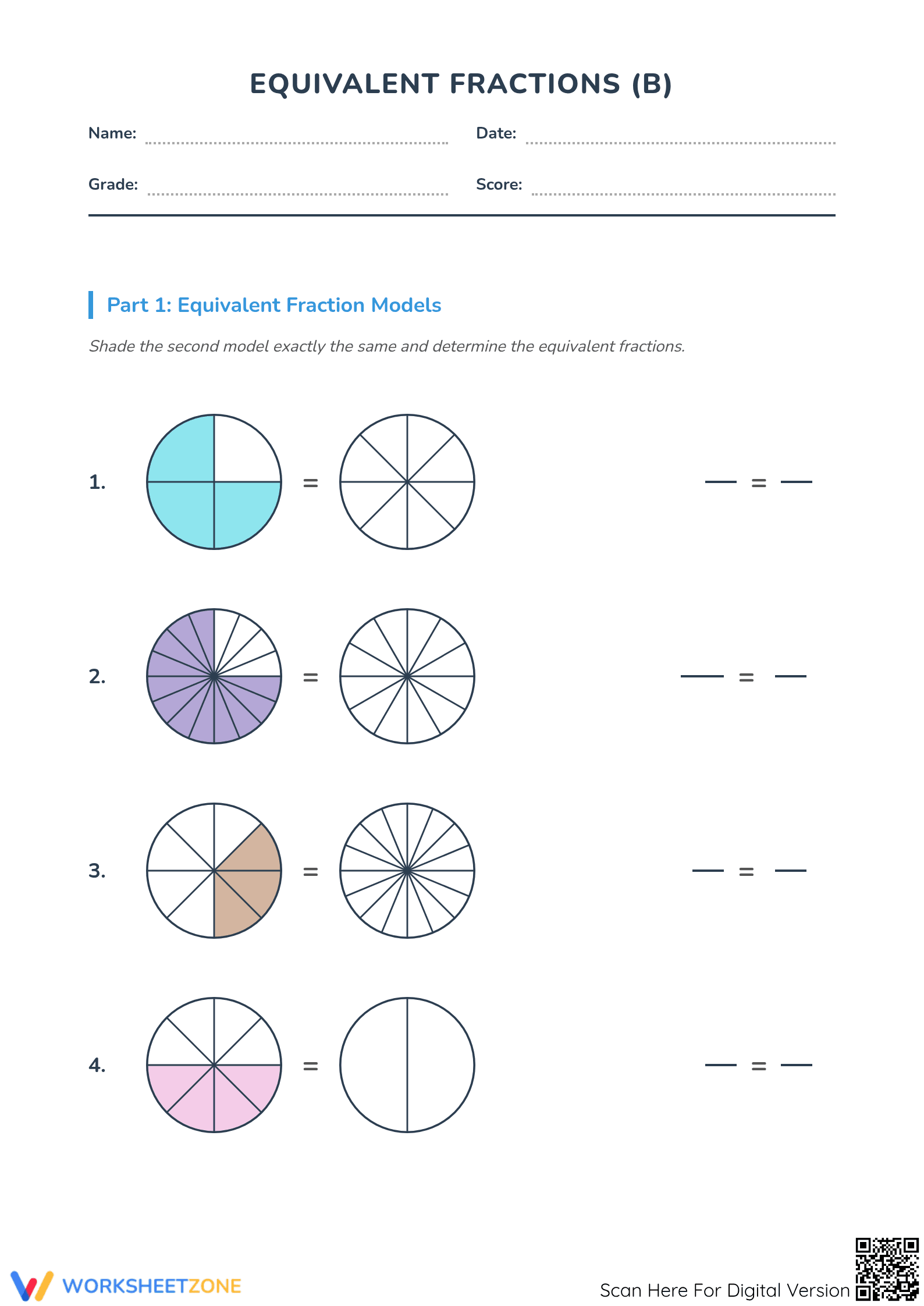
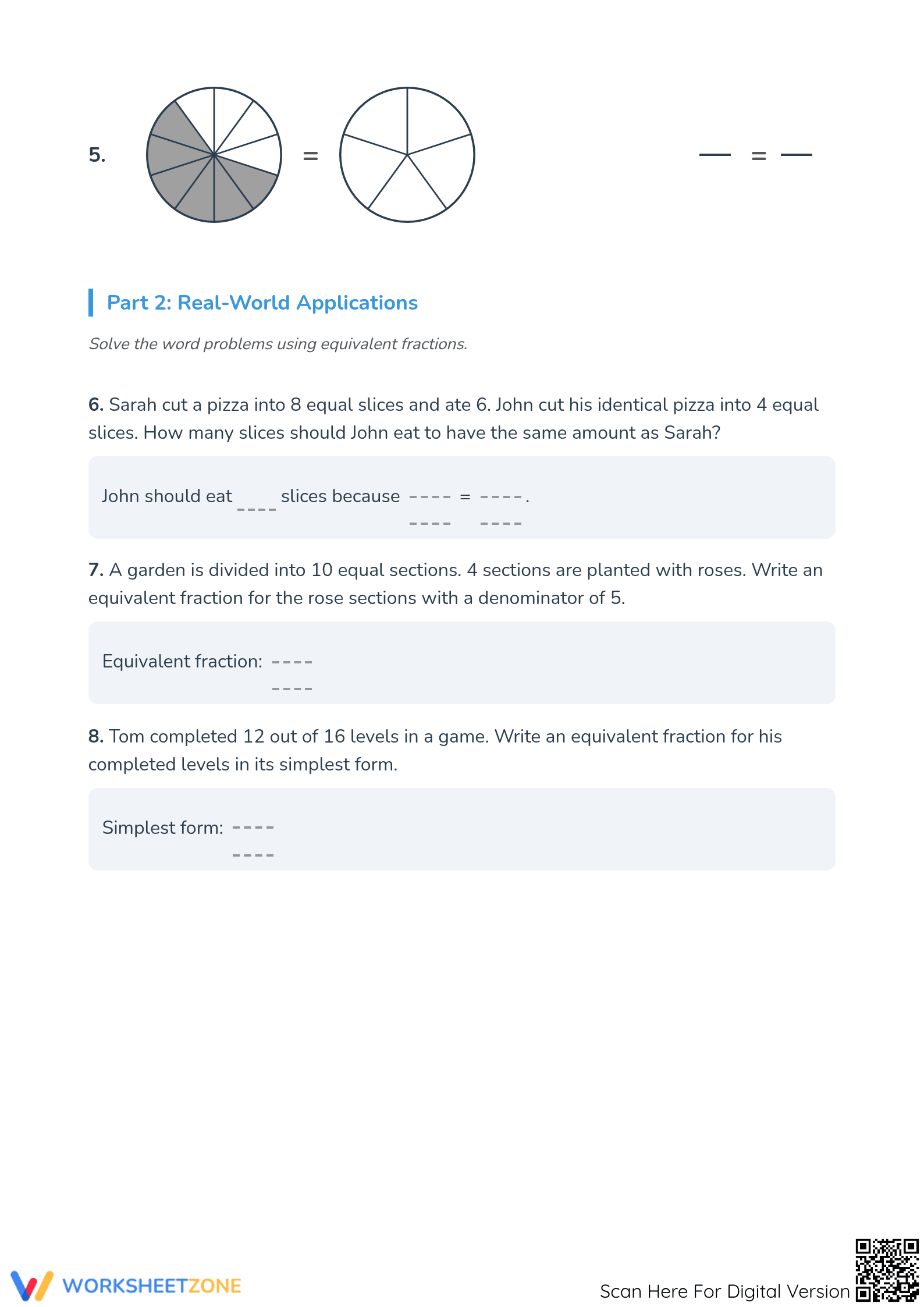
This two-page printable resource includes 8 tasks designed for immediate classroom use. The first page features five visual modeling problems where students shade circles to find equivalents. The second page transitions to higher-order thinking with three real-world word problems involving pizza and garden plots. A complete answer key is provided for rapid grading.
Skill Progression
- Guided Practice: Problems 1 and 2 provide shaded models where students identify a corresponding equivalent fraction through visual comparison.
- Supported Practice: Problems 3 through 5 require students to determine both the shading and numerical representation independently using partitioned circles.
- Independent Practice: Real-world word problems require students to apply equivalent fraction logic to scenarios without visual aids, including fraction simplification.
This gradual-release approach follows the I Do, We Do, You Do model to ensure consistent student success.
Standards Alignment
This resource is aligned to CCSS.MATH.CONTENT.4.NF.A.1. Students explain why fractions are equivalent using visual fraction models. The worksheet focuses on how the number and size of parts differ even though the fractions represent the same size. Standard codes can be copied directly into lesson plans, IEP goals, or district curriculum mapping tools.
How to Use It
Use this worksheet as a mid-unit formative assessment to check for misconceptions regarding fractional area. During instruction, observe if students accurately divide the second model before shading to identify those who need more support with denominators. This activity typically takes 15 to 20 minutes to complete during a math block or center rotation.
Who It's For
This resource is ideal for fourth-grade students beginning their fraction unit or fifth-grade students needing a review of simplification. It works effectively as a supplemental practice sheet or a homework assignment. For students requiring more support, pair this worksheet with physical fraction tiles to provide concrete tactile reinforcement before they shade the paper models.
Fisher & Frey (2014) emphasize that visual representations are critical scaffolds for developing mathematical literacy, particularly when transitioning to abstract concepts like CCSS.MATH.CONTENT.4.NF.A.1. This worksheet operationalizes this research by utilizing circle area models to demonstrate that equivalent fractions represent the same portion of a whole. By engaging with 8 distinct tasks, students internalize that the denominator represents total parts while the numerator represents the count, and that these values change proportionally without altering the total quantity. High-quality visual modeling reduces cognitive load during initial learning, allowing students to focus on the logic of proportionality. This printable resource ensures that Grade 4 learners build the necessary foundation for complex operations with fractions, as highlighted by the EdReports 2024 analysis of effective math instructional materials.


