


























Views
Downloads

Grade 4 Aligned: Equivalent Fractions Worksheet
Paste this activity's link or code into your existing LMS (Google Classroom, Canvas, Teams, Schoology, Moodle, etc.).
Students can open and work on the activity right away, with no student login required.
You'll still be able to track student progress and results from your teacher account.
Master equivalent fractions with this comprehensive assessment. This worksheet guides Grade 4 students through simplifying, building, and matching equivalent values using numerical methods and visual supports. By completing these 24 structured tasks, learners demonstrate a deep understanding of fraction relationships, ensuring they are prepared for more complex operations with non-like denominators.
At a Glance
- Grade: 4 · Subject: Math
- Standard:
CCSS.MATH.CONTENT.4.NF.A.1— Explain fraction equivalence using visual models and numerical multiplication or division- Skill Focus: Equivalent fractions and simplification
- Format: 5 pages · 24 problems · Answer key included · PDF
- Best For: Formative assessment and mastery checks
- Time: 25–35 minutes
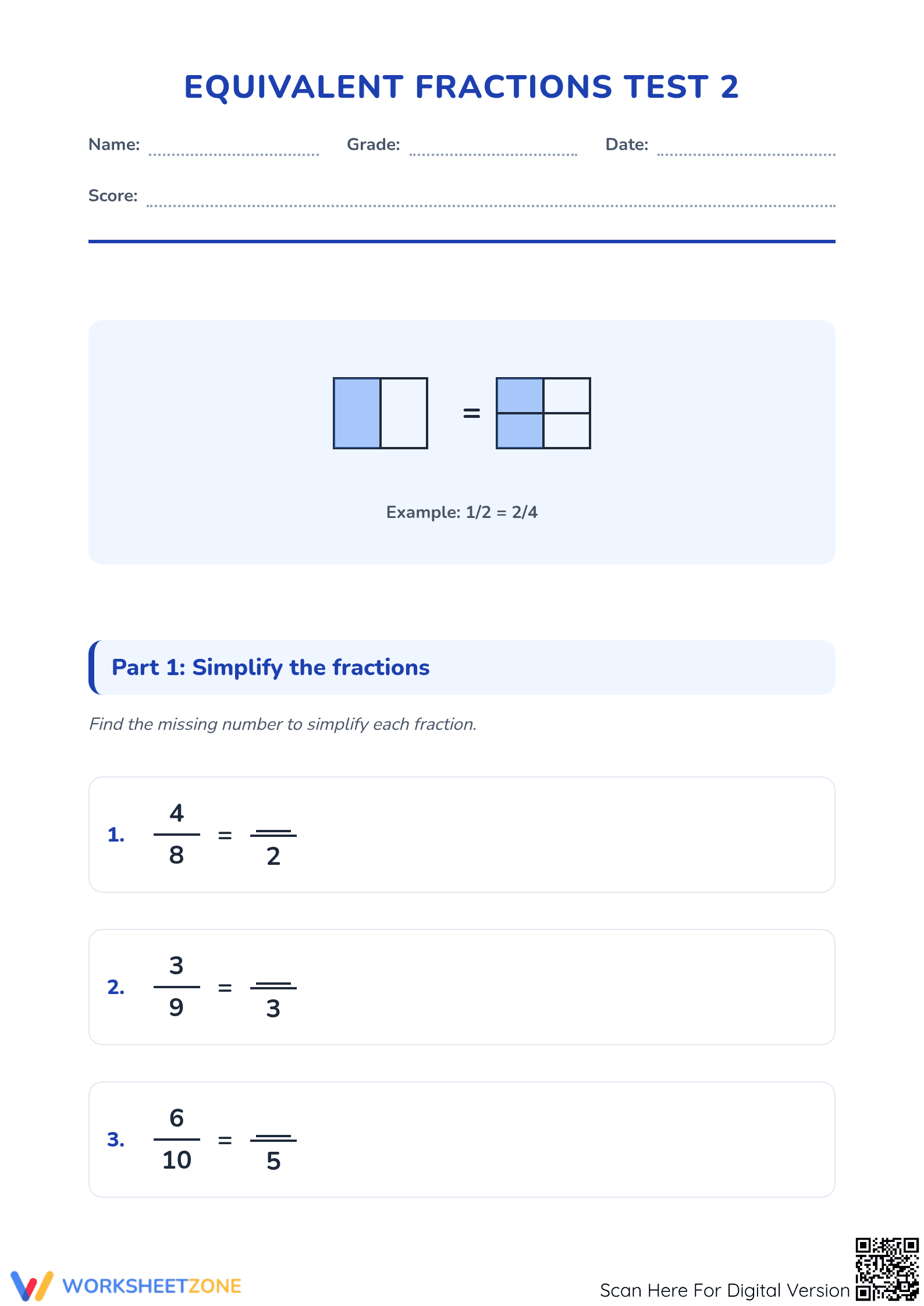
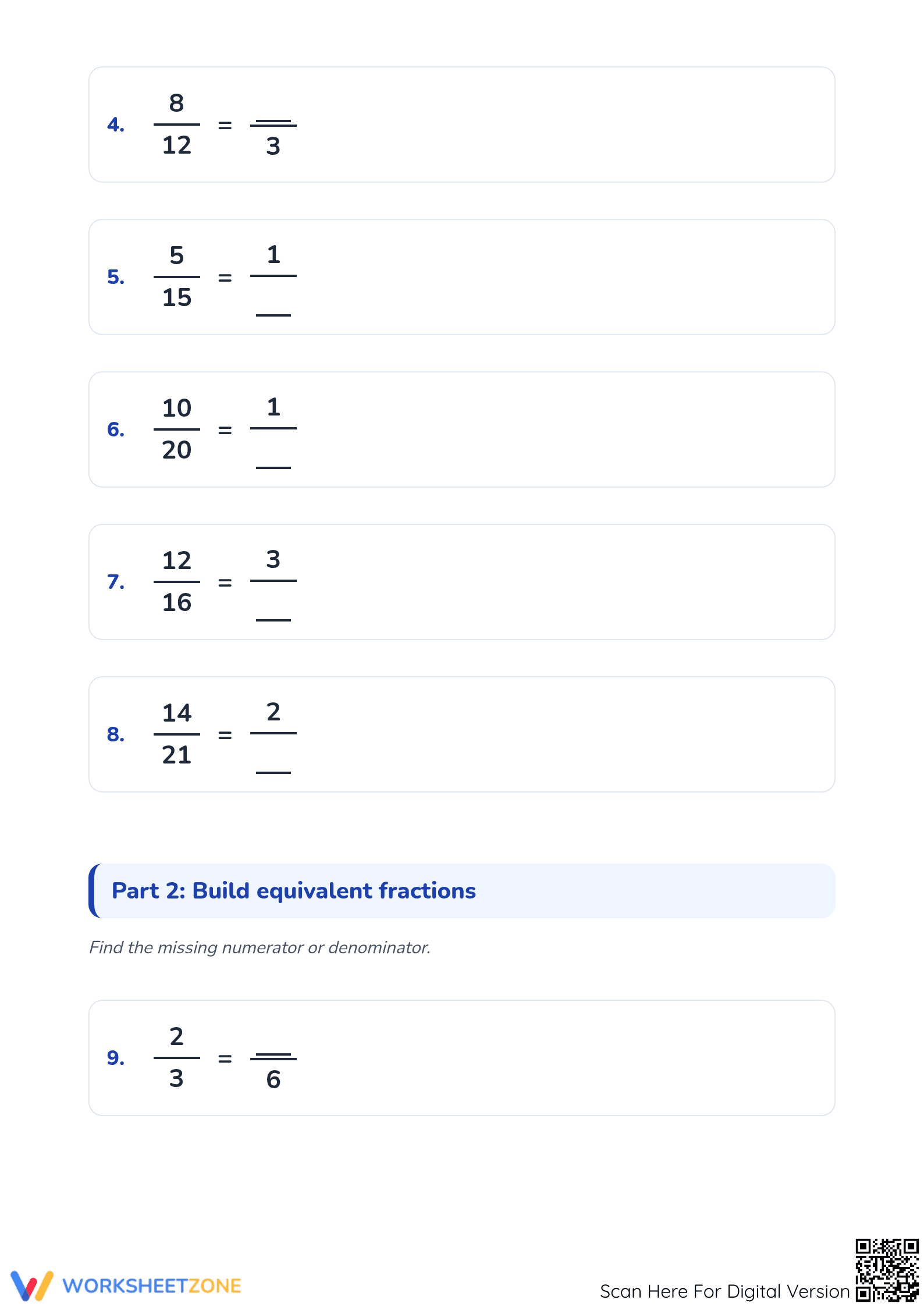
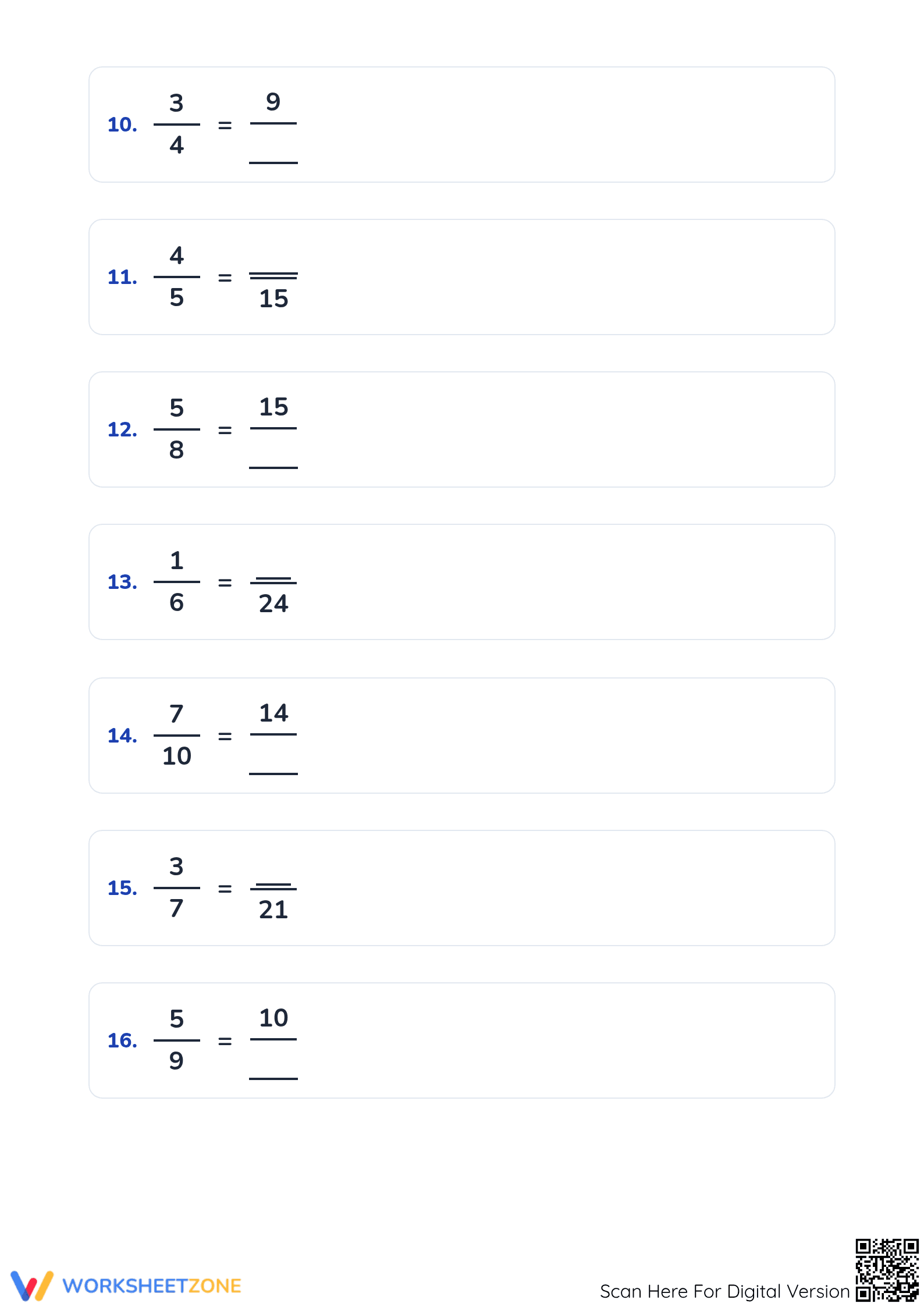
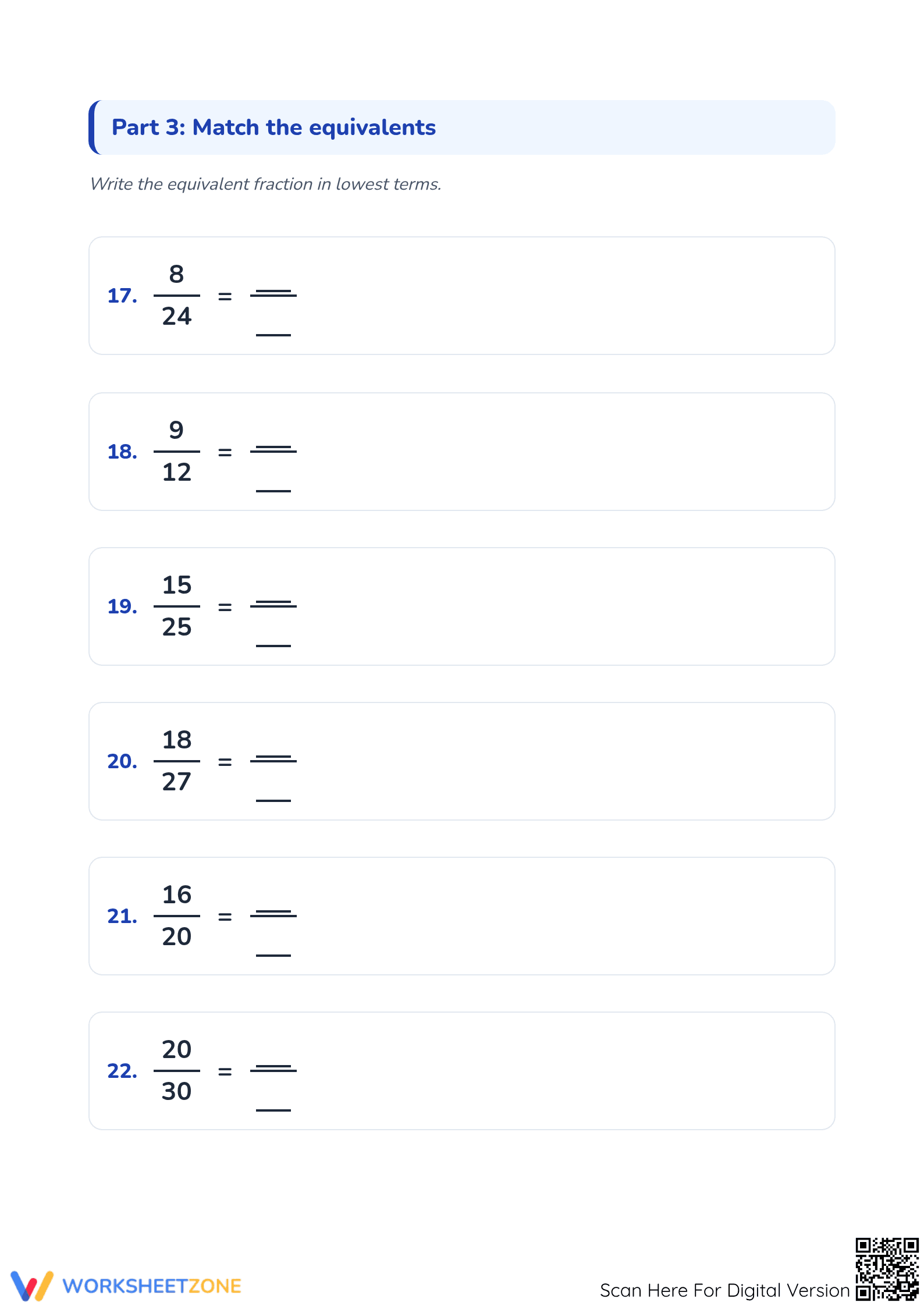
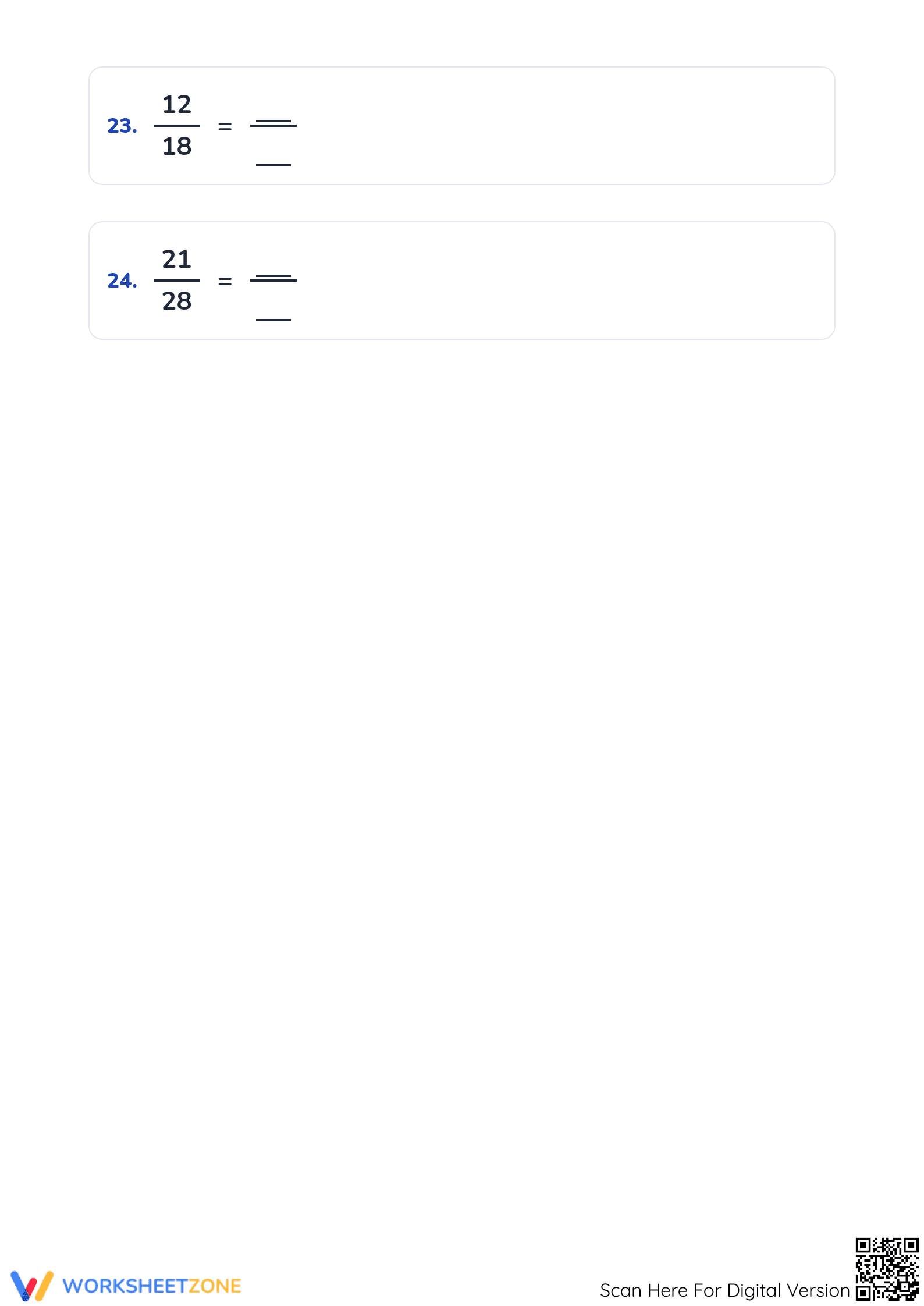
This 5-page PDF contains three distinct sections to verify student competency. Part 1 focuses on simplifying fractions with 8 problems. Part 2 requires building equivalents by finding missing numerators or denominators across 8 items. Part 3 concludes with 8 problems involving matching equivalents in lowest terms. A complete answer key is provided for rapid grading.
Mastery Evidence
- Approaching Mastery: Students successfully complete Part 1 using the provided visual example as a guide to simplify fractions.
- Meeting Mastery: Students independently find missing numerators and denominators in Part 2, showing fluency with multiplication scaling.
- Exceeding Mastery: Students accurately match fractions to their lowest terms in Part 3 without the aid of visual scaffolds.
The progression from visual examples to abstract numerical manipulation identifies student conceptual gaps. Scores can be entered directly into gradebooks or IEP progress notes to document standard-specific growth.
Standards Alignment
This resource is strictly aligned to CCSS.MATH.CONTENT.4.NF.A.1. The standard requires students to explain why a fraction a/b is equivalent to a fraction (n*a)/(n*b) by using visual models. Both standard codes can be copied directly into lesson plans, IEP goals, or district curriculum mapping tools.
How to Use It
Deploy this as a summative chapter test after completing units on fraction equivalence. Teachers should observe students during Part 1 to ensure they understand that dividing both terms by the same number maintains value. The expected completion time is 30 minutes, making it a perfect tool for a mid-week progress check or data-gathering for small group interventions.
Who It's For
This worksheet is tailored for Grade 4 students, but its clear layout makes it an excellent intervention tool for older learners. It pairs naturally with a fraction tiles anchor chart or a digital fraction wall to provide additional scaffolding for English Language Learners or students with IEPs requiring visual aids.
According to a ScienceDirect TpT Analysis, high-quality math resources that balance visual modeling with abstract computation significantly improve long-term retention of fraction concepts. This assessment leverages the CCSS.MATH.CONTENT.4.NF.A.1 framework to ensure students move beyond rote memorization of multiplication facts and toward a functional understanding of equivalent values. Research from NAEP indicates that fourth-grade competency in fraction equivalence is a primary predictor of success in middle school algebra and proportional reasoning. By providing 24 targeted tasks that bridge the gap between visual models and numerical simplification, this worksheet creates a data-rich environment for educators to measure student growth accurately. The inclusion of three distinct task types—simplifying, building, and matching—aligns with evidence-based practices for diverse learners. Standardizing these checks ensures that every student meets the rigorous demands of state frameworks while building a solid foundation for future STEM curricula.


