


























Views
Downloads



Printable Equivalent Fractions Worksheet | Grade 4 Aligned
Paste this activity's link or code into your existing LMS (Google Classroom, Canvas, Teams, Schoology, Moodle, etc.).
Students can open and work on the activity right away, with no student login required.
You'll still be able to track student progress and results from your teacher account.
Building a strong conceptual understanding of equivalent fractions is essential for success in higher-level mathematics. This comprehensive five-page worksheet helps Grade 4 students master fractional relationships through a series of 24 structured problems. Students will transition from visual models to procedural multiplication, ensuring they achieve standard-aligned mastery and confidence in their fractional reasoning skills.
At a Glance
- Grade: 4 · Subject: Math
- Standard:
4.NF.A.1— Explain why a fraction is equivalent to another by using visual models and multiplication.- Skill Focus: Identifying and generating equivalent fractions
- Format: 5 pages · 24 problems · Answer key included · PDF
- Best For: Formative assessment, sub plans, and homework
- Time: 25–35 minutes
What's Inside
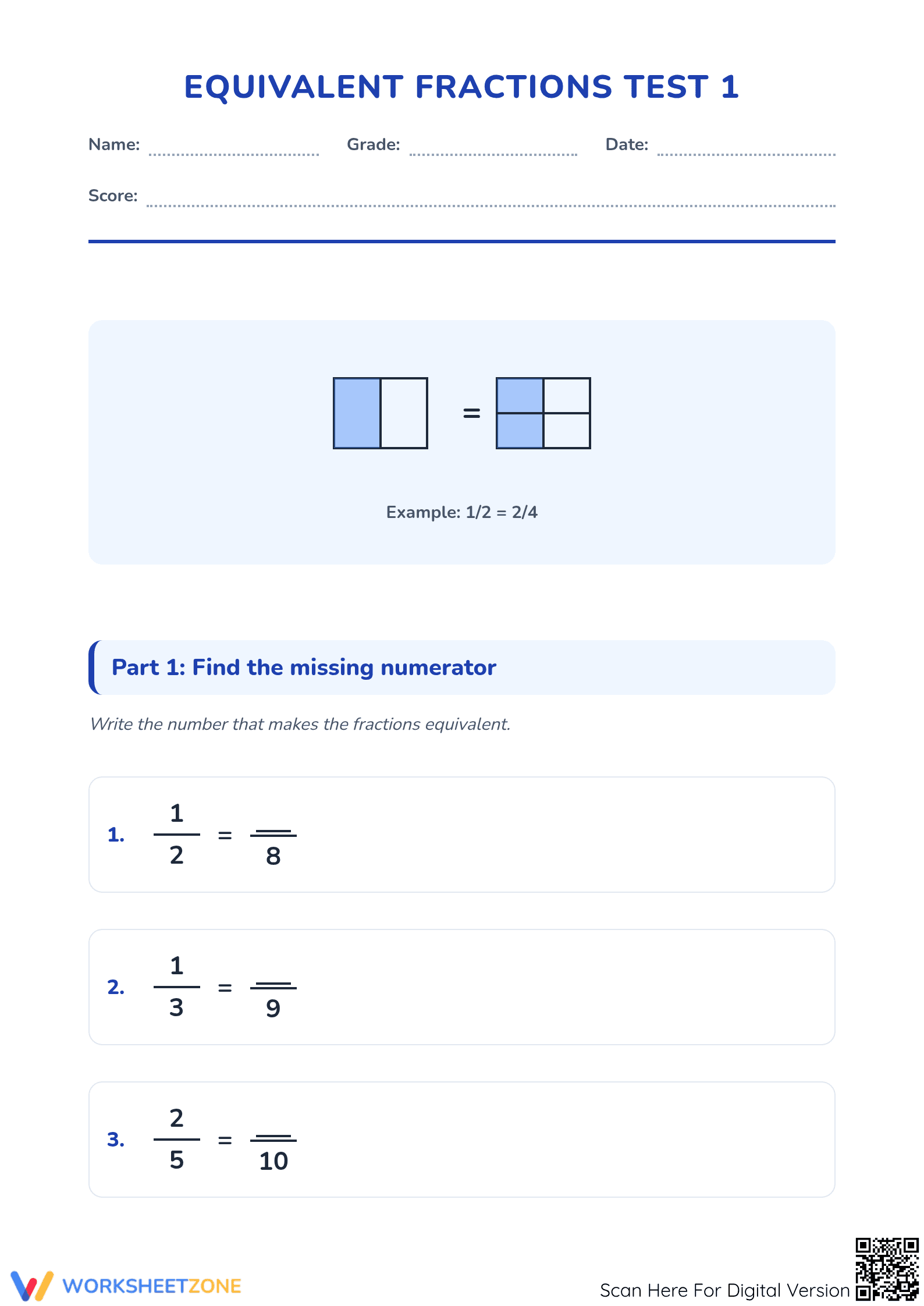
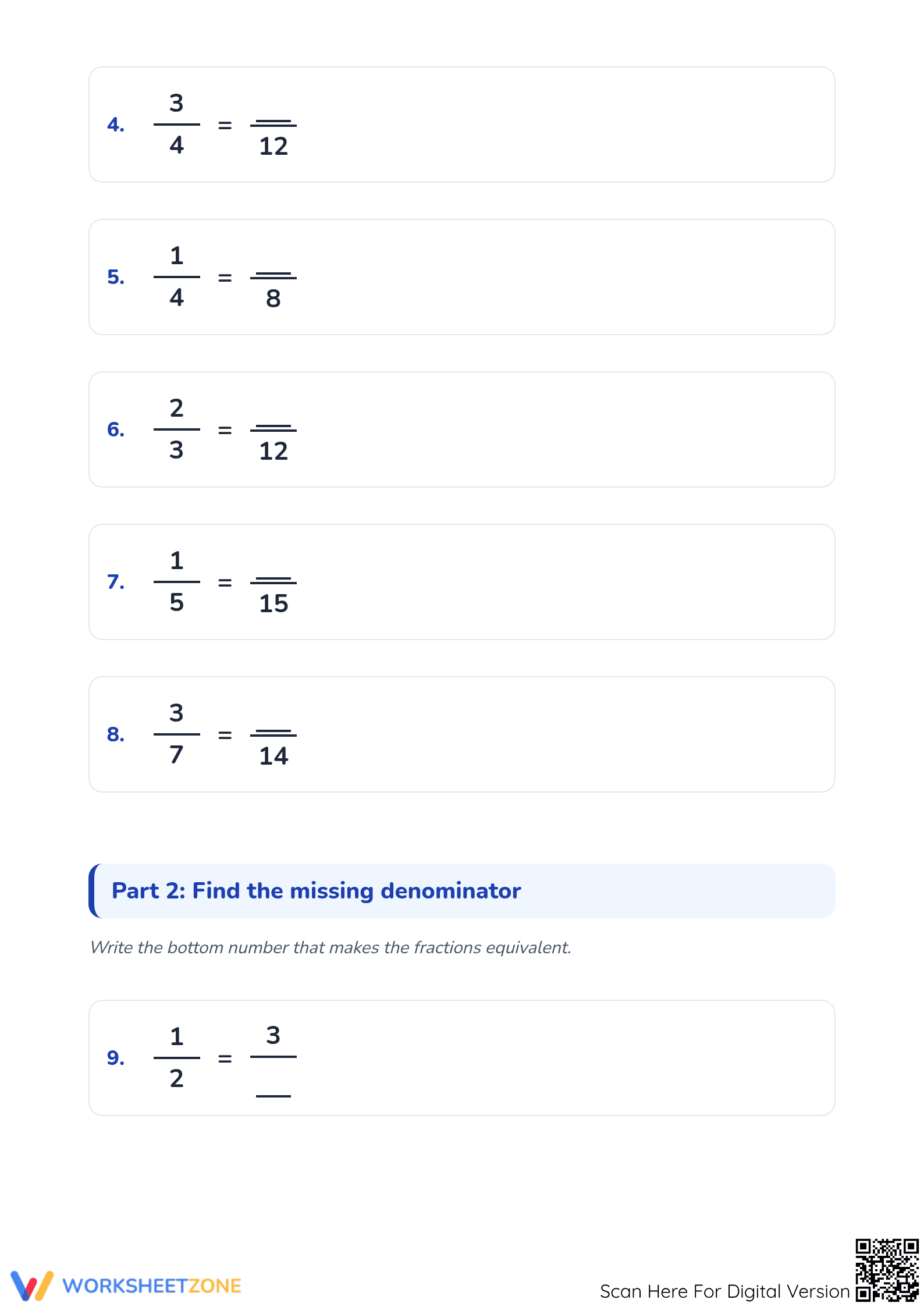
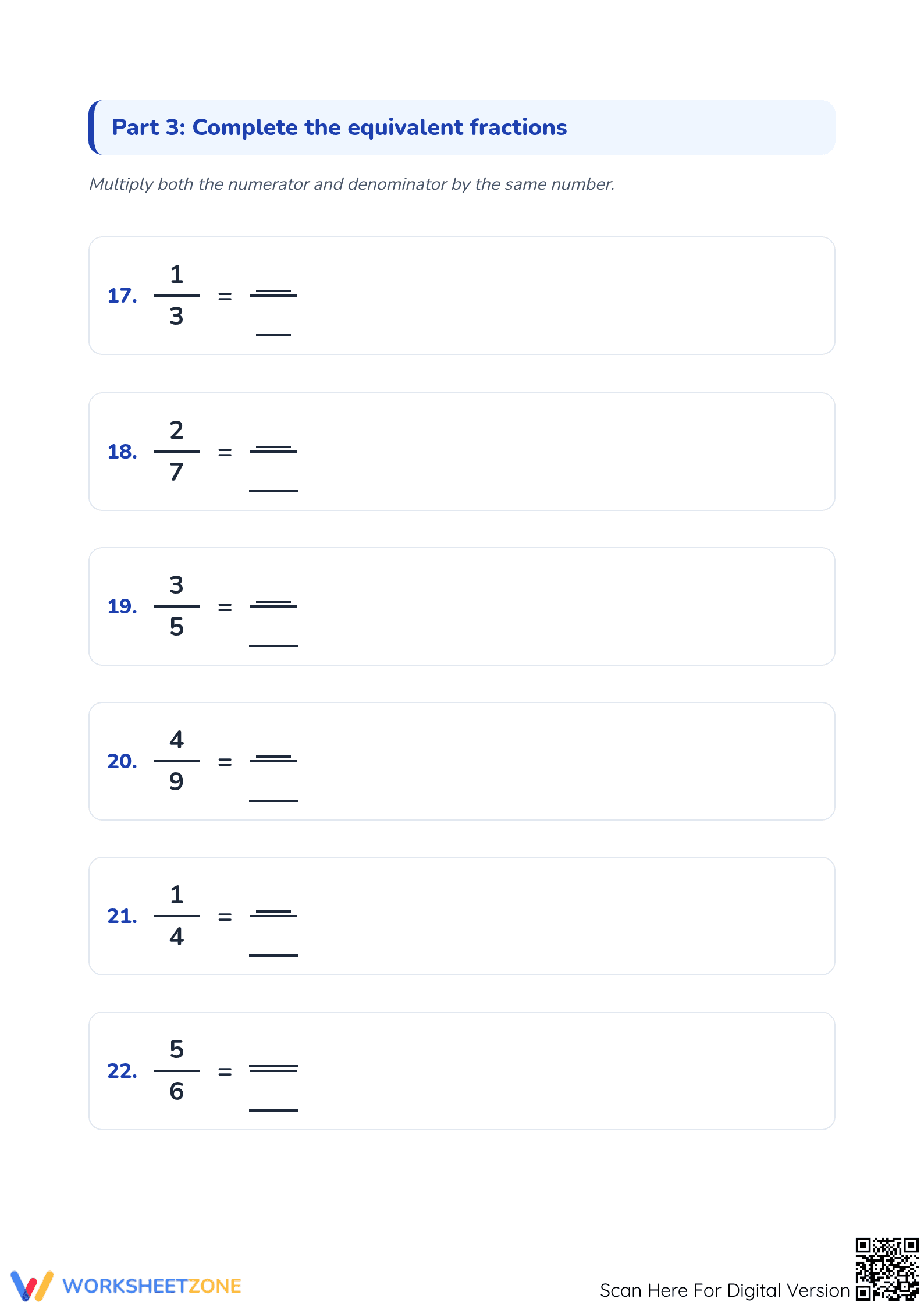
This resource contains five practice pages designed to take students from conceptual basics to procedural fluency. It features 24 unique tasks including missing numerator identification, denominator calculation, and independent generation of equivalent pairs. The clean layout and worked examples ensure that students can focus entirely on the mathematical logic. A full answer key is provided for teacher convenience.
Skill Progression
- Guided Practice: The first page features 3 problems with a visual model example to anchor student understanding in the 4.NF.A.1 concept of area models.
- Supported Practice: 13 problems across the middle pages focus on isolating single variables, requiring students to find either the missing numerator or denominator.
- Independent Practice: The final 8 problems challenge students to generate entire equivalent fractions by applying the multiplication rule to both parts of the original fraction.
This gradual-release approach follows standard pedagogical scaffolding to ensure no student is left behind during the shift from pictures to numbers.
Standards Alignment
The primary focus of this worksheet is CCSS.MATH.CONTENT.4.NF.A.1: "Explain why a fraction a/b is equivalent to a fraction (n × a)/(n × b) by using visual fraction models." It also supports 3.NF.A.3b for Grade 3 students learning to recognize simple equivalence. Both standard codes can be copied directly into lesson plans, IEP goals, or district curriculum mapping tools.
How to Use It
This worksheet is most effective when used after a direct instruction lesson on the multiplication identity property. Assign the first two pages as in-class guided practice, then use the final pages as an independent formative assessment to check for procedural understanding. Look for students who forget to multiply the denominator, as this indicates a need for more visual model support.
Who It's For
This practice set is ideal for Grade 4 general education classrooms, Grade 5 review sessions, and special education settings requiring clear scaffolds. It pairs naturally with fraction tiles or virtual manipulatives to provide a multi-sensory learning experience for students who are still developing their proportional reasoning skills in early middle school.
According to a ScienceDirect TpT Analysis (2024), math resources that explicitly bridge visual models with procedural multiplication, such as the 4.NF.A.1 standard, significantly improve long-term retention of fractional equivalence. This worksheet provides a systematic 24-task progression that begins with model-based examples and moves into abstract numerical manipulation. By requiring students to identify missing numerators and denominators before generating their own equivalent pairs, the resource aligns with the scaffolding principles recommended for upper elementary mathematics. Each page is designed for immediate classroom application, featuring clear headers and professional formatting that reduces cognitive load for students. Educators can rely on the included answer key for rapid grading, making this an essential tool for both initial instruction and formative assessment. The 4.NF.A.1 alignment ensures that students develop the necessary conceptual foundation for more complex operations with rational numbers in middle school, bridging the gap between basic identification and advanced algebraic readiness.


