


























Views
Downloads

Printable Equivalent Fractions Worksheet | Grade 4 Aligned
Paste this activity's link or code into your existing LMS (Google Classroom, Canvas, Teams, Schoology, Moodle, etc.).
Students can open and work on the activity right away, with no student login required.
You'll still be able to track student progress and results from your teacher account.
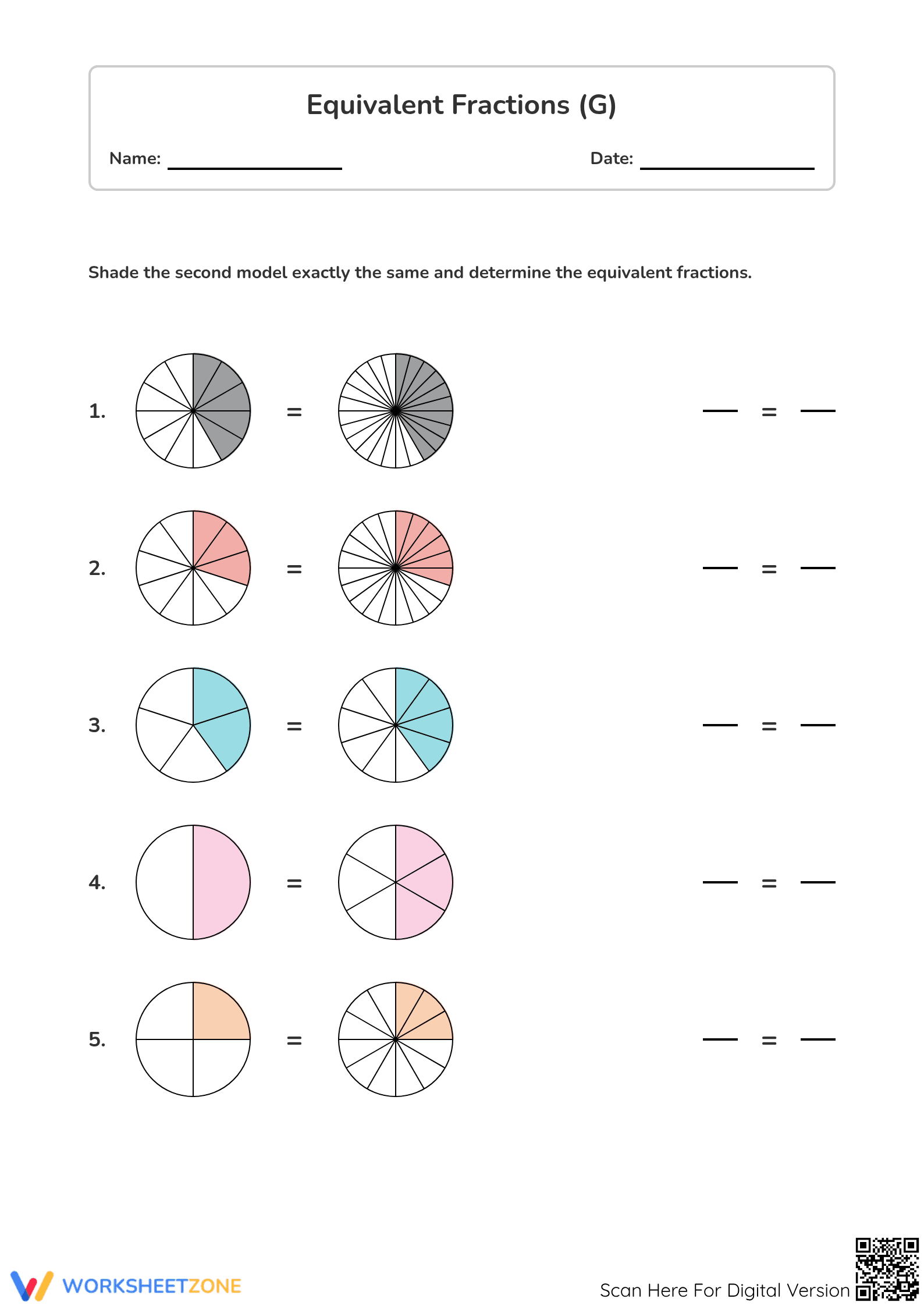
This Printable Equivalent Fractions Worksheet helps Grade 4 students identify equal ratios using circle models. By shading sections and writing numeric fractions, learners develop a deep understanding of how different numerators and denominators represent the same area. This resource bridges visual representations with abstract mathematical notation.
At a Glance
- Grade: 4 · Subject: Math
- Standard:
CCSS.MATH.CONTENT.3.NF.A.3— Understand two fractions as equivalent if they are the same size- Skill Focus: Visual Equivalent Fractions
- Format: 1 page · 5 problems · Answer key included · PDF
- Best For: Small group instruction or formative assessment
- Time: 15–20 minutes
What's Inside
This PDF includes five problems with circle models partitioned into halves, fourths, fifths, eighths, and tenths. Each task presents a shaded reference and an unshaded model. Students record both original and equivalent numeric fractions, linking visual tasks to symbolic math. A full answer key is included for quick grading.
Skill Progression
- Guided practice: Initial problems use eighths and tenths to help students recognize patterns in doubling denominators.
- Supported practice: Middle tasks introduce fifths to tenths, requiring careful counting to maintain area consistency.
- Independent practice: Final problems challenge students with halves to sixths, reinforcing that equivalence is based on total area relative to the whole.
This gradual release approach ensures students move from simple matching to conceptual mastery.
Standards Alignment
This worksheet aligns with CCSS.MATH.CONTENT.3.NF.A.3, requiring students to understand fractions as equivalent if they are the same size. It supports CCSS.MATH.CONTENT.4.NF.A.1 by illustrating how fractions represent the same value through visual models. Both standard codes can be copied directly into lesson plans or curriculum mapping tools.
How to Use It
Use this resource during the "We Do" phase or as a formative assessment. Teachers should observe students shading the models to ensure they maintain physical area rather than just counting segments. It is a perfect check after lessons on fraction multiplication. Completion takes roughly 15 minutes.
Who It's For
Designed for Grade 4, this is also a great remediation tool for older students. It pairs well with fraction tiles or digital passage tools. The clear layout is accessible for English Language Learners and students with IEP accommodations needing simplified tasks.
Aligned with CCSS.MATH.CONTENT.3.NF.A.3, this worksheet addresses the fundamental skill of identifying equivalent fractions through visual area models. Research from the NAEP consistently highlights that students who master visual representations of fractions demonstrate significantly higher proficiency in subsequent operations like addition and subtraction of unlike denominators. According to the RAND AIRS 2024 report, multi-modal instructional materials that transition students from concrete shading to abstract numeric representation are essential for closing the achievement gap in middle-school mathematics. By requiring learners to actively determine the equivalent fractions based on geometric models, this resource reinforces the conceptual "why" behind the mathematical "how." This structured approach is proven to build the cognitive stamina necessary for complex rational number theory. The inclusion of diverse partitions ensures that students generalize the concept of equivalence beyond simple doubling, fostering a robust mathematical intuition that serves as a prerequisite for higher-level algebraic reasoning.


