


























Views
Downloads


Essential Equivalent Fractions Worksheet | Grade 4 Aligned
Paste this activity's link or code into your existing LMS (Google Classroom, Canvas, Teams, Schoology, Moodle, etc.).
Students can open and work on the activity right away, with no student login required.
You'll still be able to track student progress and results from your teacher account.
This worksheet provides a comprehensive practice set for mastering equivalent fractions through visual models, numerical equations, and real-world word problems. By bridging the gap between concrete shading and abstract rules, students build a durable conceptual foundation. It is an ideal resource for ensuring Grade 4 proficiency and building mathematical confidence.
At a Glance
- Grade: 4 · Subject: Math
- Standard:
CCSS.MATH.CONTENT.4.NF.A.1— Explain fraction equivalence using visual models and numerical methods- Skill Focus: Identifying and generating equivalent fractions
- Format: 4 pages · 20 problems · Answer key included · PDF
- Best For: Independent practice and formative assessment
- Time: 35–45 minutes
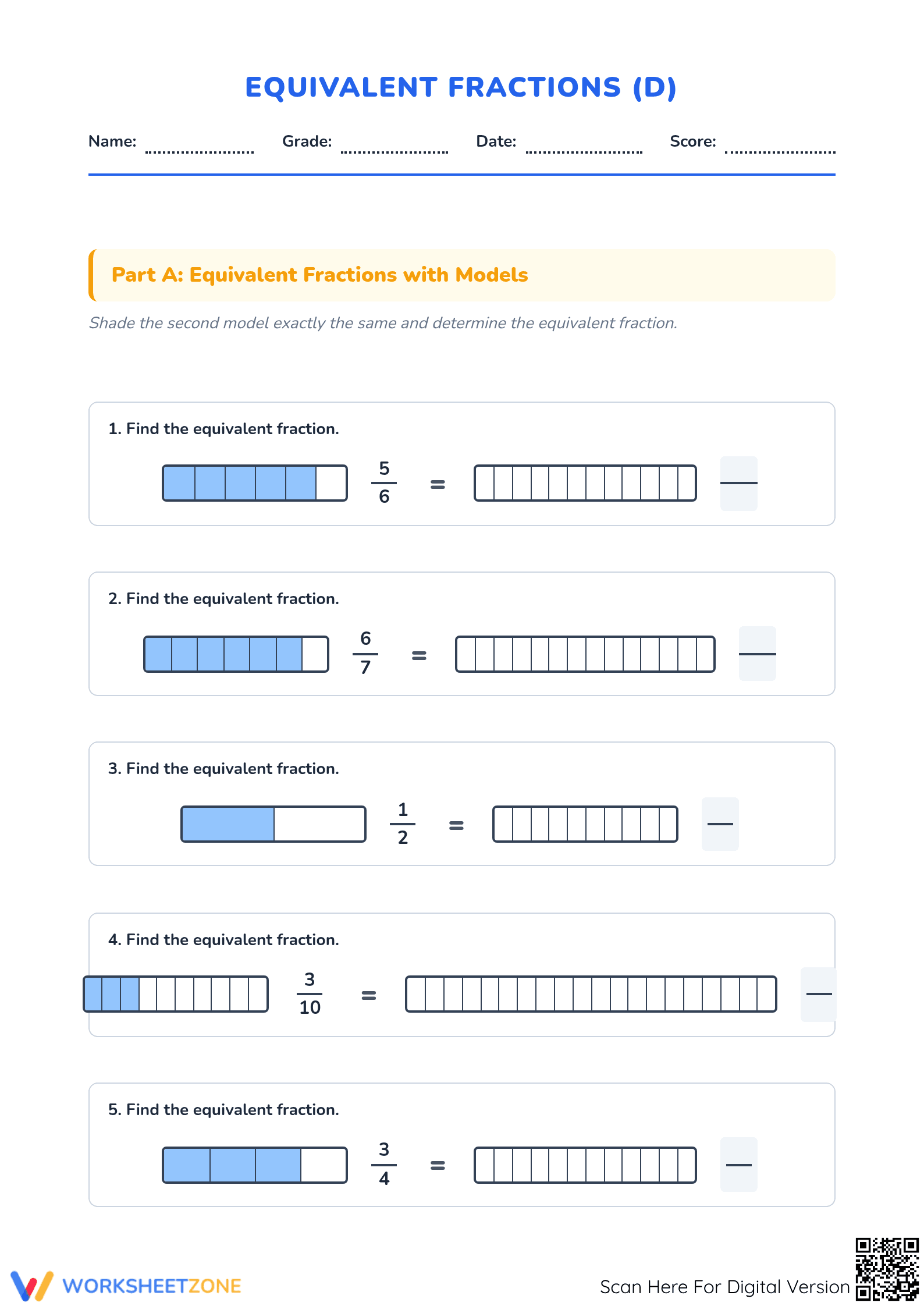
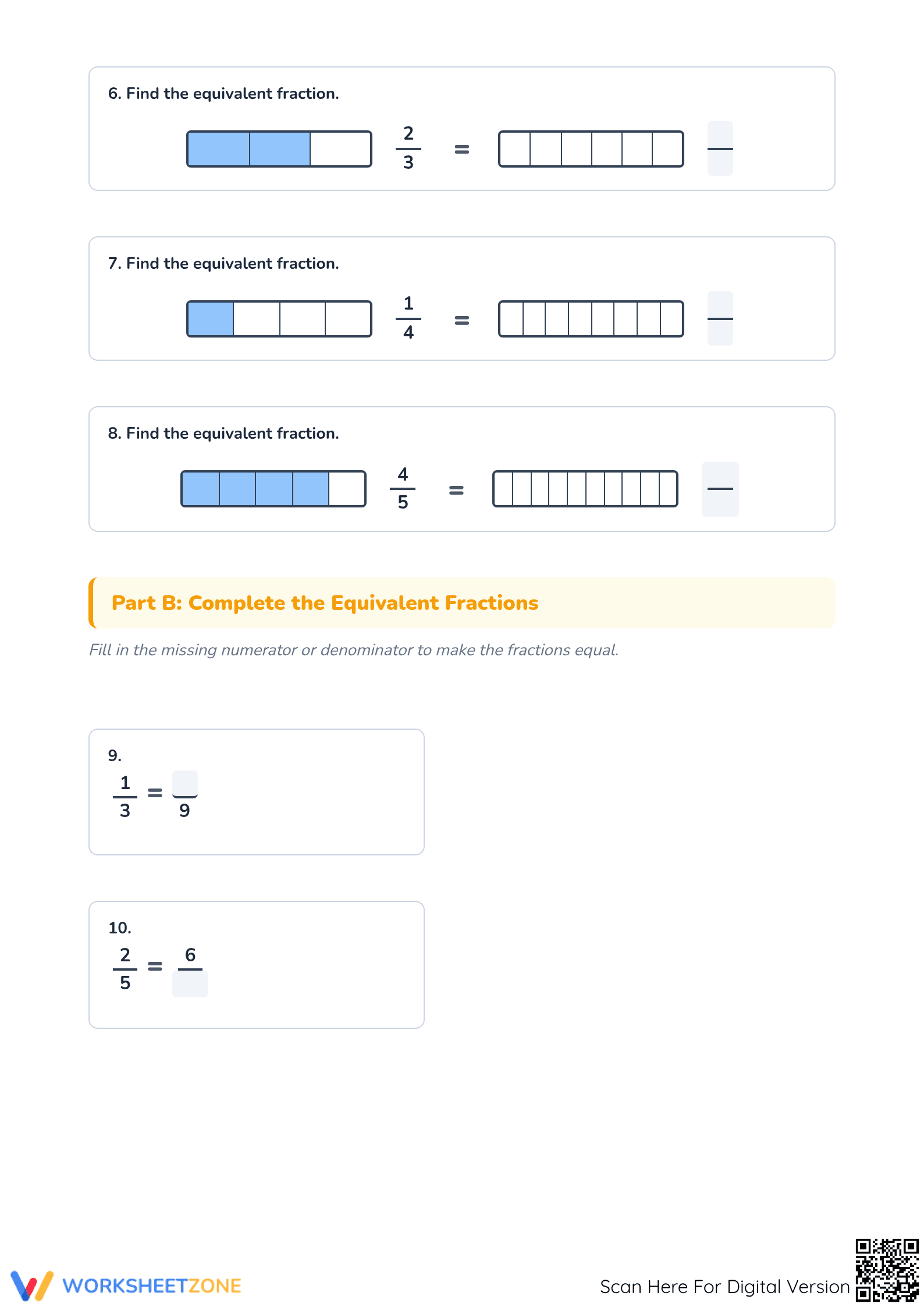
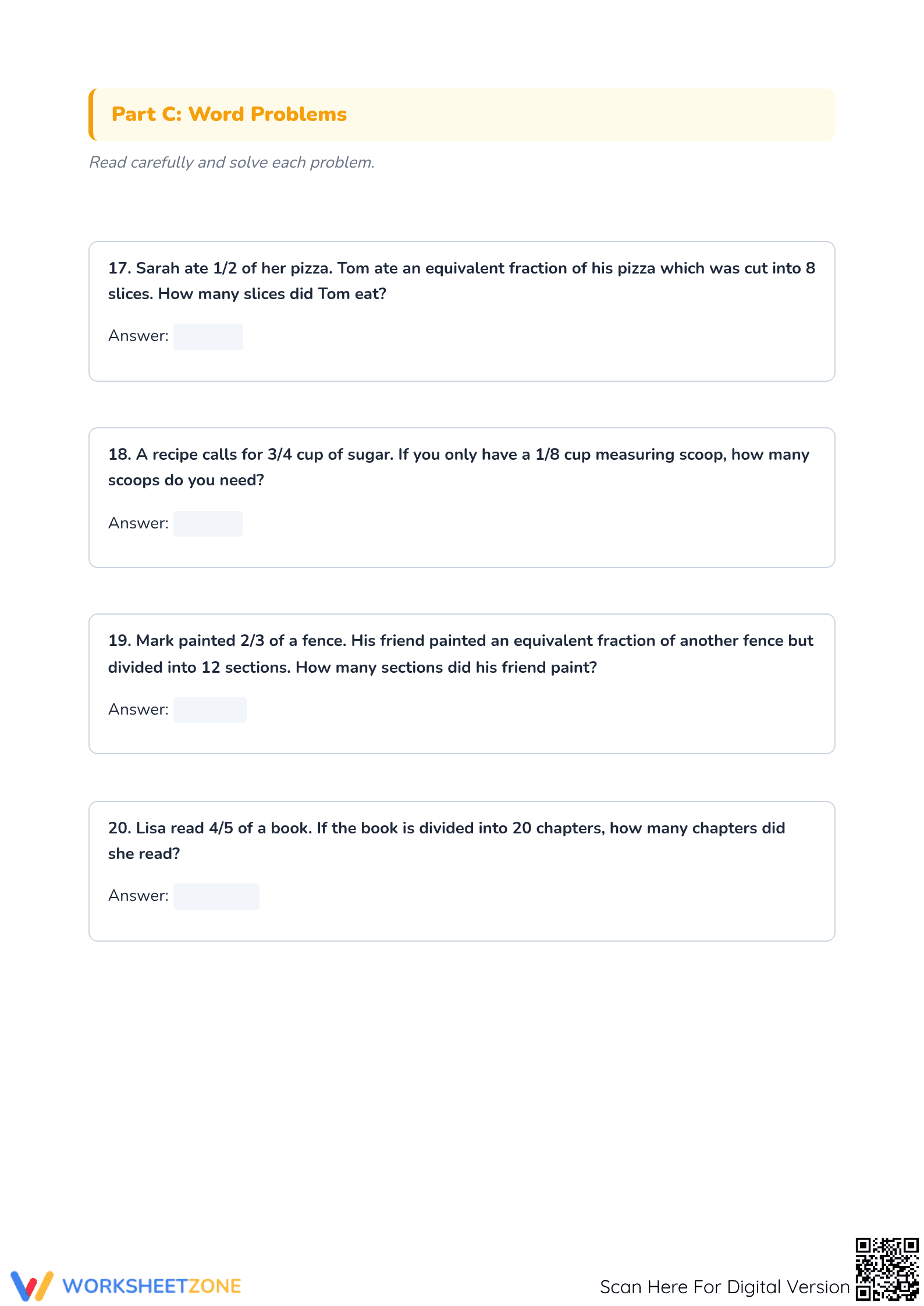
This four-page packet is organized into three sections to support a gradual release of responsibility. Part A features eight visual bar models where students shade areas to discover equivalent values. Part B moves to numerical fluency with eight missing-value equations. Finally, Part C presents four word problems involving pizza, recipes, and reading. A complete answer key is included for rapid grading and immediate student feedback.
Zero-Prep Workflow
This resource is designed for a zero-prep workflow to save teachers valuable planning time. Step 1: Print the four-page PDF (under 1 minute). Step 2: Distribute the packet for independent seatwork or as a sub plan (zero setup required). Step 3: Review the final answers using the provided key (5 minutes). Because the worksheet includes clear instructions and worked-model cues in Part A, it can be assigned as a self-directed activity with minimal instruction.
Standards Alignment
The primary alignment is CCSS.MATH.CONTENT.4.NF.A.1: "Explain why a fraction a/b is equivalent to a fraction (n × a)/(n × b) by using visual fraction models, with attention to how the number and size of the parts differ even though the two fractions themselves are the same size." This standard code can be copied directly into lesson plans, IEP goals, or district curriculum mapping tools for easy documentation.
How to Use It
Use this packet as a formative assessment to identify students struggling with the transition from visual models to abstract calculation. During the activity, observe if students correctly identify the multiplier needed in Part B. It also serves as an excellent homework assignment or independent practice following direct instruction on fraction equivalence. Expected completion time for the full 20-task packet is approximately 35–45 minutes.
Who It's For
This resource is designed for Grade 4 students, though it provides excellent remediation for Grade 5 or enrichment for Grade 3. It pairs naturally with fraction tiles or a digital number line. The inclusion of word problems makes it effective for students needing literacy integration to deepen their conceptual understanding of how fractions function in real-world contexts, such as sharing food or following a recipe.
According to the EdReports 2024 analysis of foundational math curricula, visual modeling is a non-negotiable component for developing conceptual understanding of fraction equivalence. This worksheet aligns with CCSS.MATH.CONTENT.4.NF.A.1 by requiring students to translate between shaded area models and numerical representations. Research by Fisher & Frey (2014) emphasizes that scaffolding from concrete models to abstract numerical computation—as seen in the transition from Part A to Part B of this resource—supports higher retention rates in late elementary students. By incorporating Part C’s word problems, the resource ensures students can apply equivalence in real-world contexts, a key metric in NAEP performance standards. This comprehensive practice set provides the repeated exposure necessary for students to internalize that equivalent fractions represent the same point on a number line or the same portion of a whole, despite having different numerators and denominators.


