


























Views
Downloads


Equivalent Fractions Worksheet | Grade 3 Essential Math
Paste this activity's link or code into your existing LMS (Google Classroom, Canvas, Teams, Schoology, Moodle, etc.).
Students can open and work on the activity right away, with no student login required.
You'll still be able to track student progress and results from your teacher account.
Equivalent fractions are a fundamental pillar of elementary mathematics, bridging basic part-whole relationships with advanced algebraic reasoning. This Grade 3 worksheet provides students with a structured environment to identify and generate equivalent values using both visual circular models and numerical challenges. By completing these seven targeted exercises, learners solidify their understanding of fractional equality and proportion.
At a Glance
- Grade: 3 · Subject: Math
- Standard:
CCSS.MATH.CONTENT.3.NF.A.3— Understand two fractions as equivalent if they are the same size- Skill Focus: Visual and numerical equivalent fractions
- Format: 2 pages · 7 problems · Answer key included · PDF
- Best For: Guided practice or formative assessment
- Time: 15–20 minutes
What's Inside
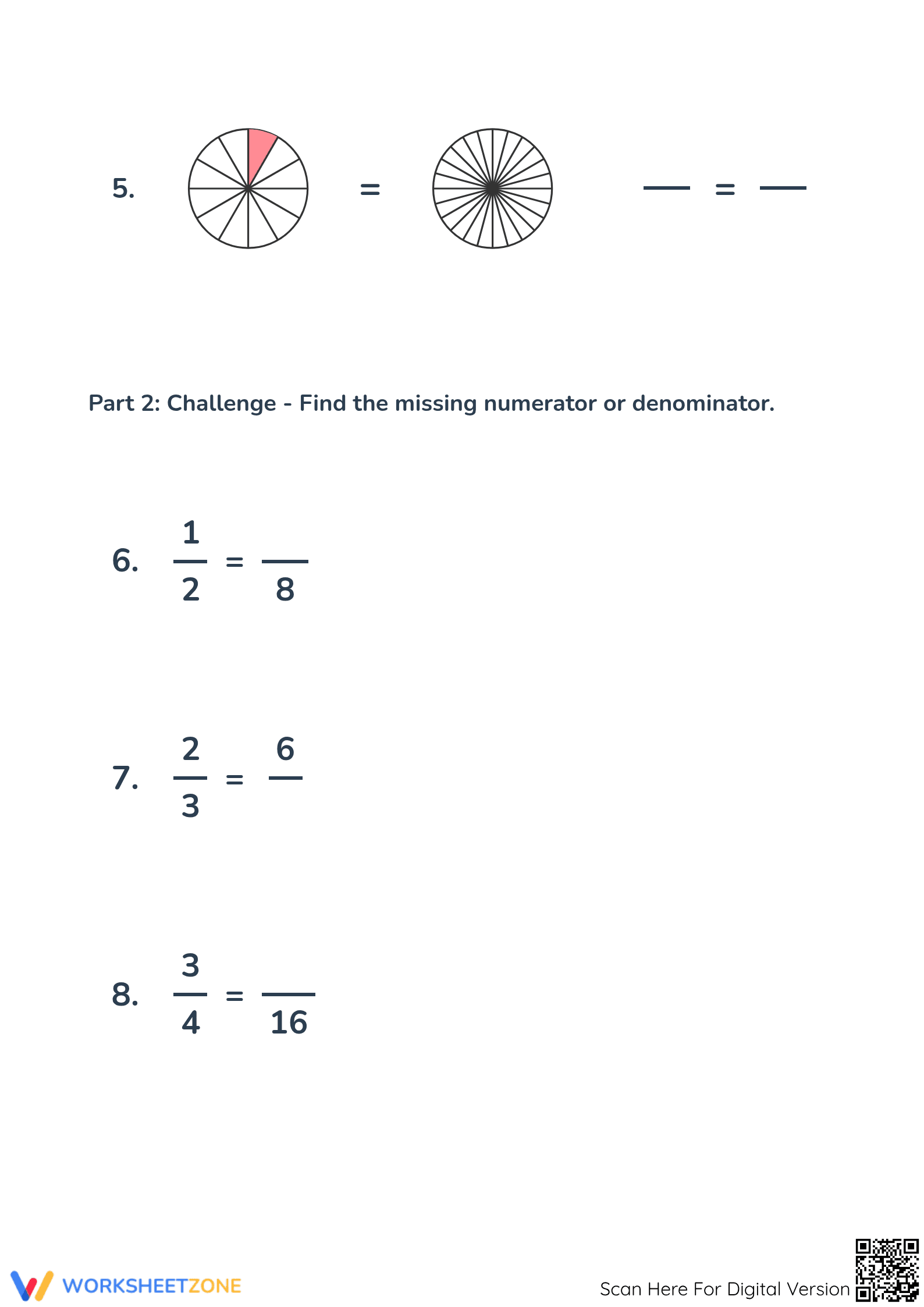
The worksheet features two distinct sections spanning two pages. Part 1 utilizes circular fraction models (circles) where students must shade a second model to match the first and write the corresponding equivalent fractions. Part 2 transitions to numerical "Challenge" problems, where students identify the missing numerator or denominator to create a balanced equation. A complete answer key is provided for immediate feedback and grading.
Skill Progression
- Guided Practice: The initial problems use highly structured visual circular models with pre-divided sections to anchor student thinking in concrete representations.
- Supported Practice: Students transition to shading models with different denominators, requiring them to visually perceive equality across varying part sizes.
- Independent Practice: The final numerical challenge removes visual scaffolds, forcing students to apply multiplicative reasoning to determine missing values in fraction equations.
This sequence follows a gradual-release model, moving from concrete visualization to abstract numerical application.
Standards Alignment
This resource is strictly aligned to CCSS.MATH.CONTENT.3.NF.A.3, which requires students to explain equivalence of fractions in special cases and compare fractions by reasoning about their size. Specifically, it addresses sub-standards A and B by utilizing visual fraction models to demonstrate that two fractions are equivalent. This standard code can be copied directly into lesson plans, IEP goals, or district curriculum mapping tools.
How to Use It
Use this worksheet during the "We Do" phase of direct instruction to transition students from identifying fractions to generating equivalents. It serves as an excellent formative assessment at the end of a lesson; teachers can observe students' shading accuracy in Part 1 to identify misconceptions regarding denominator size. Expected completion time is approximately 15 to 20 minutes for most third-grade learners.
Who It's For
This printable is designed for Grade 3 students beginning their journey with fractional equivalence, but it also serves as a critical intervention tool for Grade 4 or 5 students struggling with visual models. It pairs naturally with physical fraction tiles or circular manipulatives, allowing students to verify their shaded answers with tangible tools before moving to the numerical challenges.
Mastering equivalent fractions through visual modeling is a non-negotiable prerequisite for success in middle school rational number operations. According to the EdReports 2024 analysis of foundational math curriculum, the use of circular and area models in Grade 3 is essential for preventing the common "whole number bias" where students erroneously treat numerators and denominators as independent integers. This worksheet leverages research-based strategies for visual-to-abstract transition, ensuring that students do not merely memorize procedures but build a robust mental map of fractional values. By requiring students to shade models before writing equations, the resource enforces the conceptual link required by CCSS.MATH.CONTENT.3.NF.A.3. Educational researchers emphasize that multiple representations—visual circles combined with numerical ratios—significantly increase long-term retention of proportional reasoning. This Grade 3 math resource provides the precise balance of scaffolding and challenge needed for classroom-ready instruction.


