


























Views
Downloads


Printable Equivalent Fractions Test Worksheet | Grade 4
Paste this activity's link or code into your existing LMS (Google Classroom, Canvas, Teams, Schoology, Moodle, etc.).
Students can open and work on the activity right away, with no student login required.
You'll still be able to track student progress and results from your teacher account.
Mastery of equivalent fractions is a critical bridge to advanced rational number operations. This worksheet provides a comprehensive test environment for students to demonstrate their understanding of fraction equivalence through both visual area models and numerical scaling. Students will shade models and calculate missing values to prove deep conceptual mastery of fourth-grade math standards.
At a Glance
- Grade: 4 · Subject: Math
- Standard:
4.NF.A.1— Explain fraction equivalence using visual models and numerical multiplication or division- Skill Focus: Equivalent Fractions
- Format: 4 pages · 20 problems · Answer key included · PDF
- Best For: Formative assessment or unit test
- Time: 25–35 minutes
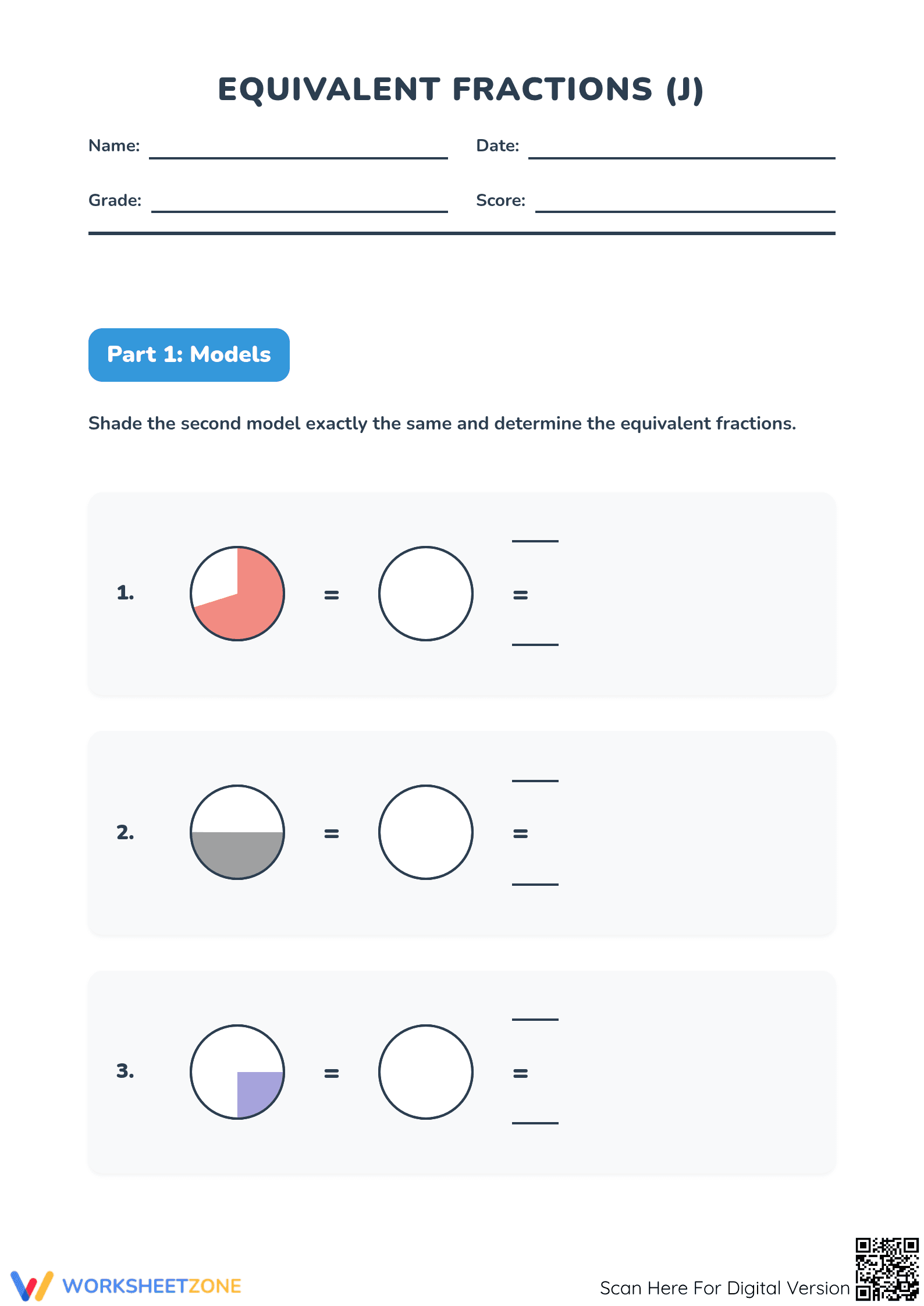
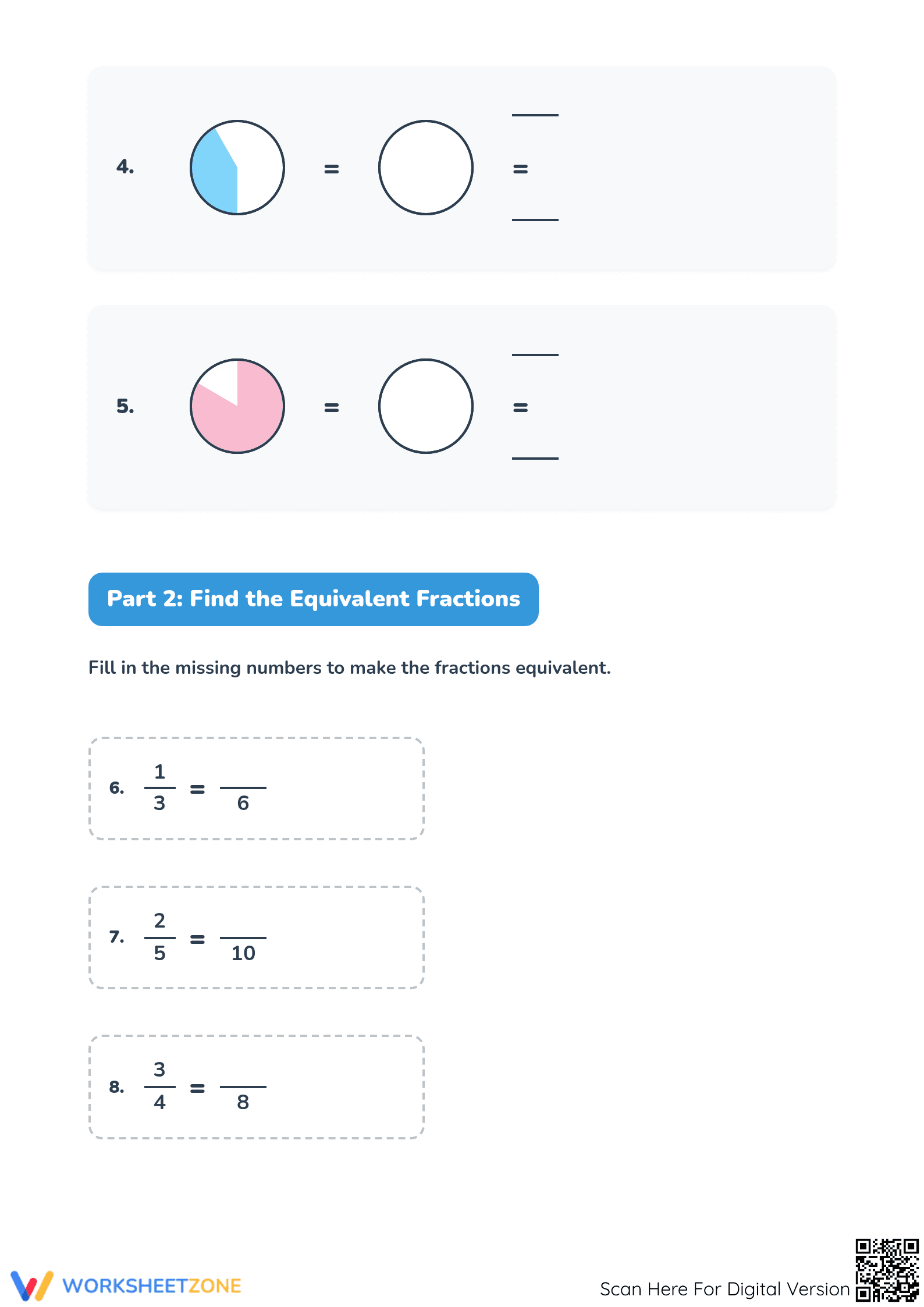
This four-page PDF includes 20 structured tasks divided into two distinct parts. Part 1 features five circle models where students must shade equivalent areas and record the corresponding fractions. Part 2 contains 15 numeric problems requiring students to identify missing numerators or denominators to maintain equality. A complete answer key is provided for rapid grading and student self-correction.
Zero-Prep Workflow
The zero-prep workflow for this resource is designed for maximum teacher efficiency. First, print the four-page packet in less than 30 seconds. Second, distribute to the class for a quiet 30-minute individual assessment or review. Finally, use the provided answer key to grade an entire class set in under 5 minutes. The clear labeling and segmented parts make this an ideal choice for emergency sub plans or "Fast Finisher" enrichment activities without any additional teacher setup required.
Standards Alignment
This resource is directly aligned with `4.NF.A.1`. Students explain why a fraction is equivalent to another by using visual fraction models, with attention to how the number and size of the parts differ even though the two fractions themselves are the same size. This standard code can be copied directly into lesson plans, IEP goals, or district curriculum mapping tools. Both standard codes can be copied directly into lesson plans, IEP goals, or district curriculum mapping tools.
How to Use It
Use this worksheet as a summative unit test after completing direct instruction on visual models and the identity property of multiplication. During completion, observe if students use multiplication or division shortcuts for the second part or if they still rely on mental visualization. This provides a clear data point for identifying students who require further scaffolding with concrete manipulatives.
Who It's For
This assessment is designed for Grade 4 general education students, but also serves as an excellent Tier 2 intervention for Grade 5 or 6 students struggling with fraction basics. It pairs perfectly with fraction tiles or a digital interactive whiteboard lesson on equivalent area models for a complete instructional cycle.
According to research from EdReports 2024, high-quality instructional materials must prioritize the coherence of fraction concepts, moving from visual representation to abstract manipulation. This worksheet facilitates that transition by adhering to standard 4.NF.A.1, ensuring students do not merely memorize procedures but understand the logic behind fraction scaling. The dual-part structure supports the gradual release of responsibility model advocated by Fisher & Frey (2014), starting with concrete visual shading before progressing to symbolic equivalence. By requiring students to interact with circle models, the resource reinforces the part-whole relationship essential for success in middle school ratios and proportions. This balanced approach to procedural fluency and conceptual understanding aligns with the latest NAEP frameworks, which highlight fraction equivalence as a primary predictor of future algebraic success in secondary mathematics education. Teachers can trust this resource to provide a valid measure of student progress toward grade-level mastery.


