


























Views
Downloads

Printable Equivalent Fractions Worksheet | Grade 3-4
Paste this activity's link or code into your existing LMS (Google Classroom, Canvas, Teams, Schoology, Moodle, etc.).
Students can open and work on the activity right away, with no student login required.
You'll still be able to track student progress and results from your teacher account.
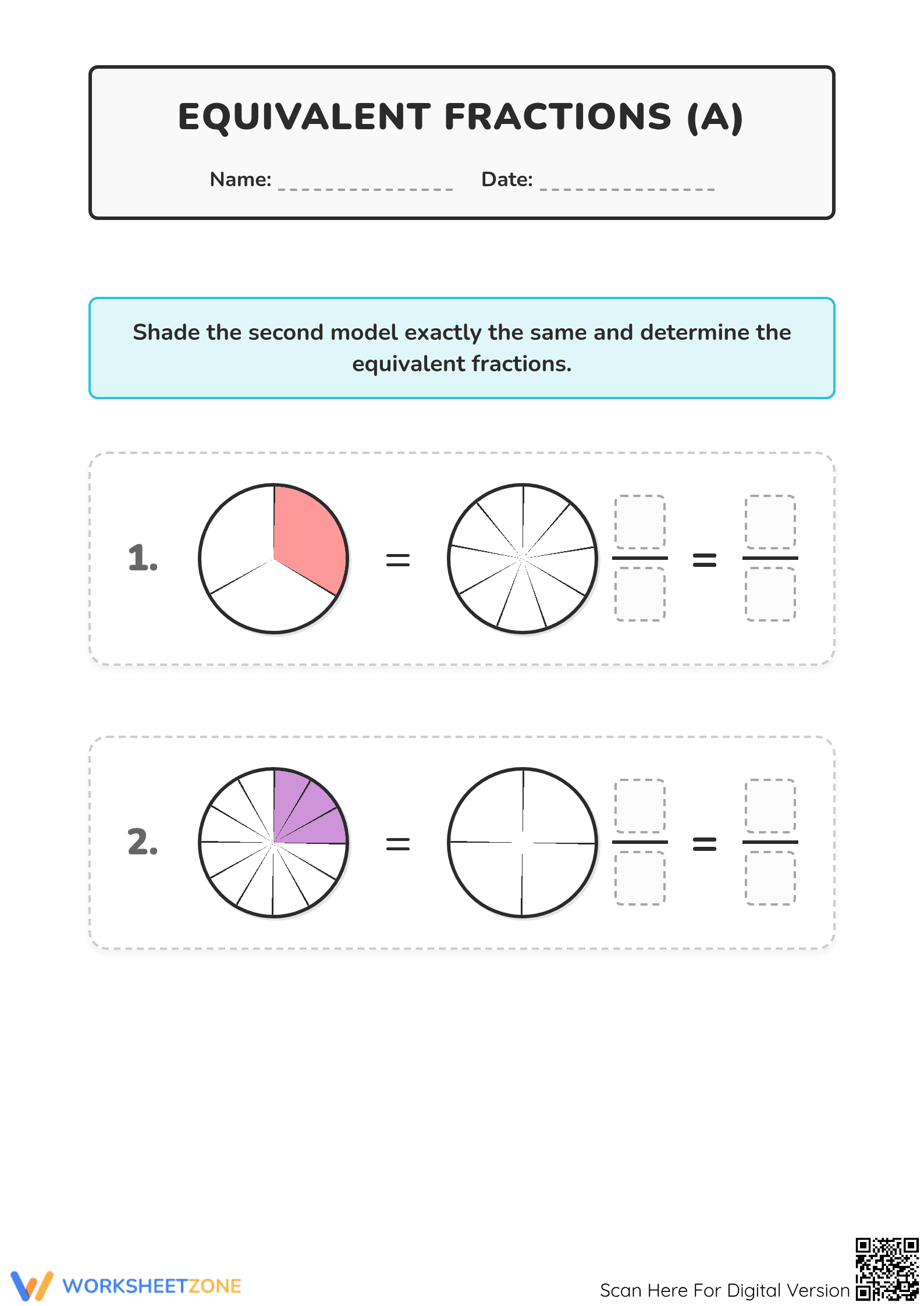
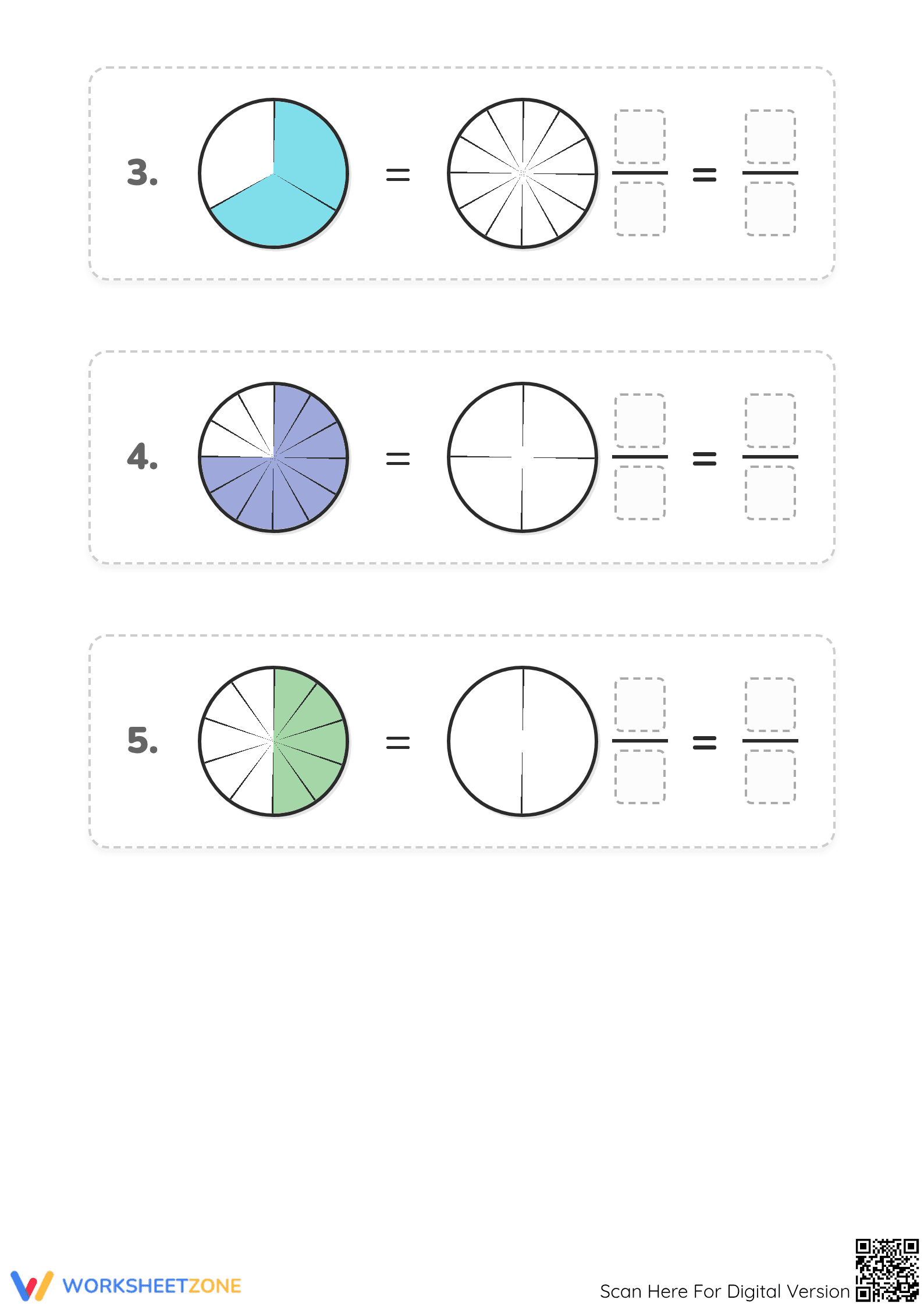
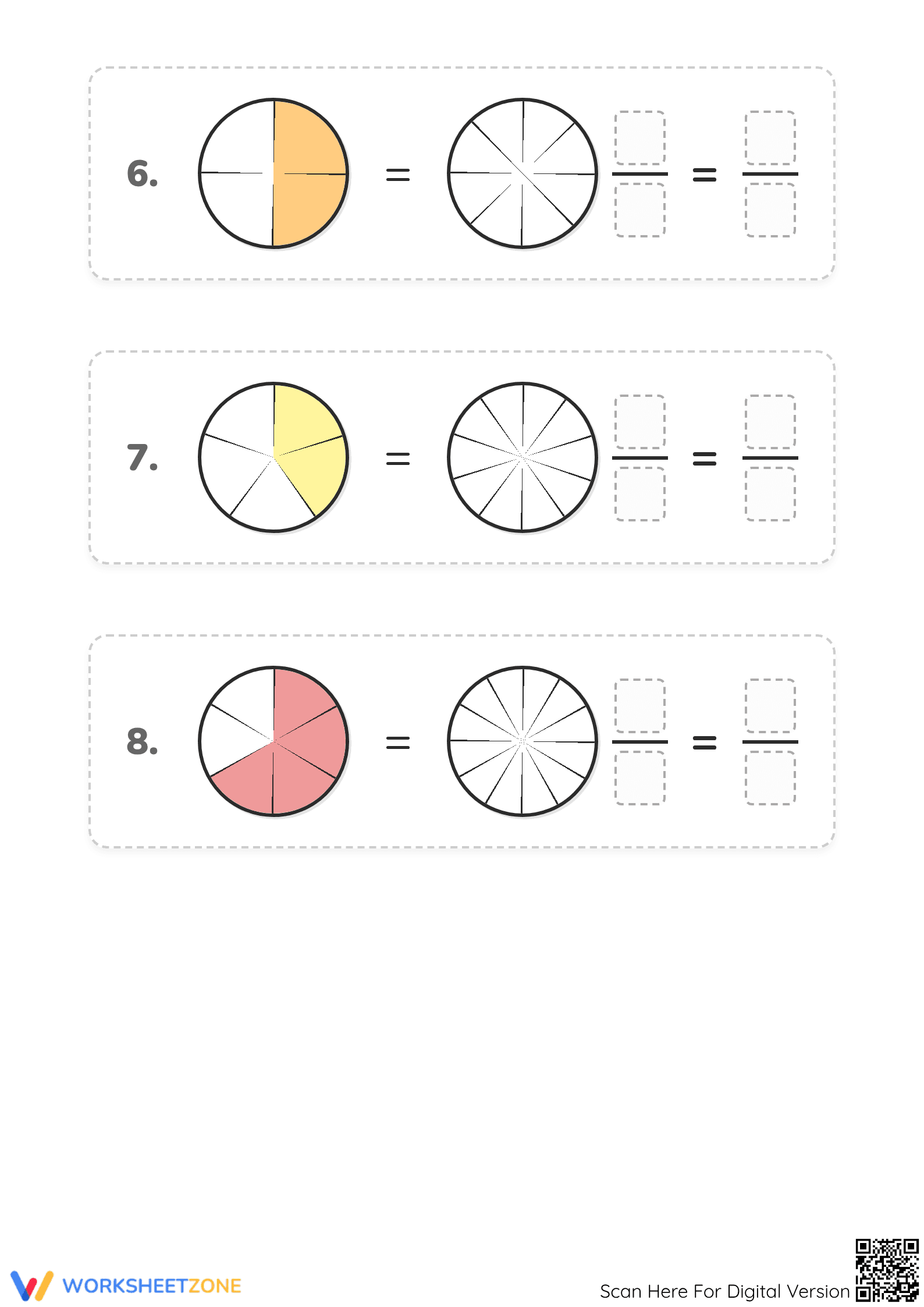
Identifying equivalent fractions is a core milestone in upper elementary mathematics. This comprehensive printable worksheet guides students through 11 specific modeling tasks where they must shade circular regions to visualize and prove equivalence. By connecting visual area models to numerical fractions, learners build the conceptual bridge necessary for mastery of ratios and advanced rational number operations.
At a Glance
- Grade: 3–4 · Subject: Math
- Standard:
CCSS.MATH.CONTENT.3.NF.A.3— Understand two fractions as equivalent if they are the same size- Skill Focus: Equivalent fractions using circular area models
- Format: 4 pages · 11 problems · Answer key included · PDF
- Best For: Independent practice and formative assessment
- Time: 20–30 minutes
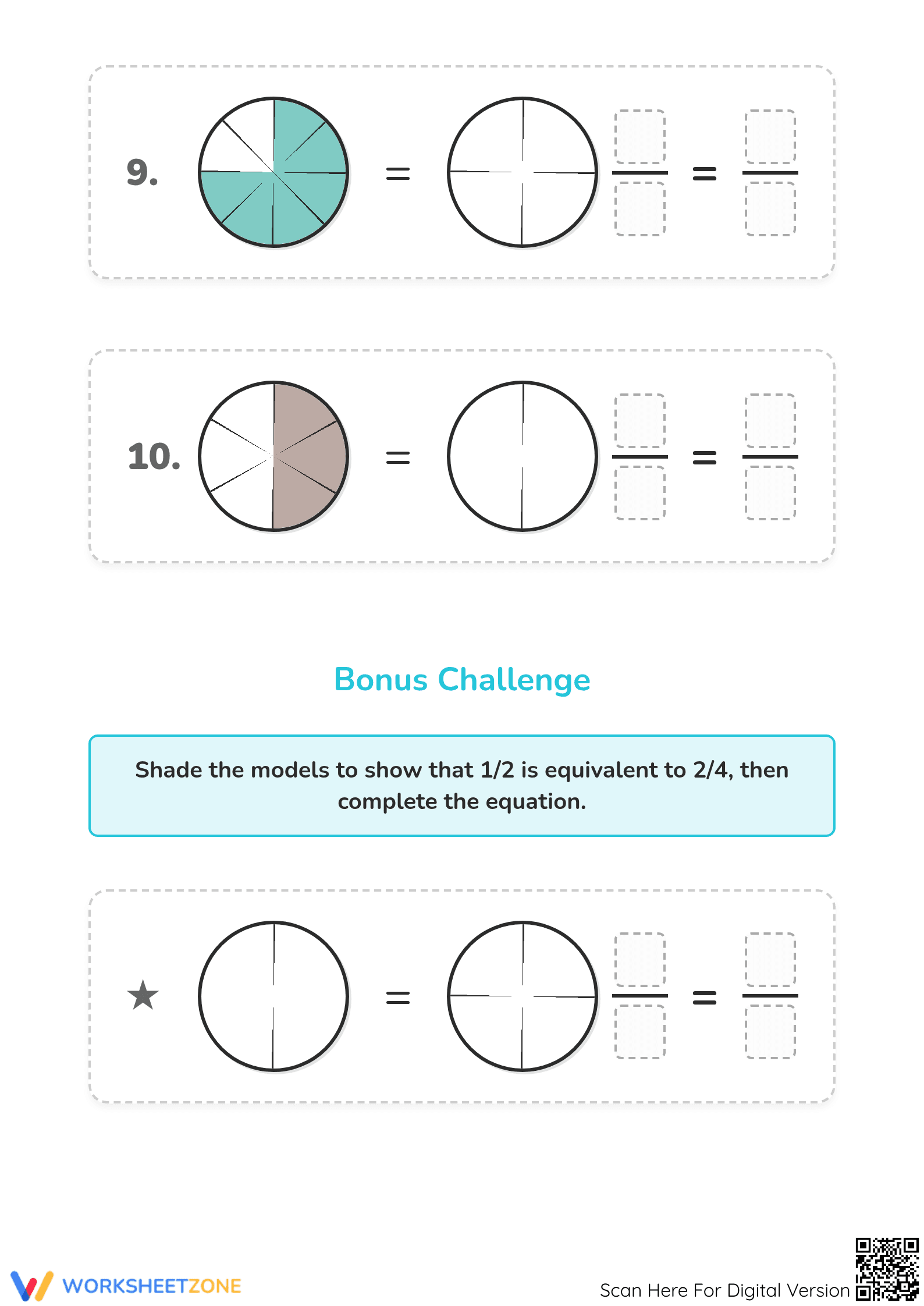
This four-page resource features ten numbered problems and one high-interest bonus challenge. Each task presents two circular models: the first is pre-shaded and partitioned, while the second requires students to replicate the shaded area using a different partition set. Accompanying boxes allow for the direct entry of numerators and denominators, facilitating a seamless transition from drawing to symbolic math.
Designed for maximum efficiency, this worksheet requires zero teacher setup beyond basic printing. Step one: Print the 4-page PDF (30 seconds). Step two: Distribute to students for immediate engagement (1 minute). Step three: Review using the included answer key to identify common misconceptions in real-time. Prep time is under two minutes, making this an ideal solution for substitute plans or unexpected instructional gaps.
The primary alignment for this resource is CCSS.MATH.CONTENT.3.NF.A.3: "Explain equivalence of fractions in special cases, and compare fractions by reasoning about their size." It specifically addresses sub-standard (b) by identifying and generating simple equivalent fractions using visual models. Both standard codes can be copied directly into lesson plans, IEP goals, or district curriculum mapping tools to ensure rigorous adherence to state expectations.
Use this worksheet immediately after a direct instruction lesson on visual fractions to solidify student understanding. During independent practice, walk through the room and observe students shading the second model; if a student struggles to recognize that 1/3 equals 3/9, use the model to point out the identical "pie slice" size. Expected completion is 20–30 minutes.
This tool is optimized for third and fourth-grade students beginning their journey with rational numbers. The clear, uncluttered layout is particularly beneficial for students who require visual scaffolds or have dyscalculia. It pairs naturally with a short-form reading passage about fractional parts or a hands-on lesson using physical fraction circles to provide a multi-sensory learning experience.
This worksheet targets CCSS.MATH.CONTENT.3.NF.A.3, focusing on the foundational concept that fractions can be equivalent even when they represent different partitions of the same whole. By utilizing circular models, students visually grasp the equality of two fractions through shading and numerical identification. This visual-to-symbolic transition is critical for long-term mathematical fluency. According to the RAND AIRS 2024 report on mathematical instructional materials, early exposure to multiple representational models significantly reduces cognitive load when students move to more abstract operations like adding unlike denominators. The inclusion of a bonus challenge encourages higher-order thinking, prompting students to apply their understanding of 1/2 and 2/4 in a novel context. This resource serves as a reliable evidence-based tool for teachers seeking to bridge the gap between concrete manipulatives and abstract number lines, ensuring that every learner achieves the necessary conceptual depth required by state and national standards.


