


























Views
Downloads



4.NF.A.1 Worksheet: Equivalent Fractions — Grade 4 Aligned
Paste this activity's link or code into your existing LMS (Google Classroom, Canvas, Teams, Schoology, Moodle, etc.).
Students can open and work on the activity right away, with no student login required.
You'll still be able to track student progress and results from your teacher account.
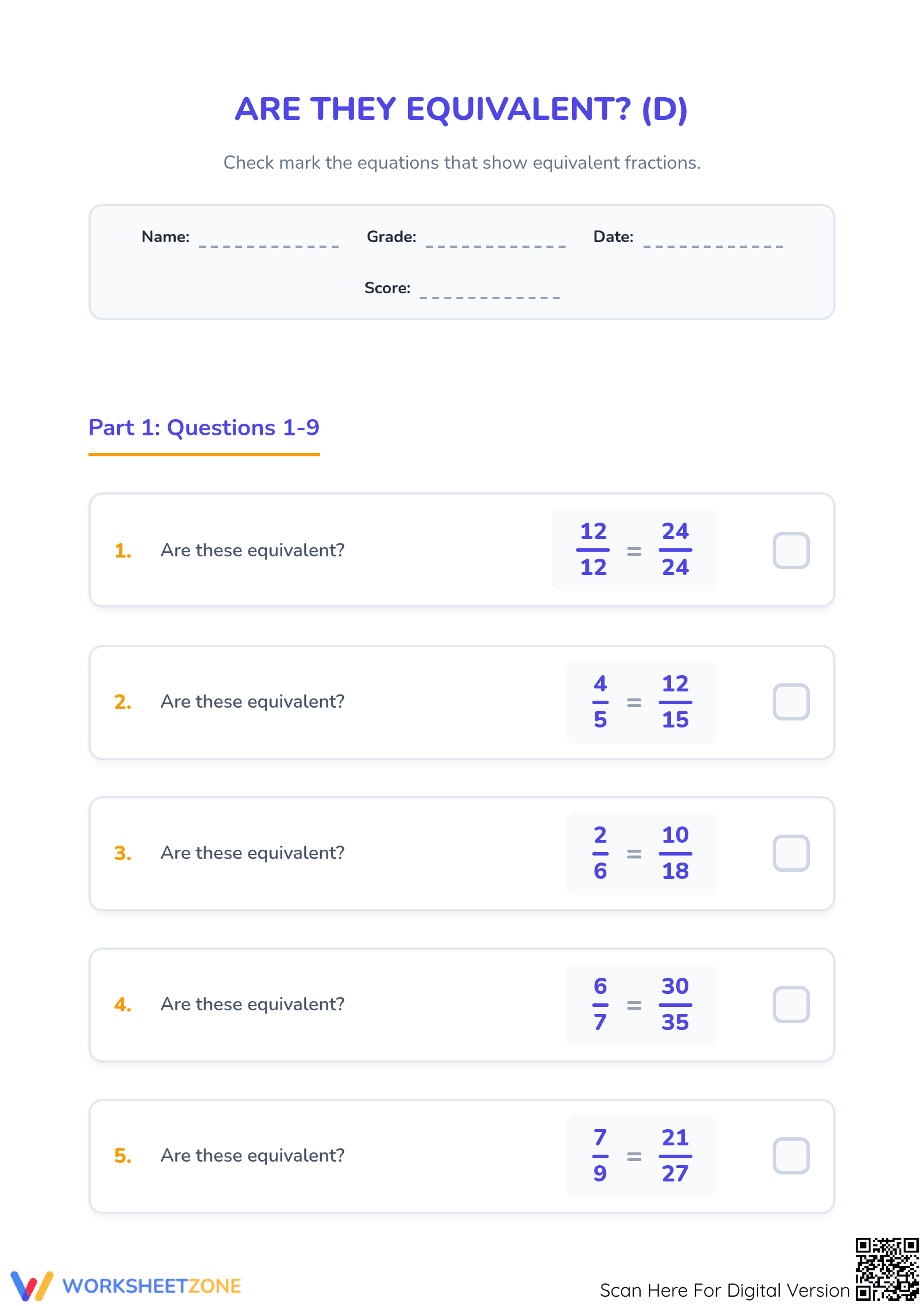
This equivalent fractions worksheet provides intensive, structured practice to help students recognize and verify fraction equality. By evaluating 30 distinct equations, learners develop the fluency needed to master fraction scaling and reduction. Students will move beyond visual models to internalize the mathematical relationships between numerators and denominators in equivalent sets.
At a Glance
- Grade: 3–6 · Subject: Math
- Standard:
CCSS.MATH.CONTENT.4.NF.A.1— Explain why fractions are equivalent by using mathematical reasoning and scaling- Skill Focus: Identifying and verifying equivalent fractions
- Format: 5 pages · 30 problems · Answer key included · PDF
- Best For: Independent practice and formative assessment
- Time: 25–35 minutes
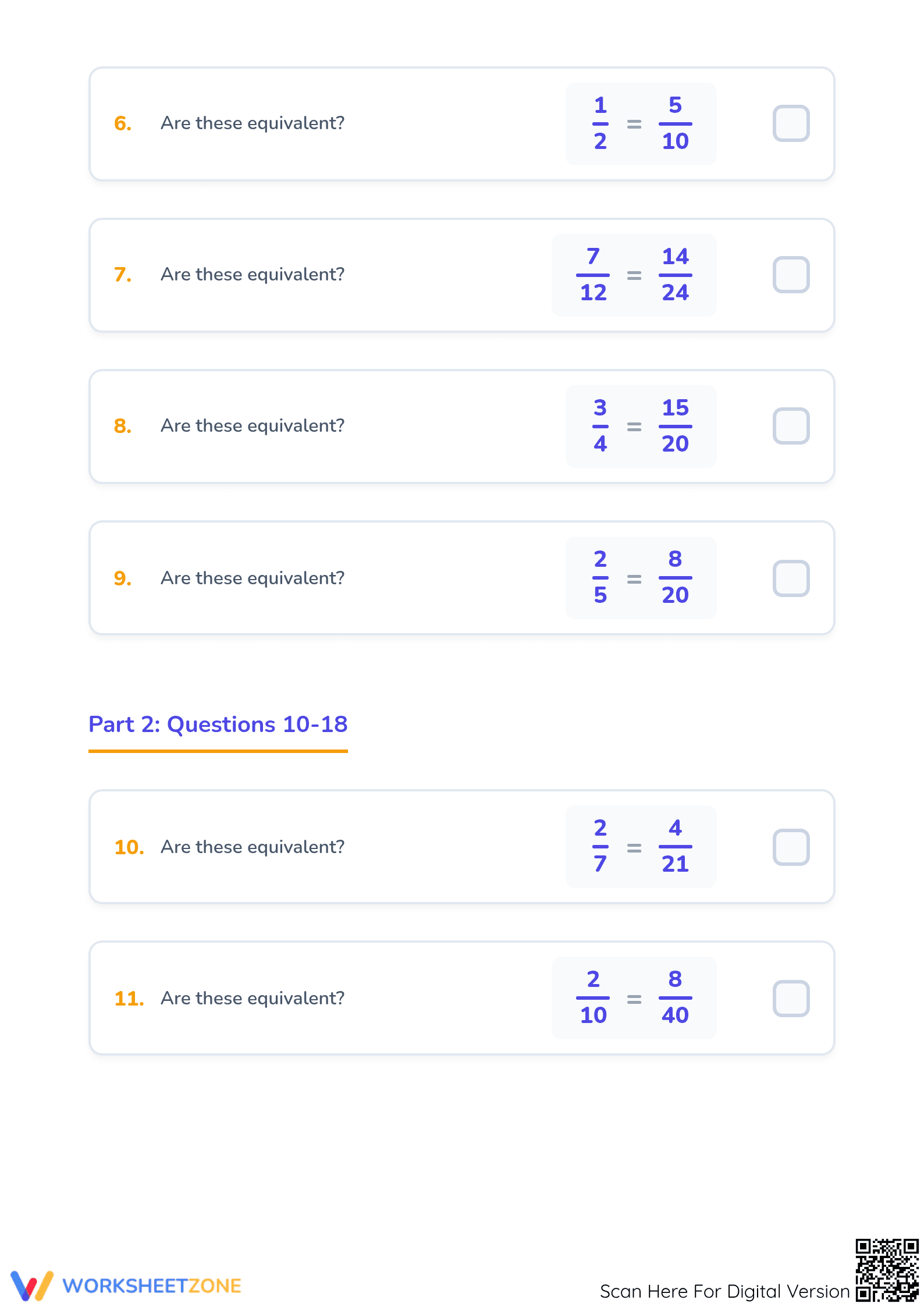
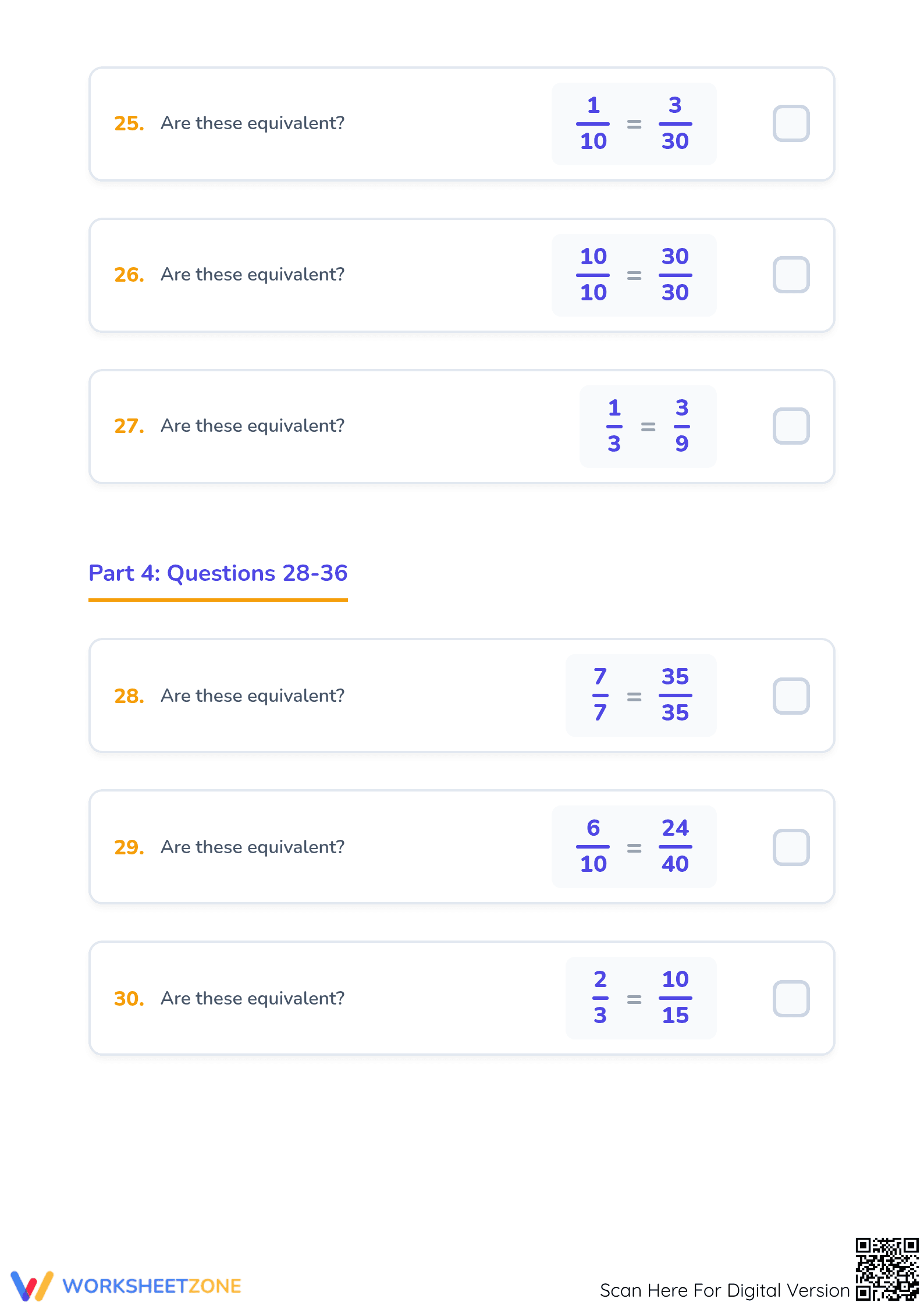
The resource is a comprehensive five-page practice set containing 30 binary-choice questions. Each problem presents a fraction equation, such as 4/5 = 12/15, and requires the student to verify if the statement is true. The layout is clean and uncluttered, with large, legible fraction notations and dedicated check-boxes for student responses. A full answer key is included for rapid grading.
Mastery Evidence
- Student performance on this 30-question assessment provides a clear map of their progress toward mastering
4.NF.A.1. - Tasks are organized to reveal common misconceptions; for instance, identifying non-equivalence in ratios like 10/10 vs 30/20 requires higher-order evaluation than simple doubling.
- Results can be categorized into proficiency tiers: Approaching (below 20 correct), Meeting (21-27 correct), and Exceeding (28-30 correct).
Scores can be entered directly into gradebooks or IEP progress notes to document longitudinal growth in fractional reasoning.
Standards Alignment
This worksheet is directly aligned with CCSS.MATH.CONTENT.4.NF.A.1. This standard requires students to explain why a fraction a/b is equivalent to a fraction (n × a)/(n × b) by recognizing how the numerator and denominator are scaled by the same factor. Both standard codes can be copied directly into lesson plans, IEP goals, or district curriculum mapping tools.
How to Use It
Use this worksheet as a mid-unit assessment after students have been introduced to the concept of equivalent fractions via visual models. It serves as an excellent bridge to abstract numerical reasoning. Teachers should observe whether students are using cross-multiplication or common factor identification to verify equivalence. Assign individual pages as targeted bell-ringers to maintain skill maintenance.
Who It's For
This resource is designed for upper elementary students mastering fraction foundations and middle school students requiring intervention or review. The straightforward format makes it a perfect resource for special education settings or as a supplemental resource for students working toward IEP goals involving rational numbers. It pairs naturally with fraction tiles or virtual manipulatives for students who still require concrete support.
The CCSS.MATH.CONTENT.4.NF.A.1 standard represents a critical shift from visual fraction models to numerical reasoning. Research from Fisher & Frey (2014) emphasizes that "fractional fluency" is built through repeated exposure to varied equivalence sets, which prevents students from treating numerators and denominators as independent whole numbers. This worksheet addresses the "whole number bias" by forcing students to evaluate the relationship between parts and wholes. According to the NAEP framework, equivalent fraction identification is a high-frequency skill that serves as the gateway to adding and subtracting fractions with unlike denominators. By completing these 30 targeted tasks, students develop the automaticity required for more complex algebraic operations. This resource utilizes a clean design to reduce cognitive load, allowing students to focus entirely on the mathematical logic of scaling. Teachers can use the resulting data to identify specific scaling factors that trigger common errors.


